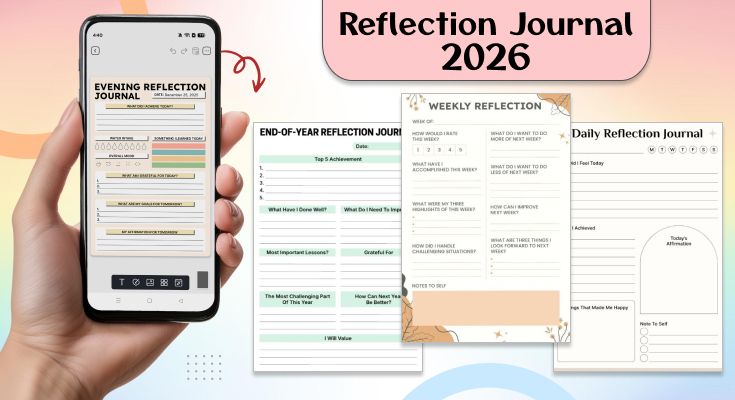
With the advent of a new year in 2026, no year is more opportune to begin with a reflection journal. If you are looking for a reflection of the year you’ve had, looking for answers to assist with goal setting, or looking for a resource to help with understanding yourself, a reflection journal can quickly become the most significant book you have on personal development.
Through this ultimate guide, you will discover all there is to learn about reflection journaling in 2026, and this will include expert tips and templates that will enable you to start today with a journaling that suits you.
What Is a Reflection Journal?
A reflection journal is an area in your personal life where you record your thoughts, feelings, and experiences in an organized format. A reflection journaling is not the same as a common diary, as it helps you explore not only what happened but also “why” something happened based on your experiences and feelings.
It’s an internal dialogue situation. Remember that you are not only putting down events of what happened to you throughout the day; you are also analyzing the implications of these events to you. You can also use a digital journal to make this process more structured and accessible.
| Regular Diary | Reflection Journal |
|---|---|
| Records daily events | Analyzes the meaning behind events |
| “Went to work today.” | “That meeting today made me realize something, I actually work way better when I’m collaborating with people instead of doing everything solo.” |
| Focuses on what happened | Focuses on why it matters |
| Surface-level documentation | Deep emotional and mental processing |
Why Keep a Reflection Journal in 2026?
Reflective journaling is not a method to be practiced in a way that you could record your thoughts because, in reality, reflective journaling also holds certain advantages, and these are seen in the studies being conducted, showing how people reflecting on their thoughts, using journaling, experience increased levels of emotional happiness and goal achievement. The therapy journal templates can be particularly effective for processing complex emotions and tracking your mental health progress.
TOP 5 BENEFITS OF REFLECTIVE JOURNAL
| Benefit | How It Helps You | What This Actually Looks Like |
|---|---|---|
| Actually Understanding Yourself | Makes your brain go deeper instead of just surface-level reactions | Notice patterns in behavior and emotional responses |
| Better Emotional Processing | Creates space to sit with and understand feelings | Less anxiety, feeling steadier emotionally |
| Making Better Decisions | Builds a personal database of lessons learned | Make informed choices aligned with your values |
| Deeper Learning | Transforms information into wisdom | Integrate new skills and experiences more fully |
| Greater Gratitude | Draws attention to positive experiences | Increased overall life satisfaction |
How to Start Your Reflection Journal in 2026?
Starting a reflection journal isn’t some big production. You don’t need special notebooks or skills or the perfect setup. You just need to start.
Step 1: Pick How You’re Gonna Do This
Handwritten Journal:
- ✅ Tactile, personal experience
- ✅ Slows down thoughts for a deeper connection
- ✅ No screen time required
- ❌ Less convenient for on-the-go journaling
Digital Journal:
- ✅ Access anywhere (phone, tablet, computer)
- ✅ Built-in prompts and reminders
- ✅ Searchable past entries
- ❌ Screen fatigue for some users
There’s no right answer. Some people do both write by hand when they’re processing feelings, and type when they’re planning stuff out. The daily journal templates can help you maintain consistency regardless of which format you choose. Whatever works.
Step 2: Create a Consistent Routine
Showing up regularly beats being perfect. Don’t commit to something unrealistic that you’ll quit in three days. Five minutes every day does way more than writing for an hour once every couple weeks when you remember.
Best Times to Journal:
| Time Slot | Benefits | Best For |
|---|---|---|
| Morning (6-8 AM) | Sets intentions for the day | Goal-setters, planners, morning people |
| Lunch Break (12-1 PM) | Mid-day mental reset | Busy professionals, stress management |
| Evening (8-10 PM) | Process the day, clear your mind | Night owls, better sleep preparation |
| Before Bed (10-11 PM) | Release worries, emotional closure | Overthinkers, anxious minds |
Daily planner templates can help you block out consistent time slots for your reflection practice, making it easier to build the habit.
Step 3: Start with Simple Prompts
Blank pages are intimidating. Prompts help they give you something to start with instead of just sitting there wondering what to write.
5 Beginner-Friendly Prompts:
- What went well today? Why did it actually go well?
- How do I actually feel right now?
- What’s bouncing around in my head that needs to come out?
- What did today teach me about myself?
- One thing I’m grateful for right now?
Your journal’s not an English essay. Nobody’s reading it. Just write. This is just for you. Your journal is for your eyes only. Self-care planner templates can complement your reflection practice by helping you track habits and wellness alongside your emotional insights. Let the words flow without judgment.
Which are The Reflection Journal Templates for Different Needs?
Not every situation needs the same kind of reflection. Here are templates made for different things. Use them as they are or change them however you want.
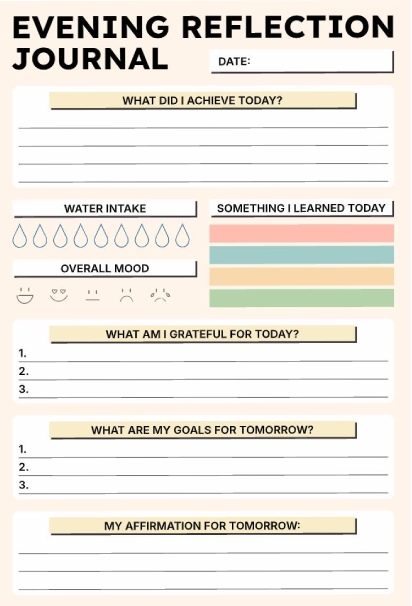
Template 1: Daily Evening Reflection and Gratitude Journal
Use of this template will not only conclude your day but also give you a reason to take time and contemplate on that day. You can record what you have accomplished, monitor your intake of water through cute droplet icons, and also check your mood through faces. The space where you write about what you learned and what you have to thank for today, as well as where you state your goals and a motivational statement to push you through the day ahead of you, is found in this template.
Best For: Those who want to end their day on an uplifting note with the elements of gratitude, self-analysis, and the formulation of goals for the next day.
Template 2: Personal Daily Reflection and Affirmation Journal
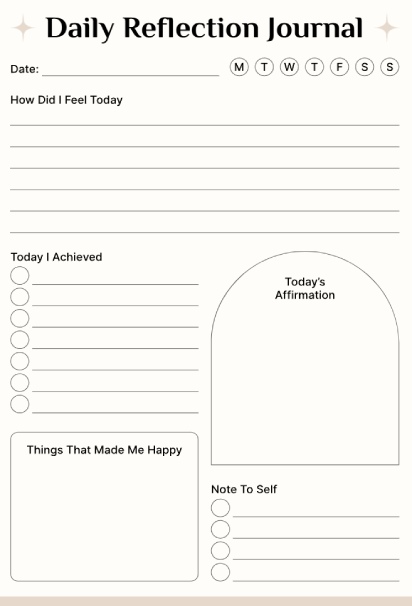
This basic everyday journal allows you to reflect on your feelings and keep a record of what matters most to you. You can write about your feelings on the current day and make a list of what you accomplished by using check boxes to check off your accomplishments. There is a special section allotted to note your affirmation of the day in a specially designed, rounded box, and a section to write things that made you happy. You can note reminders or words of affirmation in the note to self section. The design of this journal allows for less complexity in your everyday journaling.
Best for: Those just starting on the journaling journey, or anyone looking for a clean page that doesn’t offer too many suggestions on what needs to be filled out.
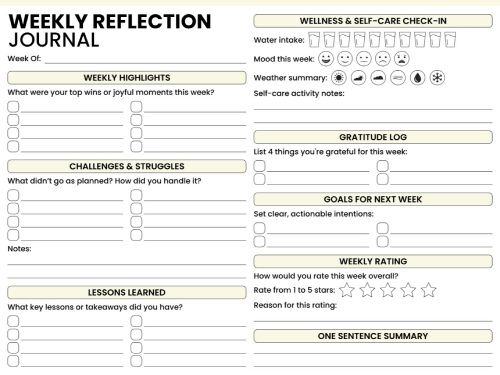
Template 3: Weekly Reflection and Goal Setting Journal
This is an all-around journaling page that entails all that has happened in your week on one page. You will be able to highlight some of the best experiences in your week, overcome some of the challenges you have encountered, and record some of the most invaluable lessons learned. There is a section for wellness that entails monitoring water consumption and moods. There is a section that relates to gratitude and involves appreciating four good things in life. The goals section will enable you to plan for the next week. Finally, at the bottom, there is a section where you evaluate your week and provide a summary in one sentence.
Best For: Those who prefer to have weekly meetings instead of daily journaling to get the whole picture of their ‘ups and downs as well as the growth in their whole week.’
Template 4: Weekly Reflection and Mindfulness Journal
This journal provides a clean grid system that will assist you in organizing your ideas as well as tracking your progress each week. It provides a mood tracking section where you get a chance to explore what you’re feeling and why, as well as a section that contributes to your gratitude log as you get a chance to identify three positive things. You get a chance to reflect on what you’ve accomplished, what you’ve struggled with, and what you’ve learned about yourself, as well as a section to plan what you need to get accomplished and set weekly goals. It provides a section for writing everything that comes into your mind.
Best for: People who prefer a structured format for the reflection questions but also want the ability to record any thoughts that pop into their mind during a weekly review.

Template 5: Daily Reflection and Goal Setting Journal
In this journal, I have purposefully incorporated a coaching orientation to enable you to monitor and record your own personal growth and change. I encourage you to begin with a mindset check-in and reflect upon your personal goal at this time, in addition to recording your successes and points of resistance. There is a section for reflecting upon core beliefs that have arisen and their subsequent impact on decision-making. You can list action steps for the next coaching session and record any coaching or accountability needed from a professional coach. Another section is reserved for recording coaching notes or stream-of-consciousness elements.
Best for: Individuals who are working with a life coach or therapist and are looking to monitor their personal growth experience, and also prepare for life coaching sessions.

Template 6: Daily Reflection and Self-Improvement Journal
This overall reflection journal allows you to walk through every part of your day to reflect upon it. You can identify the most positive part of your day, what kind of difficulties you faced, and what kind of emotional feeling you experienced. There is space provided to list what you have learned, as well as how to improve next time as well. There is a section provided to reflect upon your own personal growth, another for your overall goals for tomorrow, and another section to list your progress within your own personal growth ideas. Reflections can also be provided concerning gratefulness, affirmations, and a final thoughts section to complete your day’s reflection. All areas are provided, thanks to the mint green headers that organize everything properly for you to do so.
Best For: Individuals who are interested in writing very detailed journal entries and would like a very detailed prompt to help them explore different facets of themselves and their lives.

Template 7: End-of-Year Reflection and Goals Journal
This yearly reflection journal allows you to look back on the entire year and all of the things that have occurred throughout it. Your five most important accomplishments of the year can be listed at the top of the page, and then there is an opportunity to reflect on what’s working well and what can be worked on. There are areas to record some of the most important things that have been learned throughout the year are and what an individual has to be thankful for. There is also an opportunity to reflect on what sucked the most throughout the year and what needs to be worked on in the coming year.
Best for: For year-end reflection. If you ever want to actually acknowledge what went right in the year that passed, learn from things that went wrong, and try to determine what you are shooting for in the coming year.

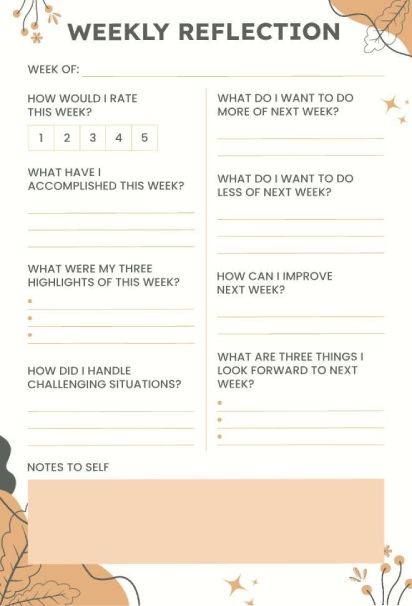
Template 8: Weekly Reflection and Planning Journal
This lovely reflection diary for a week features a warm and natural design with floral elements. The reflection tool only evaluates your week from 1 to 5, so that it can then motivate you to write down the things that happened in the week that you accomplished, as well as the top three things that you enjoyed. This reflection template will also remind you to write down things that happened in the week that you would like to happen more in the coming week, and things that you would like to happen less in the coming week.
Best for: Those who are interested in journaling designs and want an effective means for organizing their week, while also reflecting on what they’ve accomplished and how they can improve.
Real-Life Examples of Reflection Journal Entries
It might be helpful to look at some examples of reflective writing. Here are a few examples written in different styles.
Example 1: Focus on Gratitude Each
January 15, 2026
Three things I am grateful for today: My cup of coffee was especially delicious this morning. My colleague, Sarah, appreciated my presentation. I finally completed that book I’ve been reading for weeks.
The actual presentation went much better than I had expected. I was quite nervous because it was to be done with senior leadership, but I was well prepared, and it really showed. I had no issue answering their questions confidently either. This is a reminder that preparation truly pays off because I noticed that when I knew I was prepared, I wasn’t really nervous at all.
Tomorrow, I plan to: Maintain momentum. Spend an additional 30 minutes getting prepared for my client meeting versus winging it. Goal planner templates can help you track these action items and follow through on the insights you gain from reflection.
Example 2: Processing a Challenge
February 3, 2026
Had a tough conversation with my mom today about her health issues. She refuses to see a doctor about the symptoms she has been experiencing. I was angry with her, then scared, then ashamed of myself for being angry.
What I’ve learned: My anger is a response to my fear of losing her. I’m afraid of something seriously being wrong, and by the time she comes to terms with it, it may be too late.
What I can control:
- Express concern without nagging
- Research options and share information in a gentle manner
- Take care of my own health as an example for others
- Accept the fact that she is an adult and has her own decision-making.
Example 3: Weekly Review
March 7, 2026
| Area | This Week |
|---|---|
| Wins | Initiated that online course, been to the gym 4x, caught up with an old friend. |
| Issues | Put off working on taxes; still having trouble with bedtime. |
| Pattern Noticed | Way more energy with the morning workouts compared to the evening ones. |
| Focus of Next Week | 30 min on taxes, try morning workouts Mon/Wed/Fri |
Example 4: Goal Progress
April 20, 2026 – Goal: Run a 10K by June
Progress: Ran 3 times this week, accumulating a distance of 12 miles (compared to 8 miles last week).
Problem: The right knee is a problem after yesterday’s run. Went out in distance much too fast, raising distance 50% from 8 to 12 miles when training guidelines call for not exceeding a 10% increase.
Lesson: Enthusiasm is getting beyond my body’s adaptability.
Next Steps: Rest day tomorrow, gentle walk on Friday, return to running on Saturday, but maintain total weekly mileage at 10 miles while allowing knee recovery. Exercise planner templates can help you track progressive overload safely and prevent injury by keeping your training increases within recommended guidelines.
Frequently Asked Questions
There’s no rule about this. Five minutes works if that’s what you’ve got. Don’t stress about hitting some word count, just be honest and get specific about what’s actually going on. Most people end up writing for like 5-10 minutes once they get into a rhythm, but if you write for two minutes and it helps, that’s fine too.
The first is based on the level and intensity that these books entail. While the diary is basically a record of what happened and what you did and where you were and who you met, the reflection journal is a record of even deeper reflections as to why these events happened and their implications for you based on lessons learned. For instance, while the entry for the diary will read something like “Had lunch with Sarah,” the entry for the reflection journal will read something like an analysis of why this event is even significant for you and what you have learned from this experience that changed your perspectives.
For newbies, keep it simple. Journaling by hand, a simple lined journal from any stationery store will be perfect, without needing the fancy features of a journal. For journaling on a computer, a free journaling app, such as Day One, Journey, or just a basic Google Doc, will be a great starting point. One should not start with a journal with too much guidance on journaling, meaning they have a complete set of journaling ideas, as this will limit creativity. Start with a journal with a simple layout until a habit has been established, then move on to a guidance journal.
Yes, research consistently supports the benefits of reflective journaling. Studies show that people who journal regularly are 42% more likely to achieve their goals compared to those who don’t write them down. Reflective writing has been proven to reduce anxiety, improve emotional processing, enhance self-awareness, boost immune function, and increase overall life satisfaction by 23%. The key is consistency; the benefits compound over time with regular practice, even if it’s just 5-10 minutes daily.
Both! Balanced journaling includes celebrations of good moments and processing of difficult ones. This gives you a whole picture of your life and helps build resilience. Research shows that writing only about negative experiences does have therapeutic value, but long-term, balance is healthier. The goal is a mix that reflects your experience. Many people use a 3:1 ratio for every challenging thing processed by noting three positive moments or three things they are grateful for.
Conclusion- Your Reflection Journey Starts Now
Each transition, big or small, can only be achieved through the act of taking that initial step. Reflections are no exception to this rule. You don’t need a nice journal, a planned routine, and a full understanding of how everything works that you’re doing. Just start. Right now, wherever you are, with whatever you have. Stop making it complicated in your head.
Make it simple:
- Grab one of these templates that doesn’t immediately make you want to close the tab
- Set your phone timer for five minutes
- Write whatever’s going through your head. Don’t filter it or stress about sounding coherent.
That is all. Such a small practice is enough to create a habit of reflection.
Since you are aware of the fact that you like journaling online, there might be an online application that can make it simpler for you. Tools like PlanWiz, Day One, Journey, Notion, and Reflectly enable you to be dedicated and organize your thoughts.
When it comes to dedication, an application like PlanWiz enables you to organize plans within some predefined planner templates, which might be more appropriate for you than other methods.
As you move into 2026, remember this: growth doesn’t occur when you do everything just right; growth occurs when you show up. Your imperfect ideas matter too. Future you will probably appreciate that you started today instead of putting it off forever.
Learn More:
The 15 Best Digital Journal Apps for 202610 Best Apps for Bullet Journaling in 2026 (Free & Paid)
Aesthetic Gratitude Journal Template for Inner Peace and Happiness
Dream Journal Guide 2026: Free Templates, Tips for Dream Journaling