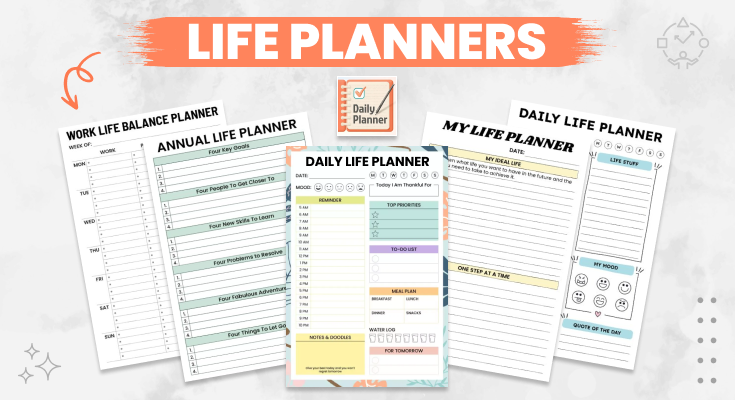
You remember this when you missed an important meeting or had to meet a deadline? Or when your resolutions and plans for the upcoming year got swirled away in the March madness? You’re not alone in this, as the world is moving at such a pace, and disorganization is now more of a challenge than ever. This is exactly the kind of moment when the gargantuan rebirth of the “Life Planners” takes place.
The days are gone when planners were purely in the form of dull, dated books. The life planners of today are intelligent tools, designed to help you manage all things, right from your responsibilities to your lifetime goals. You can choose according to your needs if you are a working person, a parent, or a college-going person. There is a life planner for everyone.
In this comprehensive guide, you will learn the various types of life planners that exist in the market as of 2026, effective planning strategies that work, and have printable templates to begin with today. Let us change the way you organize your life.
What Is a Life Planner, and Do You Actually Need a Life Planner?
It’s essentially a blueprint for structuring the way you tackle daily activities, as well as tackling goals and everything in between. It’s making sure the things taking up your days actually mean something to you, not just filling time because that’s what you always do.
A calendar? That’s just dates and times. A planner makes you ask yourself, “Okay, but should this even be here? Is this worth it?” Budget planner templates work the same way for your finances, questioning whether expenses align with your actual priorities.
Writing your goals down makes a huge difference. People who do it are way more likely to actually follow through. That’s been studied and proven multiple times. One such research project at UCLA discovered that students who kept intention journals reached their goals 92% more often than those not track at all.
But here’s what makes the year 2026 different. Gone are the days when it was paper versus digital debates; now we see hybrid systems, AI-enhanced planning tools that can actually adapt to how you actually work, not how someone thinks you should work.
Which Type of Life Planner Is the Perfect Match for Your Lifestyle?
Picking the best planner for your life isn’t based on trends, but on the way you think, work, and live. Some individuals have to have the details laid out for them to remain on track, while others want the flexibility to have the overall perspective of their time. Knowledge of the various aspects of life planners can assist you in picking the appropriate planner suited to the way you live.
1. Daily Planners
These break your day into chunks, usually hour by hour, with space for tasks, notes, priorities, all that stuff.
Work for: Anyone whose schedule is packed. Your days are packed with appointments, meetings, and stuff that’s different every single day. If you don’t write it down somewhere with actual times, you’ll 100% forget what you’re supposed to be doing when. That’s what daily planners are for. That’s what daily planner templates are for.
Features:
- Hourly time slots, usually covering 6 AM to 9 PM
- Priorities: Priorities refer
- Notes area for quick thoughts
- Habit trackers embedded into daily planners
2. Weekly Planners
Weekly layouts let you see the whole week at once. You can spot disaster days coming and figure out where you actually have some breathing room. Still have space for daily details when you need them. Makes it easier to actually balance work and life instead of just saying you will.
Work for: Anyone juggling a bunch of projects at once, parents trying to keep track of everyone’s stuff, people whose brains naturally think “okay, what’s happening this week” instead of just today. Weekly planner templates help you visualize your entire week and manage multiple commitments without losing track of important details.
Features:
- Seven-Day Spread on Two Pages
- Weekly goal section
- Flexible task lists
- Space for notes and reflection
3. Monthly Planners
Monthly planners give you perspective. Planners give you the big picture. See your whole month laid out so you’re not getting blindsided by stuff you forgot was coming.
Works for: People who actually have some space in their schedule and aren’t running around constantly. Also useful if you want to notice patterns, like realizing you always crash the last week of the month or that certain weeks are consistently insane. Using monthly schedule planner templates can help you identify these patterns and plan around your natural energy cycles.
Features:
- Calendar grid for each month
- Monthly goal-setting pages
- Project tracking sections
- Habit tracking grids
4. Academic Planners
Beginning from July to August and extending to June every year, academic planners synchronize with the academic year. These are specifically created for those who live an academic life, including students and teachers.
Work for: Individuals who are students, teachers, parents with kids at school, or professionals. The study planner template is particularly helpful for managing coursework, exam prep, and academic deadlines throughout the semester.
Features:
- Tracking pages for assignments
- Learning timetables
- Grade trackers
- Semester at a glance spreads
- Class schedule sections
5. Digital Planners
Digital planners allow all the benefits of paper planners to go onto your tablet or computer. Just interactive PDFs you use with apps like GoodNotes, Notability, Noteshelf, whatever you prefer.
Work for: People who are comfortable with tech and want unlimited space, easy reorganizing without having to rewrite everything, plus having it on all their devices. The digital planner for iPad offers the perfect combination of flexibility and structure for tech-savvy organizers.
Advantages:
- Re-usable pages. No need to buy a new planner.
- Hyperlinked Navigation
- Easy color coding & customization
- Cloud synchronization across devices
- Eco-friendly, no paper is wasted
6. Hybrid Planners
Hybrid planners are the ones that incorporate paper and digital parts. You could require the paper one for day-to-day work, but interface the digital one for appointments and reminders.
Work for: Anyone who loves the joy of writing with pen and paper on hand, or for those who enjoy the feel of paper but also appreciate the capabilities and advancements of technology. Using both a physical planner templates for reflection and digital tools for scheduling gives you the best of both worlds.
How it works:
- Paper Organiser for fundamental planning and reflection
- Digital calendar for appointments and reminders
- Applications for task management in projects
- Note-taking tools for reference materials
7. Minimal Planners
All extraneous elements removed, the minimal planner has only clean layouts and simple designs to provide focus during the planning aspect. No need to deal with overwhelming tracking or cluttered pages.
Work for: Minimalists, those with ADHD who have trouble processing busy pages, or just those who prefer simplicity instead of complexity. The ADHD planner templates with minimal design can reduce visual overwhelm while keeping you organized.
Key characteristics:
- Clean, uncluttered layouts
- Simple typography
- Neutral color palettes
- Focus on essential information only
8. Bullet Journals
Although not a type of pre-designed planner, bullet journals are notebooks that are customized for you to design yourself. There are three components in the Bullet Journal System: rapid logging, collections, and migration.
Work for: Creative individuals who like having their own system completely in their hands, or individuals who have ever-changing needs. The Bullet journal templates can provide structure while still allowing customization for your unique planning style.
Core components:
- Index for navigation
- Future log for long-term planning
- MONTHLY LOG FOR BRIEFING
- Daily log for fast tasks recording
- Custom collections for specific needs
How to Set Up Your Life Planner for Success
Setting up a planner shouldn’t turn into this three-hour project where you make it Instagram-perfect and then abandon it by Tuesday. You’re making something that works for your actual life, not copying some aesthetic setup from Pinterest.
Step 1: What Will You Actually Stick With?
Be brutally honest with yourself here. What kind of planner will you actually open? Some people need to write things down by hand; it helps them process and remember. Other people want everything digital so they can pull it up on their phone whenever, wherever. Neither is better. Just pick what matches your brain.
What to grab:
- Your planner, notebook, app, whatever you’ve decided on
- Pens or highlighters if going analog, or devise a color system if going digital
- Dates you are already aware of
- About an hour of uninterrupted time
Don’t spiral on this decision. The planner that works is the one you’ll actually open every day, not the prettiest one that sits unopened on your shelf.
Step 2: Get the Basics Down
Start simply before making it complicated.
Add your information: Fill out the “if lost, return to” section. Obviously, but if you lose this thing with your whole life in it, you want it back.
Block out the non-negotiables: Mark your recurring stuff first. Work hours, kids’ activities, regular appointments, meetings you can’t skip. Everything else fits around these.
Pick your colors and stick with them: Choose a color system now so you’re not deciding every single time you write something down.
- Blue for the work stuff
- Green stands for healthy and fit.
- Orange is for family and relationships.
- Purple means personal growth.
- Red for urgent things
Being consistent here saves you from decision fatigue later; trust me.
Step 3: Plan the entire year
Now open your annual calendar and underline all of the important dates you already know:
- Birthdays and anniversaries
- Holidays and school breaks
- Project deadlines you’re aware of
- Vacations you’ve planned
- Annual stuff (taxes, insurance renewals, that kind of thing)
This overview avoids unpleasant surprises. When December gets out of control, you will be relieved to have marked everything in January rather than trying to remember if it was the 15th or the 18th.
Step 4: Determine What You’re Really Trying to Accomplish
OK, now for the deeper stuff: Before you start filling in daily to-dos, get clear on where you’re heading.
Now write in your vision: Using one paragraph, describe what you would like your life to look like a year from now. Go into detail. Not “be healthier,” but more like “wake up with energy, run three times a week, cook meals I actually enjoy eating, feel strong.”
Define your values: Now, name your top five. These become your filter for decisions. When you’re choosing between opportunities, you’ll ask, “Does this actually align with what matters to me?”
Checking in on different areas of life: Rate these from 1-10:
- Physical health
- Mental emotional condition
- Career stuff
- Financial situation
- Relationships
- Personal growth
- Amusement and fun
- Your living space
What about the lowest scores? Those are to be given attention as you go on setting goals.
Step 5: Set Your Big Goals-But Not Too Many
Based on what you just figured out, identify 3-5 big goals for the next 90 days. That’s it. Not ten. Not twenty. Three to five that count.
Go ahead and make each one specific using SMART goals. Yeah, I know it is a cliché, but it works:
- Specific: “Save money” becomes “Save $3,000 for an emergency fund.”
- Measurable: You can measure it objectively.
- Achievable: This means challenging yet realistic, given the resources you have.
- Relevant: In fact, supports your vision.n
- Time-bound: Has an actual deadline. ne
Write these somewhere prominent in your planner where you’ll see them all the time.
Step 6: Break It Down Month by Month
For each of your 90-day goals, work your way backward. What would need to happen every month for you to remain on track?
Example: Goal: To have $3,000 saved up in three months
- Month 1: Save $1,000-cut back on eating out, sell stuff you don’t use
- Month 2: $1,000 saved; cancel subscriptions you forgot about, negotiate bills.
- Month 3: Put aside $1,000-in续 new habits, maybe adding in some freelancing
Write these down in the sections for each month. That one overwhelming goal suddenly turns into doable monthly checkpoints.
Step 7: Set up Each Month
Overview for each month:
- Monthly calendar: Transfer important dates from your yearly view and add anything new that’s come up.
- Monthly priorities: This is your top 3-5. These are pulled straight from your quarterly milestones.
- Monthly goals: What exactly do you want done by the end of the month? Keep these attainable within 30 days.
- Habit tracker: Choose 3-5 habits to track this month. Draw a simple grid, with the dates across the top and the habits down the side. Check them off daily. It’s surprisingly satisfying.
Step 8: Plan out your weeks
Weekly planning is where the strategy hits the road. Block out 30 minutes at the end of every week for this Sunday evening or Friday afternoon, whatever works.
Weekly review:
- How was last week? What worked? What was a disaster?
- What do your monthly goals need this week?
- What’s on the card?
- What are 3-5 things you must do?
- When exactly will you do them? (Don’t just list the schedule)
Set up weekly:
- Write out daily time blocks
- Add appointments
- First, schedule the high-priority tasks.
- Leave buffer time-things always take longer than you think
- Actually put in your calendar self-care, exercise, and time off
Step 9: Your Daily Planning Thing (10 Minutes, Tops)
Spending 10-15 minutes planning your day sounds annoying, but it honestly makes everything run way smoother.
Morning (5-10 minutes):
- Check what’s already on your calendar today. What’s non-negotiable?
- Pick your top 1-3 things: If you only got three things done today, what would make you feel good about it?
- Actually, schedule when you’re doing stuff. Not “I’ll work on this today sometime,” write down “2:00-3:30 PM: work on a project.” Real times.
- Decide how you want today to feel. Calm? Productive? Energized? Set that intention.
Evening (5 minutes):
- Check off what you did (feels great)
- Note what didn’t get done and why
- Just dump everything in your head.
- Pick any three things for tomorrow
- Get ready for the morrow
Pro tip: Keep a daily “wins” section. Write one thing that went well. It builds momentum over time.
Step 10: Create Space for Different Life Areas
Beyond daily stuff, create areas for ongoing tracking:
- Objectives: A granular explanation with action steps
- Projects: One page per project with timelines and tasks
- Notes: Empty pages for meetings, ideas, random thoughts
- Money: Income, expenses, savings progress, debt payoff
- Health: Gym, food, water, rest
- Gratitude: This can be done daily or weekly entries.
- Ideas: Quotes, articles, books, things to try
Step 11: Actually Review Your Progress
Planning without review is a waste of time. You’re just writing stuff down and never checking if it matters. Build these into your calendar as real appointments:
Daily (5 minutes, each evening):
- What was accomplished?
- What did not, and why?
- What’s the plan for tomorrow?
Weekly review (30 minutes, Sunday or Friday, pick one):
- Did I actually do my weekly priorities, or did they get pushed aside?
- What patterns keep showing up? (Always exhausted by Wednesday? Most productive between 9-11 AM? Notice this stuff.)
- What needs to be different next week?
- Am I actually working toward my monthly goals, or just staying busy and feeling productive without real progress?
Monthly review (1 hour, last day of the month):
- Hit my monthly targets? Honestly?
- Where are the bigger quarterly goals at?
- What worked this month that I should keep doing?
- What was a disaster that needs fixing?
- Update trackers. Celebrate something. Don’t skip this part.
Quarterly review (2-3 hours, every 90 days):
- Did I hit my quarterly goals?
- Redo that life assessment. Did those scores actually improve, or am I lying to myself?
- What are the next quarter’s goals?
- Does my vision need adjusting based on how life’s actually going?
- Celebrate wins. The small ones count. Actually, they count more because there are way more of them.
Step 12: Make It Feel Like Yours
Your planner should feel like your thing, not some aesthetic you copied from someone’s feed.
If you want personality, add it:
- Stickers, tape, drawings, whatever makes you actually want to open this thing
- Photos of people who matter or things you’re working toward
- Quotes that hit different for you specifically
- Change up pens or how you write
Make it match your real life:
- Add meal planning pages if you cook a lot
- Include workout tracking if fitness is a priority
- Create reading lists if you’re a book lover
- Design travel planning sections if you travel frequently
Keep it practical:
- Don’t add sections you won’t use
- If something isn’t working after a month, change it
- Simpler is often better than complex
The goal isn’t to create a beautiful planner for social media. It’s to build a tool that genuinely helps you live better.
What Are the Essential Life Planning Methods That Actually Work?
Time Blocking
Time blocking is essentially breaking up your day into chunks where you concentrate on certain things. Rather than having this endless list of things you’ve got to get done before you, you’re essentially saying, ‘Okay, from 2-4 PM I’m going to work on this thing.
How it actually works: Break down your day to see where you can block off time periods to do certain things. Perhaps 9-11 is when you do intense focus on a project. 11-11:30 is when you respond to emails. Then 11:30-12:30 is when you do meetings.
Why this actually helps:
- Keeps tasks from swallowing your whole day. Give yourself unlimited time, and everything will expand to fill it, guaranteed.
- You get real boundaries. Can actually focus without things constantly pulling you in seventeen directions.
- Shows you real quick when you’re being delusional about how much fits in one day
- Saves you from that constant “wait, what should I be doing right now?” mental drain every half hour
What actually works:
- Start with like 2-3 blocks. Don’t make some insane minute-by-minute schedule you know you’ll ditch by lunch.
- Color code stuff so you can glance at your day and know what’s happening
- Build in buffer time. Everything runs longer than you think. Every. Single. Time.
- Check reality weekly. That thing you thought would take an hour? Did it actually take two? Adjust your blocks based on what really happened, not what you wish happened.
Time Boxing
Just like time blocking, but with one major exception: this time you’re committing to see a task through to its completion.
Example: “I’m going to get this report draft written in 90 minutes” versus “I’ll work on that report 2-4 PM.” See the difference? One has an endpoint. The other? You could mess around for two hours, make minimal progress, and still check it off as time spent.
When to use it:
- “It can be a never-ending list of tasks to complete.”
- Perfectionism is holding you back.k
- You have some small tasks to complete
- “Decision making is taking too long.”
The SMART Goal Framework
SMART goals are Specific, Measurable, Achievable, Relevant, and Time-bound. This framework transforms vague wishes into concrete action plans.
Instead of: “Get healthier,” Try: “Exercise for 30 minutes, four times per week, for the next three months.”
Why it works: Specificity removes ambiguity. Measurability lets you track progress. Achievability keeps you motivated. Relevance ensures alignment with bigger goals. Time-bound creates urgency and checkpoints. Goal planner templates make tracking these specific objectives much easier than keeping them in your head.
The 8 Pillars for a Balanced Life
This method divides life into eight key areas:
- Health and fitness
- Personal relationships
- Career and work
- Finances
- Personal growth
- Recreation and hobbies
- Physical environment
- Contribution and purpose
How to use it: Regularly assess satisfaction in each pillar. Identify which areas need attention. Set goals that improve your weakest pillars while maintaining the strong ones.
The Wheel of Life Assessment
A visual tool that shows how balanced your life actually is. You rate each life area from 1-10 and connect the dots, creating a wheel. An uneven wheel reveals an imbalance.
Action step: After identifying low-scoring areas, create specific action plans to improve them. Reassess quarterly to track improvement.
Priority Ranking Methods
- Eisenhower Matrix: Categorize tasks by urgent/not urgent and important/not important. Focus on important-not-urgent tasks to be proactive rather than reactive.
- ABC Method: Label tasks as A (must do today), B (should do soon), or C (nice to do eventually). Complete all A tasks before touching B tasks.
- MIT (Most Important Tasks): Identify 1-3 tasks each day that would make the day successful if nothing else got done. Do these first.
Weekly Review System
Dedicate 30 minutes each week to:
- Review what you accomplished
- Identify what didn’t work and why
- Adjust upcoming plans based on lessons learned
- Set priorities for the coming week
- Clear your mind of loose ends
This reflection creates continuous improvement in how you plan and execute.
90-Day Planning Cycles
Instead of vague annual goals, break the year into four 90-day periods. Set specific objectives for each cycle. This creates urgency while allowing flexibility to adapt.
- Quarter 1 (Jan-Mar): Foundation and planning
- Quarter 2 (Apr-Jun): Growth and expansion
- Quarter 3 (Jul-Sep): Execution and results
- Quarter 4 (Oct-Dec): Reflection and preparation
Best Printable Life Planner Templates for 2026
Do you want to start your life planner? We have ready-to-use templates that make it easy. You can download it, print it, or save it on your device and fill it in each morning.
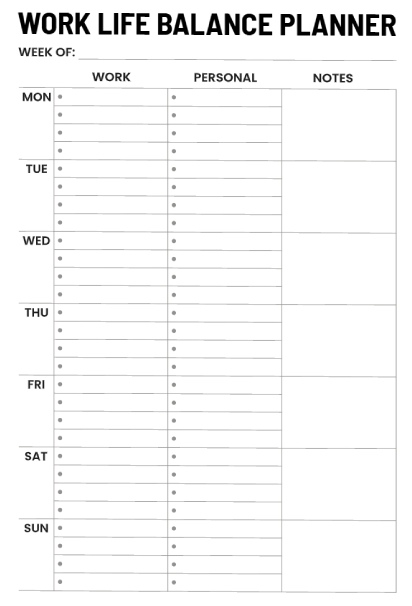
Template #1: Weekly Work Life Balance Organization Planner
This weekly planner splits things into work and personal columns for each day. You can actually see if you’re spending all your time on work stuff and ignoring everything else (or vice versa). There’s a notes section on the right for whatever thoughts, reminders, how the day went, whether you felt balanced or completely lopsided. Each day has room for multiple items, so you can list out what needs to happen. Pretty simple way to look at your week and make sure you’re not just working nonstop and calling it productivity.
Best for: Anyone trying to actually separate work from life. Especially helpful if you work from home and everything blurs together, or if you’re constantly feeling like work’s taking over and you need to see it laid out to believe it.
What’s Included:
- Weekly layout (Monday through Sunday)
- Separate work and personal task columns
- Bullet point lines for multiple daily entries
- Notes section for observations and reminders
- Week-of date field
Template #2: Comprehensive Life Goals and Priorities Planner
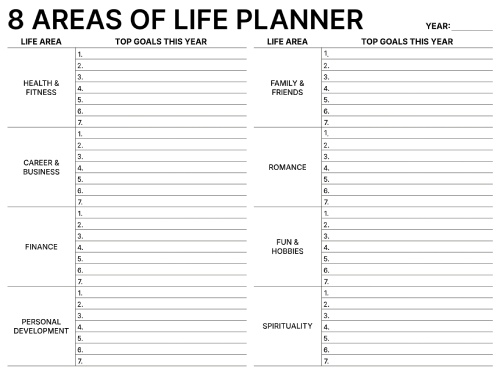
This life planning workbook allows you to organize your aims in eight key areas so that nothing gets missed. You can jot down what matters most to you in terms of health and fitness, business and career, money, and personal growth on one page. The other page focuses on family and associates, relationships, recreation and hobbies, and spiritual life. There are ample lines allocated to each domain so that you can jot down several aims or even break down bigger aims into smaller ones, should the need arise.
Best for: Those who engage in yearly planning, personal life coaches, or anyone who is seeking the complete development of personal life with appropriate goal development in various aspects.
What’s Included:
- Eight life area categories
- Numbered goal lines (1-7) for each area
- Year field for annual planning
- Two-column layout for easy viewing
- Space for multiple goals per category
Template #3: Daily Life and Mood Tracking Planner
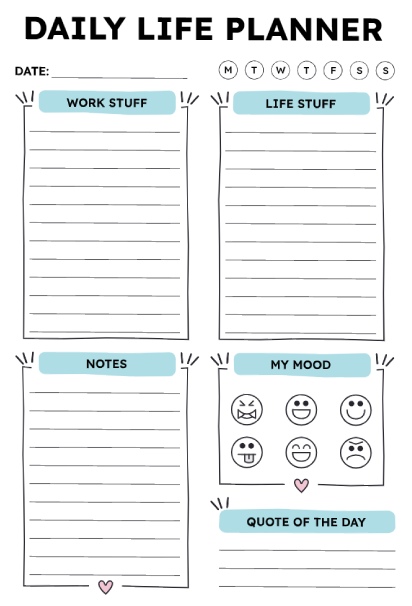
This daily planner makes it easy to manage both business and personal life in one functional page. Work things and personal things are placed side by side at the top of the page, so it is simple to manage both aspects of your day. There is also a big section for additional notes where you can list out all of the other things you haven’t placed in the other squares, as well as a mood tracker section where you can see how you are feeling by viewing the six different emoji faces. There is also a box at the end of the planner for the quote of the day, where you are able to place something inspirational or as a reminder to you. The colorful pictures make this daily planner fun and essential rather than a burden.
Best for: Students, freelancers, or people who like a casual and enjoyable approach to structuring their day and governing their productive and emotional cycles.
What’s Included:
- Work stuff task list
- Life stuff task list
- Large notes section
- Mood tracker with 6 emoji options
- Quote of the day section
- Date and weekday selector
Template #4: Personal Development and Improvement Life Planner
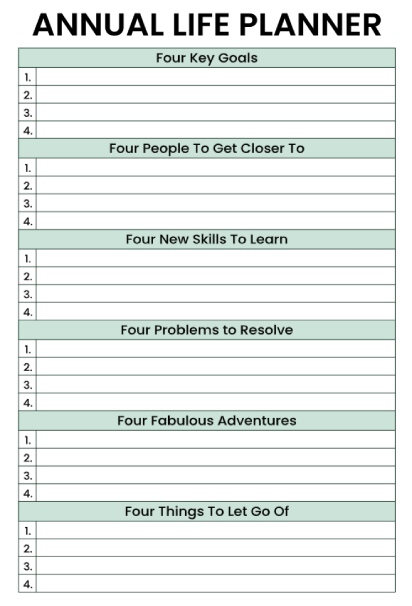
This yearly planner narrows down four items from each of the six life categories to keep your goals manageable and realistic: four key goals you want to realize, four people you want to get closer to, and four new skills you want to learn. There are specific places for four problems you need to resolve, four adventures you want to have, and four things you are ready to let go of. The “four” framework stops you from getting overwhelmed with too many goals while having you contemplate different aspects of your life. This is a powerful way to reflect on every passing year and live with purpose.
Best for: Anyone doing New Year planning, mid-year reviews, or anyone desiring to approach annual goal setting in a focused way, without making an impossible list.
What’s Included:
- Four key goals section
- Four people to get closer to
- Four new skills to learn
- Four problems to resolve
- Four fabulous adventures
- Four things to let go of
Template #5: Top Priorities and Life Areas Planner
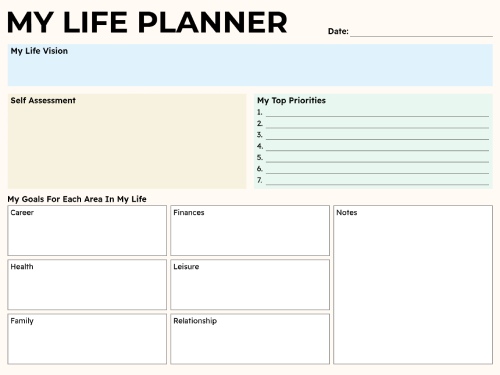
This life goal organizer opens with the big picture, filling in the details. First comes the section where one writes out one’s life vision and does some personal assessment on where one currently stands. Then comes the step of recording the top seven priorities so that one has a clear understanding of what really matters. Now comes the goal-setting section, where one places targets in the twelve basic areas: career, health, family, finances, fun, and relations. This will surely help bring the life vision down into the details of what the twelve areas comprise.
Best for: People embarking on a fresh life journey, individuals switching to a new career, or anyone wanting to link their long-term life vision and values to action.
What’s Included:
- My life vision section
- Self-assessment box
- Top 7 priorities list
- Goals for career, health, and family sections
- Goals for finances, leisure, and relationship sections
- Notes column
Template #6: Comprehensive Long-Term Life Goals Planner
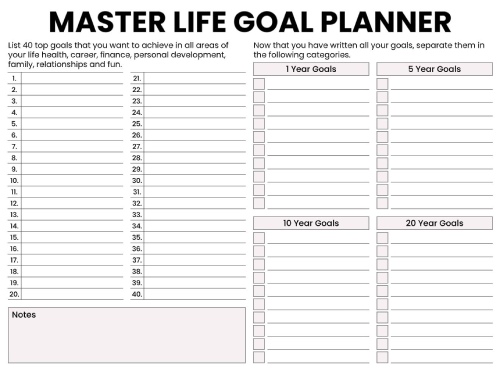
This comprehensive planner allows you to jot down 40 major goals that you wish to achieve in your lifetime and sort them accordingly into buckets based on the time period within which you wish to achieve them.’ The left side panel requires you to ‘write down all the big goals and dreams you wish to achieve and number them from 1 to 40.’ The right panel requires you to ‘sort the goals into 1-year goals, 5-year goals, 10-year goals, and 20-year goals, depending on when you wish to achieve them.’ The ‘notes area at the bottom allows you to jot down notes or thoughts about the goals you wish to achieve.’
Best for: Big dreamers, long-term planners, or individuals who seek to establish their bucket list and organize it in terms of reaching their goals.
What’s Included:
- 40 numbered goal lines
- 1-year goals column
- 5-year goals column
- 10-year goals column
- 20-year goals column
- Notes section at the bottom
Template #7: Future Goals and Steps Life Planner
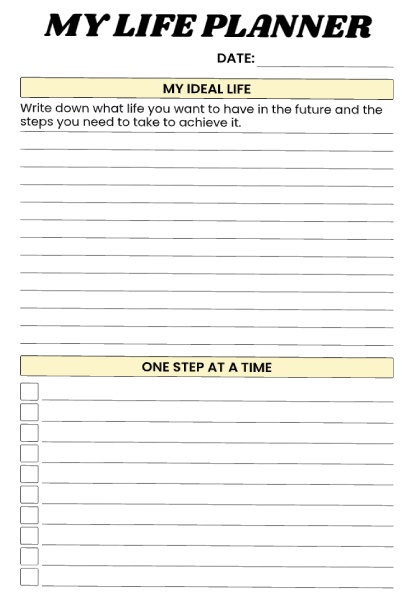
This life planner assists you in breaking down your dream life into achievable actions. On top, you have a big space where you write out your idea of the ideal life you want, including the life you envision for yourself in the future. The question nudges you into thinking about the actions required to achieve this. Below this section, you have the ‘one step at a time’ section with checkboxes, where you break down your overall goal into personal steps that you can implement. All this is done to ensure you don’t feel overwhelmed by listing out the actions required to implement your ideal life envisioned in the future.
Best for: People who feel stuck or are overwhelmed with a life change and need assistance working through how to break up their vision into workable steps that can be checked off.
What’s Included:
- My ideal life writing section
- Guided prompts for vision clarity
- One step at a time checklist
- Multiple checkbox lines for action steps
- Date field
Frequently Asked Questions
A life planner is simply a time-organizing tool that will assist you with figuring out what you are even attempting to accomplish. It is different from a calendar since it allows you to manage your goals, habits, and schedules using one platform or device. Your life planner will assist you with achieving this by ensuring that you establish big goals and break them down into smaller goals at the end of each quarter, month, week, and day. The life planner is simply the tool that will ensure that you are on the right track and pursuing the most suitable goals or activities.
The first system will require 2-4 hours of your time and involves the creation of your vision, evaluating your life, creating annual and quarterly goals, and creating templates to be used on your pages. All of this will easily occupy the whole weekend. Once you are through with that, you will require 20-30 minutes to prepare for the week and another 5-10 minutes to accomplish all that you had intended to do in the morning and evening.
Yes, if done on a regular basis. Studies reveal that people with written goals attain them 92% more effectively compared to those with no goals or without written goals. The life planners break down the general wishes into concrete goals that include quarterly goals, monthly accomplishments, weekly goals, and daily activities. You only need to use the life planners if you use them on a regular basis.
Yes, you should. A detailed life planner shows you the big picture and keeps the balance between life areas. Use color coding: let work tasks be different from personal priorities, health goals, and family commitments visually. That’s the way this visual system will show you when you’re over-investing in one area at the expense of another. If you plan holistically, career advancement will not be at the expense of relationships or health.
The 8 Pillars system fragments life into the eight regions: health and fitness, the second one being relations, work, finances, personal growth, recreation, environment, and contribution/purpose. The level of satisfaction on each pillar is measured on a scale of 1 to 10, and on the basis of this, the pillars where improvements are required are understood. Goals will be determined based on the improvement of the pillars, so that not even the strongest pillars are ignored.
Conclusion
Life planning is not about the goal of being perfect; it’s a matter of progress. It’s the difference between intention and chaos. Planning your life is the difference between having time control and time controlling you.
“The difference between people who accomplish their dreams and those who merely dream? They put it down on paper, they come up with a plan, they follow through.”
Best Digital Life Planner Apps of 2026
If you like digital planning, you may like these powerful applications:
- Planwiz: Life management software for creating plans, tracking goals, monitoring habits, and developing templates.
- Todoist: Super simple task management. You can type stuff naturally, and it figures out what you mean. Works across all your devices.
- Notion: Completely customizable. You can build whatever planning system makes sense for your brain. Takes some setup time, but worth it if you want control.
- GoodNotes: Designed specifically for the needs of all iPad users to write on the Apple Pencil and digital planners.
- Sunsama: Made for thoughtful daily planning using time-blocking and calendar integration.
Begin Today, Not Tomorrow
You have everything that you need: Eight types of planners, techniques that will give you successful results, setup procedures, and free templates. Find one that suits you. Download a template. Fill it out tonight. Your future self, less stressed and more accomplished, living with purpose, relies on the decision you make today.