

Have you ever woken up from a great dream and then it is gone in just a few seconds? It has already disappeared. The dream journal is very helpful in this situation especially if you are interested in dreaming or want to know what your mind does when you are asleep at night. I made this guide to make things easy to understand and follow for people who are just starting out with dream journals and lucid dreaming and want to learn more, about dreams and the dream journal.
I’ve tested several dream journaling apps and only included the ones that actually worked. You’ll also find easy tips to remember dreams better, plus beginner guides and free templates to get started. Everything you need to use Planwiz is explained below. Don’t let tonight’s dreams disappear-start your dream diary with a daily planner template.
What is a Dream Journal?
Definition and Purpose
So what’s a dream journal actually for? Simple-you write down your dreams right when you wake up, before they fade away. It’s basically your way of capturing what’s going on in your subconscious. All those weird emotions, random thoughts, the stuff your brain is processing while you’re knocked out-it all goes in there.
Main purposes:
- You’ll remember way more of your dreams over time
- You start noticing patterns, like certain themes that keep popping up
- It helps if you’re trying to get into lucid dreaming
- You learn a lot about yourself in the process
Here’s something interesting-research actually shows that if you keep a dream journal regularly, your recall gets about 35% better after just two weeks. Pretty cool payoff for something that takes like five minutes in the morning.
History of Dream Journaling
Prehistoric societies (3000–300 BCE):
- The Ancient Egyptians really believed that dreams were messages, from God. They would actually write down their dreams on papyrus scrolls. I mean can you picture doing that every morning? The Ancient Egyptians thought this was a way to start the day by writing down their dreams from God.
- Aristotle wrote one of the attempts at really looking at dreams in a scientific way in his book “On Dreams” which was done a long time ago back, in 350 BCE. Aristotle did this work “On Dreams” to understand dreams better.
Contemporary period (1900s–present):
- Everything changed in 1899 when Sigmund Freud wrote The Interpretation of Dreams. This book made dream analysis a tool that psychologists use. Before that people thought dreams were mystical stuff. Now dream analysis is a part of psychology because of Sigmund Freud and his book The Interpretation of Dreams.
- Carl Jung went far with this idea. Carl Jung kept a journal of his dreams for more than 40 years while he was working on his ideas, about analytical psychology. Carl Jung did this to really understand his dreams and the dreams of other people.
- These days people who study sleep use something called dream diaries to learn more, about the sleep where we dream, which is called REM sleep. How we are aware of things and the way our brains remember things and keep them in our memory, which is what our brains do with memories.
What Are the Different Types of Dream Journals?
Digital Dream Tracking (Mobile Apps & Software)
Advantages:
- Instant accessibility (smartphones are usually at the bedside)
- Voice-to-text capability for quick recording when awake
- Cloud synchronization between various devices
- Advanced features for searching and filtering
- AI-driven pattern recognition and analysis
- Integration of multimedia (pictures, sound, drawings)
- Reminders that are sent automatically and habit monitoring
- Options for data recovery and backup
Disadvantages:
- Exposure to blue light may impair the quality of sleep.
- reliance on the functionality and battery of the device
- Privacy issues in the absence of adequate encryption
- Possible distractions from alerts
- Learning curve for specific uses
Physical Dream Diaries (Paper-based)
Advantages:
- Sleep hygiene is maintained with no screen time.
- Writing by touch could improve memory encoding.
- Total privacy free from online threats
- No technical specifications or battery issues
- Freedom to sketch and express oneself creatively
- Intimate, personal recording experience
Disadvantages:
- Deterioration, loss, or damage risk
- No options for recovery or backup
- Searching historical entries is challenging.
- Writing in low light is difficult.
- more time-consuming than voice recording or typing
- Limited capacity for analysis
What Are the Benefits of Keeping a Dream Journal?
What Mental Benefits Does Dream Journaling Provide?
Supercharge Your Memory
Dream recall is part of memory training. Research from Harvard shows a 28% improvement in daily memory after 8 weeks of journaling. Your brain gets better at remembering everything, except for dreams.
Reduce Anxiety & Stress
Writing down nightmares reduces their power. Studies show a 30% decrease in anxiety and 27% fewer bad dreams after a month of regular journaling. To process emotions more deeply, you might try using dream tracking along with therapy journal templates made for mental health work.
Boost Self-Awareness
Dreams show your hidden emotions. Ninety percent of dream journalists find feelings they weren’t aware of; it’s like free therapy for your subconscious.
How Does Dream Journaling Improve Your Sleep?
Sleep Better, Naturally
Just planning to write down your dreams can improve your sleep quality by 22%. You start paying more attention to your sleep patterns and naturally begin making rest a bigger priority. Try using health planner templates to track your overall wellness, too. This helps you monitor the link between sleep, dreams, and physical health.
Master Lucid Dreaming
Dream diaries are the top tool for lucid dreaming. People who keep journals are six times more likely to achieve lucidity by spotting dream patterns and doing “reality checks.”
What Emotional Benefits Come from Dream Journaling?
Process Trauma Safely
Dreams help you deal with tough emotions safely. Therapists use a dream journal for PTSD treatment. Research shows it speeds up healing by 40%.
Identify Life Patterns
Dreams that repeat themselves usually mean your brain is stuck on an issue it wants you to notice. There’s probably some deadline stress you haven’t dealt with. Your brain’s basically trying to tell you something.
Personal Growth Over Time
Reading old dream entries shows how much you’ve changed. Your dreams shift as you grow. It’s a beautiful timeline of your inner journey. Set goals based on your dream insights. Use goal planner templates to turn revelations from your subconscious into actionable plans.
How Do You Start a Dream Journal as a Complete Beginner?
Getting started with a dream journal really comes down to three things: keep something to write with next to your bed, make yourself write the moment you wake up, and stick with it for at least two weeks before you expect to see anything useful.
What’s the Fastest Way to Start Dream Journaling?
Tonight Before Bed (2 minutes):
- Place the journal or phone on the nightstand, close enough to reach easily.
- Open to a blank page or launch your dream tracking app.
- Tell yourself, “I will remember my dreams tonight.”
- Setting this intention can improve recall by 35%.
Tomorrow Morning (3 minutes):
- When you wake up do not move. You should stay in the position that you are, in when you wake up. Do not change your position all.
- Don’t open your eyes right away-run through the dream again mentally.
- Don’t delay-open your journal and write down everything.
- Write everything, even fragments. Details will come back as you write.
Now! You’re officially a dream journalist.
How Do You Set Up Your Dream Journal Step-by-Step?
Getting your dream journal set up right makes a huge difference-you’ll remember way more than just fragments. This guide walks you through picking your format and setting up your bedside area. You can start recording your first dream tonight.
Step 1: What Dream Journal Format Should You Choose?
Option A: Digital (Recommended for Beginners)
- Download any dream tracking app.
- Turn on voice-to-text mess in the morning because you are in the dream in the morning.
- Set a daily 10 PM reminder to start winding down for bed.
- Turn on cloud backup so you never lose a dream.
Option B: Physical Notebook
- Buy a dedicated journal; don’t mix it with other notes. You can also create a custom dream section in your bullet journal templates for creative freedom.
- Keep a pen clipped to the cover.
- Use a penlight for writing in a dark room.
- Date every entry.
Pro Tip:87% of successful dream journalists use digital tools for voice recording and easy searching.
Step 2: How Do You Optimize Your Sleep Environment for Dreams?
Before Bed Checklist:
- Phone on airplane mode, reducing blue light.
- Journal or device within 6 inches of the pillow.
- Keep a glass of water nearby because it helps you to remember your harder dream.
- Aim for a room temperature around 65–68°F, which helps with deeper REM sleep.
- Use eye mask while you are sleeping.
What NOT to Do:
- Don’t drink alcohol; it reduces REM sleep by 39%.
- Avoid heavy before three hours of bedtime.
- Skip caffeine after 2 PM to help you sleep better.
- Don’t use social media before your bed.
Step 3: How Do You Capture Dreams in the Morning?
The “Stay Still” Method (Most Effective):
WAKE UP → DON’T MOVE → EYES CLOSED → MENTAL REPLAY → WRITE
Why this works: Changing your body position or opening your eyes triggers waking consciousness. This overwrites dream memory. Staying still allows you to remain in the dream state longer.
The First 10 Seconds Matter:
- Right after you wake up, you can remember most of your dream-about 90%.
- After 10–30 seconds, you start forgetting, remembering around 60%.
- By 30–90 seconds, only about 30% sticks.
- After a minute and a half, almost everything is gone-less than 10% remains.
Speed Recording Options:
- Voice memo, Fastest (30 seconds avg)
- Bullet points, Quick (1-2 minutes)
- Full narrative, Detailed (5-10 minutes)
Step 4: What Should You Include in Each Dream Entry?
A structured template helps you capture six important elements every time: date and sleep quality, the dream narrative in the present tense, all characters involved, location details, your emotions throughout, and anything that didn’t align with reality. This consistent framework turns random notes into data you can analyze. After just two weeks, patterns appear that individual entries never show.
Step 5: How Do You Build a Consistent Dream Journaling Habit?
Week 1: Foundation Building
Days 1–3: Write down everything, whatever you remember
Days 4–7: Write down at least three details from each dream.
Goal: Set up the morning routine.
Week 2: Skill Development
Day 8-10: Try voice recording to speed up your recall.
Day 11-14: Include emotions and symbols.
Goal: Remember at least one full dream each night.
Success Metrics:
1 Week: Record something daily, even if it’s vague.
2 Week: Remember 1-2 dreams with details.
3 Week: Recall 2-4 dreams per night.
What Are the Best Dream Journal Templates for Beginners?
You want to start your dream journal? We have ready-to-use templates that make it easy. you can download it, print, or save them on your device, and fill them in each morning.
Template #1: Basic Dream Journal Entry
This template has all the stuff: date sleep quality rating, dream story, emotions, characters, locations and symbols. It takes around 3 to 5 minutes to fill out. This template gets everything you need for a good dream analysis. It does not make things too complicated. The dream story and emotions and characters and locations and symbols are there.
Perfect for: Beginners who want a simple, structured format
What’s included:
- Date and time fields
- Sleep quality rating
- Space for dream description
- Type of dream
- Section for symbol notes
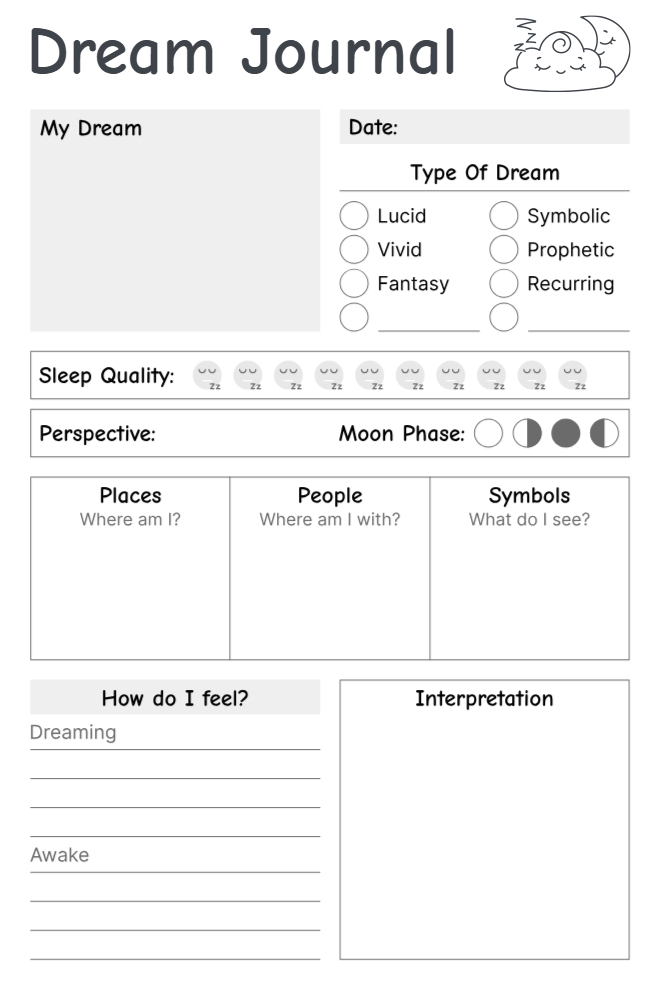
This template takes 3 to 5 minutes to complete. It covers everything you need for meaningful dream analysis.
Template #2: Quick Capture Template
Designed for busy mornings when you have just 60 seconds. It has a simple 3-word summary format (Subject + Emotion + Detail), a box for one key scene, and emotion checkboxes. You can add more details later in the day without losing your dream completely.
Perfect for: Busy mornings when you only have 60 seconds
What’s included:
- Aim of the dream
- Main things
- “Expand later” reminder flag

Use this when you’re rushed but still want to capture the dream. You can fill in more details later.
Template #3: Lucid Dreaming Tracker
A specific template to help you achieve conscious dreaming. It tracks reality checks you perform, levels of lucidity, control ratings, and what triggered your awareness. It also includes sections for reviewing what worked and setting goals for your next lucid dream.
Perfect for: People practicing conscious dreaming
What’s included:
- Moon tracker
- Dream sign catalog
- Lucidity level scale (1-10)
- What you did while lucid

This specialized template helps you keep track of your progress in achieving and maintaining lucid dreams.
Template #4: Weekly Dream Review
Check out a full week of dreams to spot patterns you’d miss in your daily notes. You’ll see a week-long overview, spots where the same ideas show up again, which people or things appear most often, how your emotions shift throughout, and ties to real stuff going on around you. Viewing your dreams as a whole like this helps you notice connections and meanings you’d completely miss looking at them one by one.
Perfect for: Pattern recognition and deeper insights
What’s included:
- 7-day dream summary grid
- Recurring themes tracker
- Emotion trend graph
- Life event connections
- Weekly insights section

Use this every Sunday to look over your dreams from the week. You can find patterns that you might miss when you write daily.
Template #5: Creative Dream Diary
Designed for visual thinkers who recall dreams in images instead of words. It includes a large interactive drawing canvas, a color palette tracker, sensory detail boxes (sight, sound, touch, smell), sections for visual symbols, and mind map space. You can express your dreams through art and creativity.
Perfect for: Visual thinkers and artists
What’s included:
- Large sketch or drawing area
- Color palette tracker
- Visual symbols section
- Mind map space
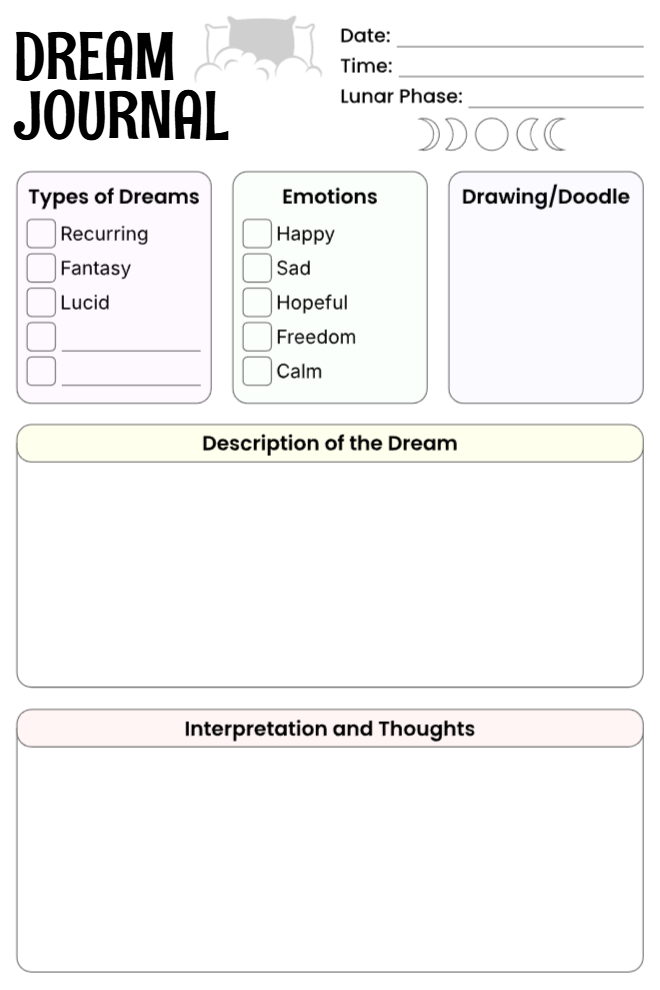
If you remember dreams as images instead of words, this template helps you capture them by drawing and using visual notes.
Template #6: Nightmare Processing Template
A therapeutic template designed to help safely address disturbing dreams. It includes emotional intensity scales, reflection prompts, a dream rewrite section where you can change the ending, coping strategies, and an analysis of real-life connections. Research shows it can reduce nightmare frequency by 30% within one month through structured processing.
Perfect for: Working through disturbing dreams therapeutically
What’s included:
- Safe reflection prompts
- Nightmare description area
- Emotional intensity scale
- Real-life connection questions
- Dream rewrite section. Change the ending.
- Coping strategies space
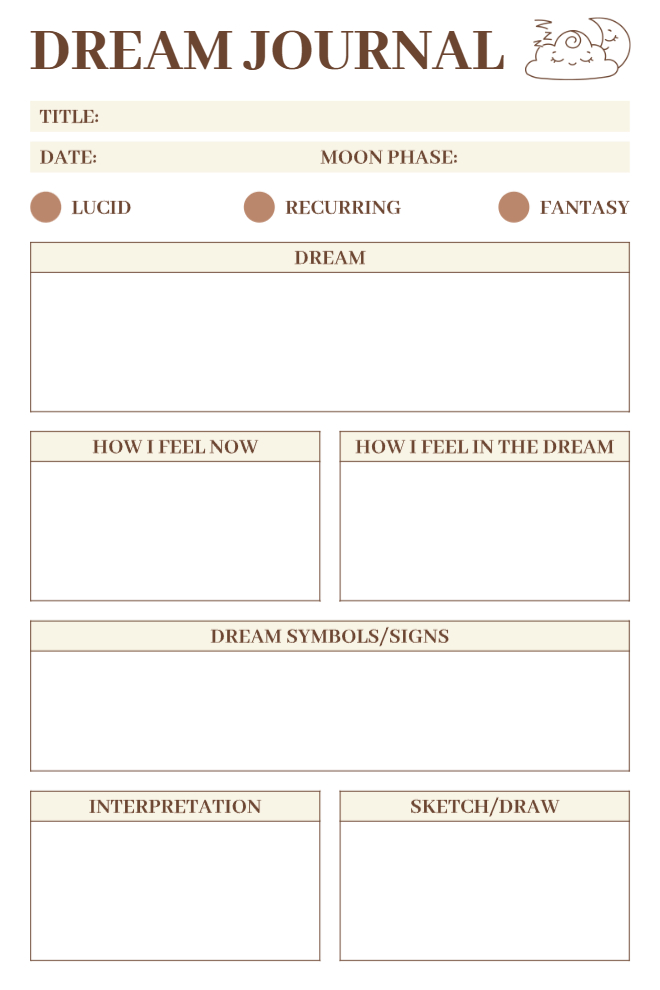
This template helps you handle scary dreams safely. It also reduces their emotional impact over time.
What’s Inside This Advanced Dream Journaling Guide?
This expert dream tracking guide is more than just a way to record dreams. In addition to exploring how REM cycles work scientifically and stating the 70% effectiveness of memory enhancement methods, it also discusses the techniques used by psychologists to interpret dream imagery. An individual should find sufficient information to help them grow as a dream analyst.
Understanding Dream Cycles
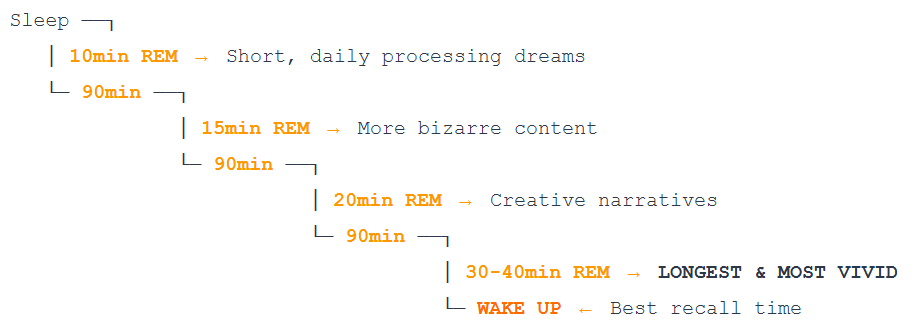
Important Point: Early morning vivid dreams are usually three to four times as long as the early night hours ‘ dreams.
Dream Memory Techniques
The Position-Stay Method: Don’t move when you wake up. Your body position holds dream memories. Moving leads to 55% memory loss within 10 seconds.
The Backward Replay: Have only bits of the dream? Mentally rewind it like a movie. Start remember your day from end to start.
The Water Trick: Drink 2 glasses of water before you are sleeping. You’ll naturally wake up during the 4-6 AM REM periods, allowing you to catch dreams mid-story.
Decoding Dream Symbols
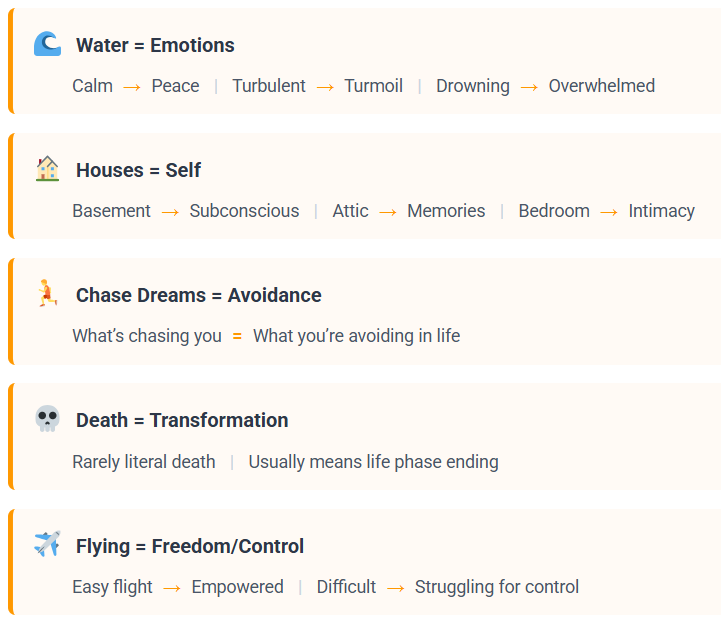
Personal Symbol Dictionary: Keep track of your recurring symbols. Your subconscious gives these symbols unique meanings.
The 3-Question Interpretation Method
For any dream, ask:
- What life situation parallels this?
- What emotion was most prominent?
- What action is my subconscious suggesting?
This avoids complicated analysis and shows the main meaning right away.
What Are the Essential Tips for Dream Journaling?
These essential dream tracking tips will improve your practice quickly. Learn effective recording techniques such as the first-word anchor method. Use pattern recognition strategies that can predict mood shifts 3 to 5 days in advance. Plus, explore proven lucid dreaming methods that have a 70% success rate.
Recording Tips
Dark Mode Recording: Use red light or the lowest brightness. Bright light can erase dream memories in seconds.
The First Word Anchor: Before opening your eyes, think of one word that captures the dream. This helps prevent total memory loss.
Fragment Priority: Record even the smallest fragments right away. Single images can often trigger full dream recall hours later.
Voice Over Typing: Feeling groggy in the morning? Use voice memos and transcribe later. This is three times faster than typing.
The 3-Word Minimum: Can’t write much? Just record: Subject, Emotion, and a Weird Detail. For example: “Flying, peaceful, purple sky.”
Pattern Recognition Tips
Weekly Theme Review: Read all the dreams from the week on Sunday. Use a weekly planner templates to organize your analysis. Patterns that are not clear daily become obvious when looking at them weekly.
Color Tracking: Note the dominant colors. Blue indicates calm periods. Red shows stress. Gray represents depression. Colors can predict mood changes 3-5 days in advance.
Character Frequency List: Who appears most often? That person or relationship may need attention in your waking life.
Location Inventory: Track all the places in your dreams. Invented locations represent parts of yourself that you have not explored.
Emotion Graphing: Rate your dream emotions daily on a scale from 1 to 10. Graphing these over time shows mental health trends before you are even aware of them.
Lucid Dreaming Tips
LUCID DREAMING FORMULA:
Reality Checks (10x daily) + Dream Signs Catalog + WBTB Protocol = LUCID DREAMS
Reality Check Habit: Check the clock twice, push a finger through your palm, and count your fingers. Do this 10 times daily. This habit carries over into your dreams, triggering lucidity.
Dream Sign Catalog: Once you’ve jotted down around 20 dreams, make a list of the weird, impossible things, like relatives who aren’t with us anymore, showing up, breathing underwater, or flying out of nowhere. Spotting these repeating oddities? That’s your cue, and you’re actually dreaming.
False Awakening Recognition: Write down every “dream within a dream.” These moments are when you are closest to conscious awareness.
Consistency Tips
Minimum Viable Entry: Having a busy morning? Write just 3 words. This helps maintain a habit without stress.
Habit Stacking: Try writing in your journal right before that first cup of coffee or after your bathroom routine. Linking it to habits you’ve already got down makes sticking with it roughly 40% easier.
Accountability Partner: Grab a friend and swap one dream story with them each week. When someone’s checking in on you, you’re about 63% more likely to actually follow through.
Milestone Rewards: Give yourself something to celebrate at 7 days, 30 days, 90 days, and when you hit a full year. Physical rewards, like treating yourself, strengthen habits neurologically.
Progress Comparison: Each month, compare your entries from Week 1 to the current week. Seeing visible improvement provides powerful motivation.
Advanced Analysis Tips
The Annual Review: Read the whole journal once a year in chronological order. This shows life narrative arcs and seasonal patterns that you may have overlooked.
What Are the Best Dream Journal Apps and Tools in 2026?
Picking the right dream tracking tool can really change everything-whether you end up losing dreams forever or actually building a meaningful collection of what’s happening in your subconscious. Curious about your options? Check out the guide to the best digital journal apps in 2026. We have tested many options to bring you the best tools in various categories, whether you prefer digital convenience, physical intimacy, or quick voice recording.
Comparison Table
| Tool | Type | Best Feature | Price | Platform |
|---|---|---|---|---|
| PlanWiz | Digital | AI analysis + voice capture | Free-$4.99/mo | iOS, Android, Web |
| Dream Journal Ultimate | Digital | Detailed statistics | Free-$3.99 | iOS, Android |
| Lucidity | Digital | Lucid dream tools | $2.99 | iOS, Android |
| Shadow | Digital | Community sharing | Free | iOS, Android |
| Moleskine | Physical | Premium quality | $15-25 | Paper |
| Leuchtturm1917 | Physical | Numbered pages | $20-30 | Paper |
| Voice Memos | Audio | Always accessible | Free | All phones |
| Otter.ai | Audio | Auto-transcription | Free-$8.33/mo | iOS, Android |
Frequently Asked Questions
A dream journal is a special place where you write down your dreams right after you wake up. This practice helps you remember your subconscious thoughts and feelings. Studies show it can improve your ability to recall dreams by 35% in just two weeks. It can also reduce anxiety by 30% and boost your memory by 28%. It’s the top tool for experiencing lucid dreams. Plus, it can help you process your emotions and tap into creative ideas.
Yes, dream tracking is shown to reduce anxiety by 30%, decrease nightmare frequency by 27%, and speed up trauma healing by 40% when used as therapy. It offers emotional processing similar to therapy sessions. It also helps identify unresolved issues through recurring themes and tracks mental health trends 3 to 5 days before you consciously notice mood changes.
You’ll notice better dream recall within 2 weeks of consistent daily journaling. Most people remember 3-4 dreams per night instead of just 1. Lucid dreaming usually starts after 6-12 weeks of regular practice. Deep pattern recognition and emotional insights appear after 3-6 months of dedicated journaling.
Place a journal or phone by your bedside. Tell yourself, “I will remember my dreams,” before sleep. Write down your dreams right after you wake up, without getting out of bed. If you’re in a hurry, start with just 3 words: a subject, an emotion, and a detail. Keep this up for 2 weeks to help train your brain. Apps like PlanWiz offer voice recording features to make this easier.
Conclusion: Your Dream Journey Starts Tonight
Dream tracking is more than a habit; it is self-discovery. The science behind it increases memory by 28%, anxiety by 30%, and lucid dreams by 600%. Every dream tracked provides insight into the emotions repressed and the underlying trends within your life. Famous innovators such as Edison and Einstein attribute their brilliant innovations to their dreams. The amazing thing about it is that it only takes 5 minutes in the morning, and within two weeks, you’ll remember 3 to 4 dreams per night.
Don’t wait for the perfect time. Your dreams happen every night, whether you write them down or not. Put your journal by your bedside tonight and jot down anything you remember tomorrow morning; even three words matter. Ready to tap into your subconscious? Check out the daily journal templates for tracking dreams and improving emotional wellness. Download PlanWiz today for easy dream tracking with voice recording, AI analysis, and attractive templates. Your future self will appreciate it.
Sweet dreams, and even better remembered dreams!