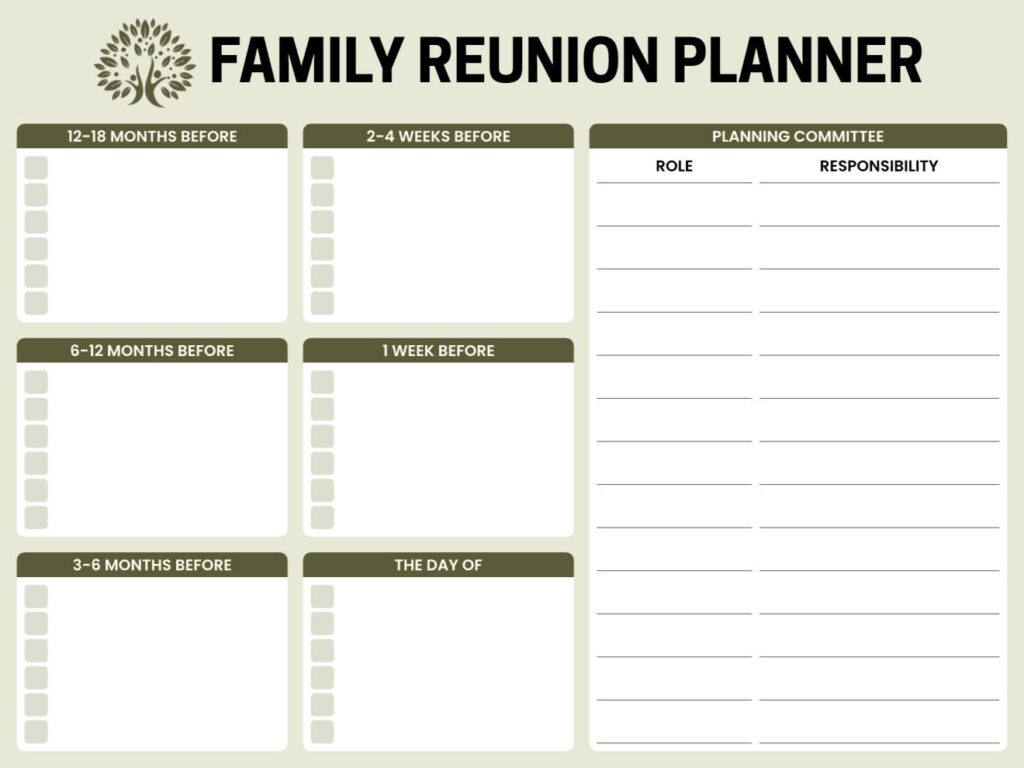
Hosting a family reunion with 30-100+ family members involves more than well-wishing; it calls upon a highly organized system which can divide the 12-18 month planning process into distinct stages with specific levels of responsibility assigned to each stage. The “Family Reunion Planner Template 2026” offered by Planwiz is just what is needed – a six-stage timeline planning system with checkboxes indicating the planning items to be accomplished at each stage.
This template allows you to better secure locations when they are most available and at lower cost, allows relatives enough lead time for travel arrangements, and does away with last-minute hassles due to oversights. In fact, this planner is unique because of its Planning Committee page that allows for systematic designation of family members to handle location arrangements, food, accommodations, and budget, rather than placing everything in the lap of one person to decide.
What is a Family Reunion Event Planner?
A reunion planning template is a specialized organizational system that takes large family gatherings and breaks them down into manageable phases, normally in 12- to 18-month segments of preparation, complete with timetables, task assignments, and progress checks, all tailored to coordinate multi-generational events across multiple households. In many ways, this structured approach is similar to how a family planner templates may keep track of daily household activities; only now it scales to coordinate dozens of people across locations and timeframes.
The organizational tool helps to organize overwhelming prep work into six different stages with check-boxes and has an organizational structure for these committee tasks that involve multiple members of the family for venue, catering, accommodation, communication, and event organization. Essentially, it helps to guide first-time organizers while acting as a reference guide for seasoned organizers to ensure that no detail goes undone.
What Are the Common Challenges in Family Reunion Planning?
Challenge #1: Low Response Rates
Your date polls and location surveys, but only 15% of the relatives respond to you, leaving you in the dark over what will work for all.
Solution: Set a deadline and say something like, “we’re making decisions based on responses received by [date]”; this gives the illusion of urgency, while not waiting around possibly forever for 100% to respond.
Challenge #2: Families with varying budgets leading to conflict
Families might have the budget for spending $200 on each person, but others would struggle to spend beyond $50, resulting in disagreements on what to pack.
Solution: Provide tiered participation through budget planner templates to monitor contributions: sharing the essential costs (place, simple meal) equally, however, making the rest of the products (t, shirts, VIP activities) optional pay, if, you, participate so that families who are careful with their budget won’t be disadvantaged.
Challenge #3: Accommodating Multiple Generations
Teenagers want adventure, toddlers need naps, and elderly relatives need accessibility-pleasing everyone seems impossible.
Solution: Design 2-3 all-family anchor events (meals, group photo) with concurrent age-appropriate options during free time rather than forcing identical activities all day.
Challenge #4: Last Minute Cancellations Impacting Headcounts.
Families cancel a few days prior to the function after you’ve submitted food deposits based on their confirmation.
Solution: One can require a non-refundable deposit or the total amount 30 days prior to the event and make the terms clear that a cancellation with short notice is still liable for payments because reservations have already been incurred.
Challenge #5: Poor Communication Leading to Confusion
Family members are unable to access important information hidden in long threads of emails or on posts that were overlooked on FB.
Solution: Set up a single communication method as your main channel and send out brief notices that contain the least amount of words but the most specific and clear actionable steps. Also, include in the subject lines words that immediately grab attention.
How Should You Plan Your Budget for a Family Reunion Event Planner?
Recommended Budget Breakdown
| Budget Category | Percentage | Amount (for $10,000 budget) | Why It Matters |
|---|---|---|---|
| Venue & Facilities | 25-30% | $2,500-$3,000 | Quality location sets the tone |
| Food & Catering | 30-35% | $3,000-$3,500 | Largest expense, highest impact |
| Accommodations Support | 15-20% | $1,500-$2,000 | Group rates need booking |
| Activities & Entertainment | 10-15% | $1,000-$1,500 | Keeps all ages engaged |
| Decorations & Materials | 5-8% | $500-$800 | Creates a memorable atmosphere |
| Contingency Fund | 10-15% | $1,000-$1,500 | Handles surprises without panic |
Money-Saving Strategies for Family Reunions
| Strategy | Potential Savings | Implementation |
|---|---|---|
| Choose Off-Peak Dates | 20-30% | Avoid holidays and peak summer weekends |
| Potluck-Style Meals | 40-50% | Families contribute signature dishes |
| Free Venues | $500-$2,000 | Public parks, community centers, and family property |
| Accommodations with Kitchens | 30-40% on food | Cook some meals instead of restaurants |
| DIY Decorations | 50-70% | Family craft sessions, reusable items |
| Digital Invitations | $100-$300 | Use email/social media instead of printed invites |
For destination reunions requiring extensive travel coordination, pair this reunion planner with a trip planner templates to manage flight bookings, car rentals, and accommodation arrangements for multiple families arriving from different locations.
Frequently Asked Questions
A family reunion planner template is a tool which provides a systematic way of breaking down the whole process of a family meeting into distinct steps.
It contains roles, checklists, and coordination systems with timeline considerations specifically for multi-generational family events. In contrast to general event planning software, it deals with specific family reunion issues related to age groups, budgets, and multiple family households.
“The template usually takes anywhere between 12 to 18 months for its preparation phase, which helps to break down the massive job of coordinating 30-100+ people into manageable chunks through a variety of action items assigned to various responsible parties.”
“Family Reunion Planning-Part of a Larger Tapestry of Celebration!” said Amy Williams in “National Reunions.” Additionally, family reunion planners must take on a challenge that a regular party host never encounters.
These challenges include coordinating across multiple households, accommodating three to four generations with different needs, and managing shared budgets with contributions from various family members.
These also encompass longer timelines because organizing 40+ individuals from various cities takes longer than organizing a birthday party within a locality.
Secondly, family reunions include family traditions, which can be complex, like catering to different diet requirements of different generations, organizing activities for people aged 2 to 92 years, and keeping different family branches satisfied regarding budgets and preferences.
Begin by setting your target reunion date, then count backward to establish dates for each planning phase-mark these prominently on the template.
Next, recruit and assign your Planning Committee, writing specific names and contact information in the committee section.
Have an initial planning meeting where the committee discusses and reviews the entire template altogether and personalizes the check-off options for each period based upon the specific needs of your reunion.
With a collaborative launch, it guarantees that the whole team has a clear understanding of the nature of the project, as well as their specific obligations to begin event.
This essential stage is all about deciding the most important things and setting up your planning structure.
Among the most important tasks are: carrying out a family survey to find out the most suitable dates and places, creating your planning committee with role assignments that are clear, and setting up a preliminary budget and contribution structure.
Moreover, initiate the local and online scouting for venues and attending locations, develop a detailed family contact list including current emails and phone numbers, and establish communication means like group email or Facebook groups.
When your communication channels are ready, think about employing a monthly schedule planner templates to communicate major milestone deadlines to the whole family. This will help to keep everyone in line with the main dates such as RSVP deadlines and payment due dates.
Each role should be assigned to a designated individual, along with contact information, to ensure every area of responsibility is well-identified. I
n your first planning meeting, it would be best to examine the usual tasks of each of these roles and modify them according to the strengths and availability of committee members.
Some are combined for smaller reunions. For example, (Activities + Children’s Programming, Food + Budget Treasurer), whereas for a larger reunion, more positions are required.
Schedule regular meetings of your committees (monthly in the early stages of planning and then weekly in the run-up to the event) where each individual shares their progress on their aspect of the event and problem-solves difficulties together.
The midplanning stage is where the activities move from decision-making to action and vendor acceptance. The critical components of this stage include: sending ‘save the date’ notifications to all family members, finally deciding on food and making provisions for people with dietary restrictions, and arranging entertainment providers.
It’s also important to lock in your hotel room block or get information about your family’s code to book, arrange for supplies for your reunion, and organize events. It’s also important for you to perform a budget check to determine if you’re overspending.
Reunions where food is provided can make use of a meal planner templates when the event organizers need a way to manage decisions on meals and handle the potluck meals presented by the various branches of the reunion families.
For small events, merge functions of different committees to empower a sole individual to take care of multiple related aspects, such as Food + Budget, and Lodging + Communications.
Keep in mind to simplify a timeline by limiting tasks in the 12-18 month phase since smaller events don’t necessarily require renting spaces a year in advance.
Try to focus your list items on getting down to basics like choosing an activity location and date, arranging for food or a potluck, determining 2 to 3 activities to do, and getting RSVPs back from all Perhaps you can begin planning 6-9 months in advance for a local event with 20 people, using the 6-12 month area of the timeline as your launching point.
Yes, destination family reunions particularly benefit from the extended timeline and committee structure this planner provides.
Be sure to include concrete travel, related activities in your 1218 month and 612 month phases plans: looking up group airfare deals, organizing car rentals or shuttle services, and reserving group activities or tours.
On your committee, designate a person to the role of Travel Coordinator who will be in charge of these logistics only. The 12–18 month lead time becomes essential for destination events since family members need maximum notice to request vacation time and book flights at reasonable prices.
First, lay the foundation for your timeline framework. Decide on the level of advance needed based on your complexity level and size.
Develop phases that mirror standard planning milestones (early decisions/venue selection, vendor selection/confirmations, final details/communications, event execution).
Build a committee structure by listing all major responsibility areas for your reunion and creating distinct roles for each, plus add contact information fields and a notes section for capturing lessons learned.
The first common error is the late start. This occurs when the wedding planners are involved only 3-6 months prior to the wedding. This significantly restricts the choice of venue and hotel rooms. It also stresses the planners.
Other common mistakes here would be: not actually delegating committee positions with people’s names, not tailoring the generic tasks of the template to suit their needs of holding a reunion, and not checking on progress from time to time so things are forgotten.
Moreover, make sure you do not miss the aspects of not budgeting for unexpected expenses and not recording the contract information and learnings for future events. Secondly, the task of managing an event should treat the event planner as a living document that needs to be reviewed and updated periodically instead of a form to be filled out and then forgotten.
Communication transparency is the top factor of success, keep all family members informed of major decisions, costs, and progress of the timeline through regular updates.
Some of the best practices are also: recruiting your planning committee early and leveraging the skills of the people’s youeding, writing everything to prevent miscommunication, and constructing 15, 20% of the budget as a reserve for unforeseen expenses.
In addition, you should prepare backup plans for outdoor activities, make accessibility a priority for the elderly or disabled family members, and get vendor agreements in writing.
The most successful event planners also recognize small milestones to keep the enthusiasm of the committee and hold a post, event debrief when the details are still recent to note down the experience for the next reunion.