Planning a family reunion comes with one universal challenge: coordinating everyone without constant confusion. The difference between a chaotic gathering and a successful one often comes down to having a clear family reunion itinerary planner. When every family member knows what’s happening and when, you’ll spend less time answering questions and more time enjoying the reunion. A well-structured family reunion itinerary planner ensures smooth coordination and eliminates scheduling headaches.
That’s why we created this free 2026 template for you. Planwiz designed this downloadable schedule organizer to work for any family size or venue, complete with a full example timeline, essential components for success, and tips to avoid common planning mistakes. Whether this is your first reunion or your tenth, this tool eliminates the confusion and helps you focus on what matters-connecting with family.
What is a Family Reunion Itinerary Planner?
A Family Reunion Itinerary Planner is “the roadmap” of your event and is just what you need, and just what you’ve got to have, for it comprises the chronological schedule of activities, meals, and events from arrival through departure. It provides the four big questions each member of the family wants answered: “What’s going on?”, “When does it start?”, “Where do I go?”,
It is like a central nervous system in your event. Without it, you will have different persons with different expectations, confused volunteers with unclear roles, and an event organizer with endless questions on things like “what’s next?” Having it, you will have everyone following the same playbook.
Why does family reunion require an itinerary planner?
Imagine this: At 11 AM during your family reunion, and half of your relatives are constantly asking when you will serve lunch while the other half have already left and hence, they missed the group photo. No one knows who is setting up the afternoon games, and the activities are overlapping.
Having good intentions does not necessarily mean having good execution. Without a written schedule, great ideas fade away into confusion upon the arrival of more than 30 people with different expectations. An itinerary is the tool that turns abstract plans into concrete reality thus, it helps the organiser to not be the only person whom everyone asks for information and it also ensures that the volunteers know their duties without needing reminders.
Many families discover that using a family planner templates several months before the reunion assists in coordinating everyone’s availability and makes tracking of RSVPs more efficient.
What Does a Family Reunion Itinerary Planner Look Like?
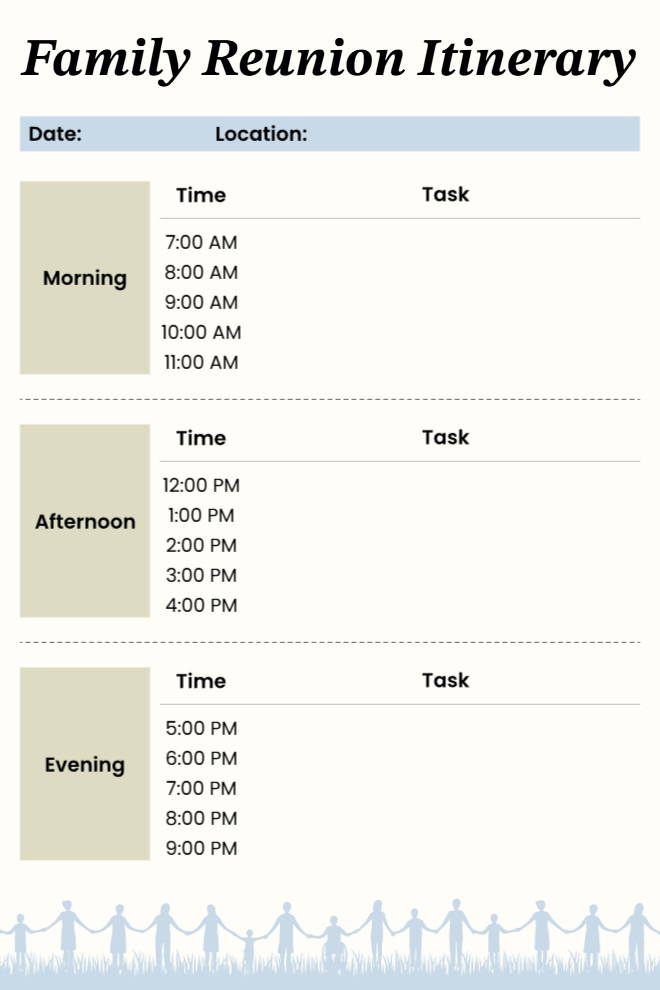
The best way to understand itinerary planning is seeing a real example. Here’s a complete single-day reunion schedule that follows a simple morning-afternoon-evening structure:
The Johnson Family Reunion
Date: Saturday, August 12, 2025 | Location: Lakeside Community Center
Morning:
| Time | Task |
|---|---|
| 9:00 AM | Arrival & Registration at Main Entrance |
| 10:00 AM | Icebreaker Games in Main Hall |
| 11:00 AM | Free Mingling Time on Patio |
Afternoon:
| Time | Task |
|---|---|
| 12:00 PM | BBQ Lunch at Outdoor Pavilion |
| 1:00 PM | Continue Lunch & Socializing |
| 2:00 PM | Family Group Photo at Front Steps |
| 3:00 PM | Kids’ Activities (Playground) & Adult Catch-up (Lounge) |
| 4:00 PM | Dessert & Coffee in Main Hall |
Evening:
| Time | Task |
|---|---|
| 5:00 PM | Talent Show & Memory Sharing on Stage |
| 6:00 PM | Closing Remarks & Thank You |
| 7:00 PM | Cleanup & Farewells |
Emergency Contact: Sarah Johnson (555, 0123) | WiFi: LakesideGuest | Password: Family2025
Why Does This Family Reunion Travel Plan Itinerary Schedule Function?
- Simple structure Morning, afternoon, and evening blocks allow you to quickly understand the flow.
- Hourly slots Every hour has a definite use which avoids confusion during the time of rest.
- Realistic timing: Two full hours accommodate lunch because people eat slowly when they are reconnecting.
- Built-in flexibility: It is possible for activities to be a little longer without the whole schedule getting derailed.
- Clear transitions The day flows naturally from the arrival to the activities and then to the memorable closeout.
This format is the best choice for single, day reunions that last 8, 10 hours. Use this layout as a model and write down the activities that fit your family’s style.
Frequently Asked Questions
A family reunion itinerary planner is a device with which you schedule all the activities, meals, and events for your family gathering in a time sequence.
It is the main schedule that, separates the different generations from small kids to old grand parents of the reunion and keeps them updated throughout the reunion.
The planner usually depicts each day broken into hourly or multi, hour time slots, with separate areas for the activity names, locations, coordinators in charge, and any special notes.
Before the event, it is a planning tool for the organizers and during the reunion, it is a guide for all the family members.
You should definitely use an itinerary planner as it keeps the family functions, which maybe the coordination of dozens of individuals, from turning into a mess and getting confusing again.
Without the schedule, for example, you might skip family photos or memorial services, food service gets more and more confusing, and family members may find themselves standing around and asking “what’s happening next?”
The planner helps to find time conflicts on the schedule before the event and also keeps track of it by setting up people responsibilities.
It works as a reduction in the main organizers loading, who is going to be less in need of recalling the activities to communicate to the group thus making the reunion a stress, relieving experience for all the participants rather than a burden to endure.
The main organizer is the one who gets a lot of help just by having a tangible understanding of the whole event, but all the participants receive some benefits from having a definite timetable.
Large extended families of 30+ people particularly require the most well-planned itineraries to coordinate different generations that have totally different needs, energy levels, and interests.
The multi-day reunion planners consider it as their only tool to handle difficult logistics that span over several days-check-in times, breakfast schedules, excursion departures, evening entertainment, and checkout procedures all require precise coordination. The first, time organizers find the template structure that guides them through planning decisions they might otherwise overlook, like creating buffer time or planning weather backups, as an attraction.
The main coordinator gets so much out of having a visual summary of the whole event, but every attendee, also, gets something out of a clear timetable.
Particularly big extended families of 30+ people need planned itineraries to be able to coordinate different generations which have different kinds of needs, energy levels, and interests.
Multi-day reunion planners consider it indispensable for dealing with complicated logistics over a few days-check-in times, breakfast schedules, excursion departures, evening entertainment, and checkout procedures all require precise coordination.
First, time organizers find it helpful the template structure which takes them through planning decisions that they might have not thought of, for instance, creating buffer times or considering the weather as a backup plan.
Quite a number of organizers discover that keeping a weekly planner templates during the preparation period is a way for them to stay in control of reunion tasks without feeling overwhelmed.
Firstly, the activity name or description, the exact location (especially if it is a large place), and the person (if any) responsible for that activity should be included. In the case of activity, be as detailed as possible instead of just “Games, ” write “Relay Races & Sack Race Competition” for example, or “Volleyball Tournament.”
The location part is very important at large venues with several areas as it helps people to find their way and not to wander around looking for activities.
The addition of the coordinator’s name makes it more formal and gives the attendees a person whom they can ask questions if they are not sure about the information. It also helps in solving the possible confusion of who is leading each activity.
The ideal plan makes use of both digital and printed forms whereby each of them is serving different functions during your planning and the performance of the event.
In this way, you can send the digital version via email or family group chat not less than two weeks before the reunion, thus giving the relatives who live far an opportunity to arrange their trip and be present at the activities they most want to attend.
Additionally, printed copies are still very important for the actual day of the event-put large-format versions at the places where there will be a lot of people passing like the entrance of the venue, near food stations, and at registration tables.
Offer single printed copies in welcome packets or place them in stacks on tables from which people can take as many-attendees (especially older relatives) may be accustomed to having a physical copy which they can refer to throughout the day.
In case you are holding a reunion at your place of living, an agenda templates will enable you to sort out your personal hosting tasks aside from the guest, facing schedule.
For small, intimate gatherings (between 10 and 30 guests), you should employ simpler schedules involving wider time slots and fewer organized activities to avoid overprogramming.
The schedule should revolve around several major points such as arriving, lunch, a group event, and leaving, and you should intersperse these with lots of free time for mingling.
Large families (50+ members) will necessitate more detailed schedules with more activities simultaneously occurring in several areas to appeal to varying interests. Add a column for location because there will be activities for kids in a certain area and adults in another and so forth simultaneously.
Firstly, create a single master itinerary that illustrates all the activities going on simultaneously, then, write down simplified and age, specific schedules that show what each group should attend.
The children schedule might indicate “9:00 AM, Craft Time at Pavilion, 12:00 PM, Pizza Lunch, ” whereas the adult schedule for the same times could be “9:00 AM, Coffee & Catch, up, 12:00 PM, Lunch & Family History Presentation.”
Parents will be able to recognize very quickly which activities are for their kids if you use color, coding on the master schedule (yellow for kids, blue for adults, green for all, ages). Put clear signs for multigenerational activities such as group photos and meals when everyone should be together.
Your family reunion template must prominently display the title at the top of the page, have a separate area for date and location details, and time increments which correspond to the duration of your reunion (hourly for single, day events, wider blocks for multi, day).
There should be enough space allotted to each activity for the description, location, and coordinator name. Additionally, you may want to include a footer with emergency contacts, WiFi passwords, venue addresses with parking information, and a small notes section for last, minute announcements.
To make the font easily readable, you should use 14, 16pt for body text, ensure there is a high contrast between the text and the background, and have visual dividers between morning/afternoon/evening sections so that it is easier to navigate. The organizing methods employed in this situation are akin to those found in the best, designed minute of meeting templates being clear and accessible should always be the priority.
The first common mistake is overbooking without leaving time for natural conversations, interactions, and activities that will serve to make the reunion memorable.
Many planners also shortchange the length of activities, such as expecting a group photo to take 30 minutes rather than 10, or a meal taking 90 minutes if people are fellowshipping, and setup and cleanup taking longer than estimated.
Mistake #2: Not Communicating the Schedule-It’s been known to happen when organizers don’t repeatedly communicate the schedule, such as sending it to people via an email weeks in advance and them just not seeing it or remembering it.
Try to avoid situations where the schedule is full of activities happening at the same time, splitting the group in multiple other activities where there isn’t a time where everyone is together.
Realistic expectations will start with proper planning skills, and this is where a goal planner templates becomes important to successful organizers to plan what they want to achieve at a reunion.
Experts advise that the entire reunion duration should have a minimum of 25-30% of the time kept as “free time” or “open mingling” so that people can talk to each other without any restrictions.
These free times actually turn out to be the most favourite ones during the reunion when the family members get to interact in a casual manner without the pressure of having to quickly go to the next event.
Put aside 15-30 minutes “buffers” or breaks between the major acts to deal with the situations such as an event/activity running longer than you planned, people arriving late, and moving from one place to another. In this manner, if an activity extends, it will not be your entire schedule that gets spoiled.