Planning for a successful family reunion does not happen when the time for the family reunion arrives; rather, it begins even before the event, with organized, productive planning sessions that see visions turned into realities. A family reunion organizational meeting planner is the magic wand that can change messes of group brainstorming sessions into organized planning sessions that see tangible decisions get made. Planwiz brings you this printable PDF template for family reunion planning especially for family reunion organization planning.
The distinction between a stressful, last-minute scramble for a reunion and one that you smoothly execute is often a matter of documentation and accountability during the planning phase. This template fixes those issues by documenting every planning decision from the choice of the caterer to the volunteer who will coordinate activities thus turning the good, intentioned volunteers into accountable task owners with particular deliverables and deadlines.
What is a Family Reunion Organizational Meeting Planner?
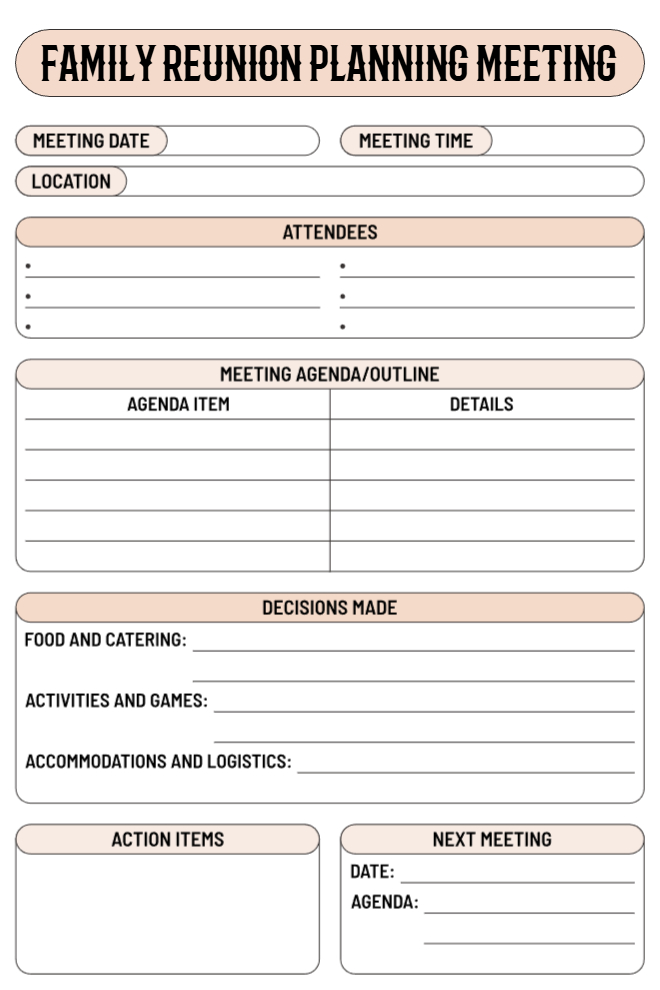
Family Reunion Meeting Planner is an organizational tool that facilitates the planning of reunion meetings. It has ready, made templates for recording meeting agendas, attendees, decisions, action items, and notes. This planner enables managing the coordination of the reunion from a single centralized system.
This planner is different from others because of its concentration on templates that are appropriate for family planners templates, with sections devoted to meeting the dietary needs of families of different ages, developing age, specific activity engagements ranging from toddlers to seniors, and even managing travel arrangements that include family members scattered geographically. The planner holds someone accountable because it records who agreed to do which tasks with specified timelines.
What Should You Include in Family Reunion Planning Meeting Checklist?
Running a productive family reunion planning meeting requires preparation, focus, and follow-through. This checklist transforms good intentions into organized action, ensuring your planning sessions move the reunion forward instead of becoming endless discussion loops. Use this step-by-step guide to keep meetings efficient, inclusive, and results-driven.
Before the Meeting
- Schedule the meeting date and time – Use a poll tool to find when most key decision-makers are available; aim for 60-90 minute sessions.
- end calendar invites with video link – Include Zoom or Google Meet details for remote family members.
- Draft and circulate the agenda -within 5, 7 days in advance so that attendees have time to prepare questions or offer themselves for roles.
- Gather necessary information– Obtain vendor quotes, venue options, and previous meeting notes for reference.
- Review previous action items – Check what was assigned last time to ensure accountability.
- Review Meeting templates – Use structured meeting agenda templates to organize discussion topics effectively.”
During the Meeting
- Start on time and assign roles – Designate a facilitator, note-taker, and timekeeper.
- Review action item updates – Each person has briefly report progress.
- Work through agenda systematically – Address each topic, capture discussion points, and make clear decisions.
- Document decisions with specifics – Record vendor names, costs, deadlines, and assigned owners.
- Tag new action items – Assign each item to someone and set a deadline for completion before switching to the next topic.
- Schedule the Next Meeting – You should determine the date for the meeting and possible agenda items before the close of the meeting.
After the Meeting
- Distribute meeting notes in 48 hours – Email the completed template to all members of the meeting, including absent family members.
- Follow up on urgent action items – Check on the people who have immediate deadlines to ensure they have what they need.
- Update shared planning documents– Supplement the budget planner templates, guest lists, and vendor comparison lists with new information.
- Personal reminders – Reminders for personal tasks and the next meeting.
Frequently Asked Questions
A meeting template is a structured organizational document that coordinates all aspects of reunion preparation through systematic planning sessions. It provides dedicated sections for recording meeting logistics, attendees, discussion topics, and decisions about critical elements like catering, activities, and accommodations.
The template has two main functions: leading effective meetings and generating a lasting record of planning decisions.
The uniform format guarantees that you cover all details and that you establish accountability throughout the planning committee, which is particularly helpful in the case of big gatherings where several family members are coordinating the work from different places or time zones.
Through keeping this record, families will be able to look back to the decisions made and establish a standard for the next reunions.
A meeting template keeps reunion coordination organized and prevents organizers from forgetting important details during the planning process.
The structured format ensures the committee systematically discusses, documents, and assigns all planning aspects-from food preferences to accommodation logistics-to responsible family members, significantly reducing confusion and last-minute stress. Templates create clear accountability by recording who agreed to handle specific tasks.
When families have more than one planning committee or members living in different places, the template acts as a shared resource that members can easily access either by sharing the digital version or making copies for each member.
Such detailed records turn out to be very significant in the case of organizing follow, up reunions since the completed templates help to decide, based on those past events, the aspects that were successful and those that require changes.
The agenda should feature the main discussion topics of the family reunion, such as: Date and location of the reunion, Food and catering preferences with dietary considerations, Entertainment and activities with party planner templates coordination.
Accommodation options for out, of, town family, Communication plans Be specific with the items you list in the left column, and use the details column to jot down key points, proposals, concerns, and preliminary decisions.
For instance, under “Food and Catering, ” write down the specific menu options being considered, dietary restrictions, costs estimate from various caterers, and the preferred service style.
Rank the agenda items according to their significance and urgency, thus placing the items that are critical for decision, making and need the consent of the whole group at the start when the attendees are most concentrated.
Also, don’t forget about these important agenda items: Photography arrangements, Memorial tributes for deceased family members, Children’s activity supervision, Transportation coordination, Creating a family reunion website or social media group for ongoing communication.
When coming up with food/catering decisions, ensure you write down the food items with the appropriate quantities. Similarly, you may want to include the contact information for the caterer with the amounts quoted and paid.
For activity/games, note down all the fun events organized with age groups, material needed, coordinators, and a plan in case of inclement weather.
As far as accommodations and logistics are concerned, it is important to keep track of hotel blocks with the respective reservation codes and deadlines, transportation, parking details, and special needs requirements, including wheelchair accessibility or childcare.
Before concluding, note action items in a To-Do planner templates with assigned owners and deadlines, and schedule the next planning meeting with a tentative agenda so everyone knows what to prepare
Vendor contact information, amounts of deposits paid, and payment due dates in order for the respective person in charge of each area to know all the information at hand.
You can add more family member rows to accommodate bigger families, extend the agenda section to include sub, committees like decorations, entertainment, and communications, and separate decision sections for different age groups.
For large gatherings of 50+ people, you may want to add columns for committee assignments so that each family branch has representation in the key planning areas.
Also, include budget tracking columns to keep a tab on expenses across different planning areas and add a “special considerations” section to note down the needs like baby changing stations, senior seating areas, or teen activity zones.
You can also enlarge the “Next Meeting” section to have sub, committee meeting schedules that can be between full family planning sessions. In multi-generational events, adding an “age-appropriate activities” breakdown that ensures programming for toddlers, school-age children, teenagers, adults, and seniors so that you don’t overlook any age group during the reunion might work.
location field to include video conferencing links, add a “screen share notes” section for digital presentations, and include a chat log summary area.
For those attending remotely, add columns to record which participants are joining through a virtual platform and which ones are physically present.
Also, make a different section for “digital action items” such as the creation of shared Google Drive folders or the setting up of a family Facebook group for reunion updates.
Introduce a “tech check” item on the agenda to make sure that all family members have access to and can use the virtual meeting platform before the planning officially starts.
Broaden the action items area to include the sharing of digital files as well as the management of an online RSVP system and virtual distribution of invitations through email or social media.
Think about adding a segment for capturing the meeting so relatives in various time zones can listen to the conversation at a different time. Also, set up a shared digital work area where all the planning documents, vendor quotes, and records of decisions are available to the whole planning committee.
Essential sections include meeting logistics, attendee tracking list, structured agenda with details column, decision documentation areas for food, activities, and accommodations, action items with assignee names, and next meeting scheduling information.
These elements guarantee thorough planning coverage and unambiguous accountability throughout the process of preparing the reunion.
Some optional but useful additions are a budget summary section that displays estimated costs against actual expenses, a “pending decisions” area for items that require further research, and a communications section indicating how you will share updates with the broader family.
The best templates additionally offer room for recording vendor contacts, emergency contact information for the reunion day, and a timeline that demonstrates the main milestones leading up to the event.
The key mistakes in the application of family reunion planning templates are not assigning members the responsibility of tackling the action items, not assigning deadlines for decision-making, not circulating the notes of the meeting to other family members who were not in attendance, and not addressing the budget part until the very last minute.
Relatives might have other plans, not knowing the others, not meet deadlines, or do the same task twice when there’s no specific information available to the family members.
Some relatives have the habit of reviewing the template in the meeting alone and not in between, while others have the habit of not retaining the completed templates so that they can’t gather valuable information regarding what happened and what didn’t.
For large gatherings, the meetings could be organized for events that last six to twelve months; for medium gatherings comprising 20-50 people would require two to three meetings lasting three to six months. Likewise, one to two meetings would suffice for a smaller one lasting two to three months.
Meetings must be held at intervals of four to six weeks to allow action items to be acted upon between the meetings. This will enable the concerned family members to adequately investigate the vendors, take quotations, and secure deposits at the proposed venues without being rushed.
About two to four weeks before the reunion, it is essential to organize a final meeting to discuss the final schedule, finalize all the details, and address any last-minute concerns.
If there are geographically dispersed family members, a combination model strategy that includes meeting in person or through emails could be a good way to keep pushing forward in communication.
For meetings to be more engaging, it can be achieved by making these meetings more focused and time-bound, assigning the roles like note taker or timekeeper alternately to involve different family members, and by utilizing the structure of the agenda.
It should encourage the input of all generations present, asking for input from different generations, what teens may want may be very different from what young parents and grandparents want, for example.
Each meeting should be concluded in such a way as to give each person specific follow-up action items to ensure they all leave the meeting feeling as though they’ve gained real value for their time investment.
In order to retain the audience, one issue should not get the whole meeting, and this is where the role of time keeper can play a part in ensuring some form of balance, perhaps across all issues on the agenda.
In families with strong-willed individuals or those with a propensity for argument, establishing some ground rules about communication and decision-making processes might be useful at the first family session itself.