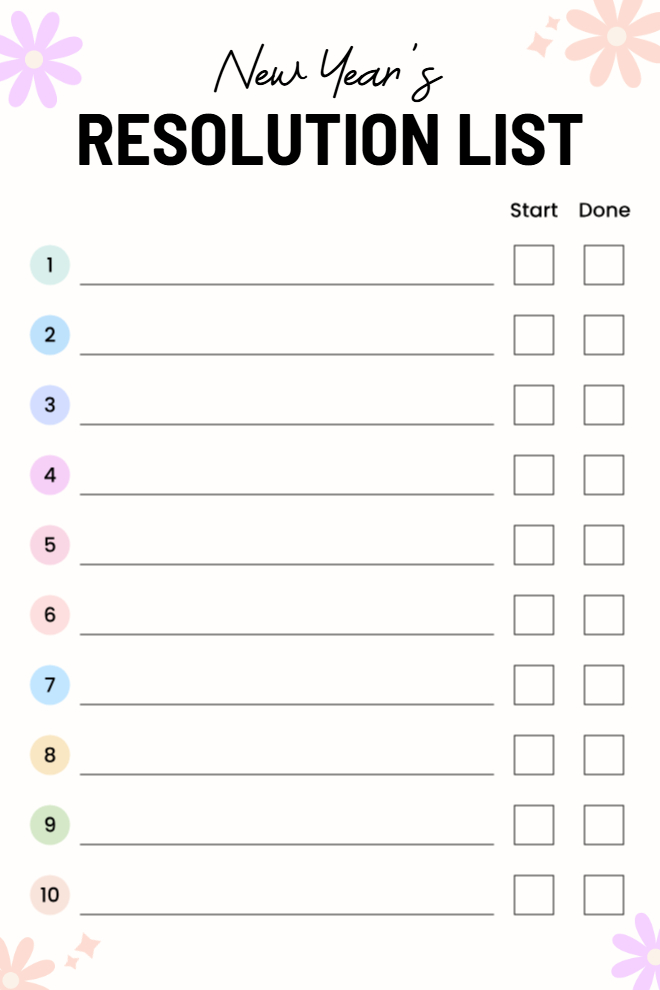
The next 12 months can be totally changed by clear goals in the new year, but resolutions usually disappear by February if you don’t have a tracking system. A New Year’s resolution list tracking planner is the way to keep your goals in writing, track progress, and maintain your account in 2026. This printable template has numbered goal slots and dual tracking columns, one to indicate when a resolution is started and the other to celebrate when it is completed.
Whatever be your reasons related to better health, professional success, financial achievements, relationship building, and/or self-improvement, this planner helps you achieve your desired goals. Download the Resolution Tracker from Planwiz, or design the editable template based on your own goal achievement pattern. As the template supports 10 resolutions and the start-done format, you would be well-equipped for a successful 2026.
What Is a New Year’s Resolution List Tracking Planner?
A New Year’s resolution list tracking planner is essentially a framework that serves the purpose of not only jotting down your resolutions but also systematizing and monitoring them. The 2026 template accommodates 10 resolutions and offers a double, tracking method wherein the “Start” and “Done” checkboxes indicate the engagement and the achievement stages respectively, thereby, facilitating the sustaining of the year’s progress more effortlessly.
Writing down goals increases an individual’s chances of achieving them by 42% as opposed to those who only retain them mentally. The list format applies to all kinds of goals: health-related accomplishments, professional success, financial targets, relationship building, and self-growth goals to suit one-off accomplishments such as “run a marathon” to regular activities including “workout 3 times a week.”
Why Does a New Year’s Resolution List Tracking Planner Work?
The Fresh Start Effect: Your Brain’s Clean Slate
New Year’s Day is not just another Monday your brain actually sees it in a different light. The “Fresh Start Effect” is the term used by psychologists for this phenomenon, whereby temporal landmarks such as January 1st separate one psychologically from one’s failures of the past. Such a reboot in the mind gives one the impression of being estranged from one’s old self, thereby causing a greater desire to effect change, e.g. following through with the New Year’s resolutions.
Written Goals Activate Your Brain’s Filter System
When you physically write goals on your New Year’s resolution list tracking planner, you activate the Reticular Activating System (RAS) in your brain. This neural network filters incoming information and decides what deserves your attention. Once your resolutions are written, your RAS starts noticing opportunities and resources related to those goals that you would have otherwise missed.
Dopamine Rewards Create Motivation Loops
Every time you check a box on your New Year’s resolution list tracking planner, your brain releases dopamine-the chemical that makes you feel good. This creates a reward loop that makes you want to check more boxes. The dual-checkbox system leverages this twice per goal, giving you dopamine hits when you start AND when you complete each resolution.
Social Accountability Leverages Loss Aversion
Sharing your New Year’s resolution list with friends or family is a way to use loss aversion people are twice as motivated to avoid losses as to gain rewards. When others are aware of your resolutions, failure seems like a loss of social credibility. This psychological pressure makes you go through with it even if the motivation is gone in February or March.
What Are the New Year’s Resolution List Examples by Category?
What Are Health & Wellness Resolutions?
- Exercise 4 times weekly for 45 minutes
- Walk 10,000 steps daily
- Sleep 7-8 hours nightly
- Meal prep every Sunday
- Run a 5K race by June
Track your wellness resolutions with a comprehensive health planner templates, use a meal planner to support your nutrition and meal prep resolutions, and stay consistent with fitness goals using an exercise planner.
What Are the Career & Professional Resolutions?
- Complete 2 industry certifications by June
- Read 12 business books this year
- Attend 1 networking event monthly
- Negotiate 15% salary increase
- Learn new software or technical skill
Professional goals require strategic planning-a business planner templates keeps career resolutions on track throughout the year.
What Are Financial Resolutions?
- Save $10,000 for emergency fund
- Pay off $5,000 credit card debt
- Invest 15% of income monthly
- Create and stick to monthly budget
- Track all expenses daily
A budget planner templates is essential for achieving financial resolutions and tracking spending consistently.
What Are Best Relationship & Social Resolutions?
- Schedule weekly date nights with partner
- Call parents or family twice weekly
- Make 3 new meaningful friendships
- Have device-free dinners 5 nights weekly
- Volunteer as a family once monthly
Coordinate family activities and quality time with a family planner templates to ensure relationship resolutions don’t get overlooked.
What Are Personal Growth Resolutions?
- Read 30 books throughout the year
- Learn Spanish to conversational level
- Journal 5 times weekly
- Volunteer 50 hours annually
- Meditate 15 minutes every morning
Journaling resolutions become easier with a structured daily journal templates that provides prompts and consistency.
What Are the Home & Lifestyle Resolutions?
- Declutter one room per month
- Create a morning routine and follow daily
- Reduce screen time to 2 hours daily
- Cook 5 new recipes each month
- Start a garden with 5 vegetables
💡 Pro Tip: Choose 1-2 resolutions from different categories for your New Year’s resolution list tracking planner to ensure balanced growth. Focus on 5-7 total resolutions for the highest success rate throughout 2026!
Frequently Asked Questions
A New Year’s Resolution List is basically a document where one is supposed to put down certain goals that have been aimed to be achieved in the upcoming year. It turns general desires like “be healthlier” into more concrete ones like “exercise thrice a week.”
Studies have found that those who put down their goals were 42% more successful in meeting those goals than those who thought of the goals in their minds alone. Writing down the list of resolutions for the New Year activates the brain in a manner that planning in the mind does not.
By creating a New Year’s resolution list, you can also avoid the unfortunate problem of remembering what you wanted to accomplish by the time February rolls around. Keeping your printed resolutions on your desk or wall reminds you daily of who you want to become in a given year.
Begin by making sure your New Year’s resolutions are specific and measurable, not general and open-ended. Instead of a resolution that is “get fit,” you could have “lose 15 pounds by June” or “take gym classes 3 times a week for 6 months.”
Use action-oriented language in which you say what you will do instead of what you will stop doing. When you write your list of resolutions in positive terms, you feel excitement about creating new habits rather than limitation.
It helps to divide overall resolutions with higher resolutions into smaller goals that you can easily accomplish on a monthly or quarterly basis using a tracking planner. This approach helps make annual resolutions seem less daunting.
Because most people find themselves most successful with the achievement of 3, 7 focused resolutions, the idea of a long list of 15, 20 resolutions is simply daunting and unrealistic regarding a New Year’s resolution. By focusing on fewer resolutions, each resolution gets the time, interest, and attention.
When you are new to goal-planning with the resolution list planner, it is better to opt for goal resolution listing between 3 and 5 resolutions in the first year. It is always better to have accomplished three significant resolutions than to have drafted a list of, say, ten resolutions and left them all unfinished by March in your tracking planners.
Think in terms of physical and mental health, work, relationships, finances, personal development, and hobbies. Simultaneous and balanced growth in a set of life sectors is a more effective way to maximize satisfaction than focusing on a single area.
It is important to check the list of resolutions periodically using the template for the weekly planner templates so that you will always have before you the goals you have established. Create an reminder for the same day and month each year to sit with the resolution tracking organizer.
And, in fact, the list of New Year’s resolutions needs to be kept in an environment where it would certainly be viewed on a day-to-day basis, such as the mirror place in the bathroom, the desk at the office, or the fridge in the kitchen. The greater the concentration of the brain on the written goals, the greater the probability of performing actions accordingly.
Your list of New Year’s resolutions can be shared with an accountability partner, which could be this friend, family member, or coworker that you can maintain contact with to make sure you are getting the accomplishment of this goal done. Having someone to hold you accountable goes a long way in helping you accomplish this.
Usually, among the lists written for the New Year’s resolutions, the top choices include or comprise the following: Those regarding overall health and fitness, as well as some combination of being healthier, exercising, or losing weight. Those addressing money, and saving, or budgeting.
“Relationship resolutions” are common in people’s lists of New Year’s resolutions, and examples include “spending more quality time with family,” “making new friends,” or “working on effective communication in relationships.” “Mental health resolutions” are becoming increasingly popular too, and some examples are ” managing stress,” “incorporating mindfulness,” or “creating a balance between work and personal life.”
While the above categories are the same every year, the best resolution tracking planner will include goals that mean something significant to you, and not to many others. This is because your New Year’s resolution list needs to reflect who you are, what your situation is, and what your dreams are.
Use the dual-checkbox system on your New Year’s resolution list planner by marking the “Start” box when you take your first action toward each goal. Check the “Done” box when you have fully achieved the resolution or have maintained a habit consistently for the target timeframe.
Create, along with your New Year’s resolution list, a month-to-month tracking system in which you grade progress toward each goal on some simple scale-for instance, 1 to 5 stars, or color-coding. A monthly schedule planner templates helps you systematically go through progress review and plan further steps for each resolution.
With this visually-oriented system, it will be pretty easy to notice which resolutions require the most attention during your monthly reviews.
Consider the use of habit tracking apps or spreadsheets to complement a printed New Year’s resolution list for those goals requiring daily or weekly actions. At the same time, always return to your original resolution tracking planner as your primary accountability tool, since physical documents build stronger commitment compared to digital records alone.
It is always advisable to start implementing your new year resolution list immediately after its creation if you are making your plans during the last month of the year, i.e., December. This is because people who start early tend to have higher success rates due to their momentum, while others are only beginning.
Having a new year’s resolution list midway through each year, you should immediately begin the pursuit of such goals without the need to wait for the onset of the new year every January. The most appropriate time to begin the achievement of great goals has always been today, and no matter what the dates are, this always holds true.
For resolutions such as training for a marathon or learning the new language, you can use the December month to prepare the systems on the resolution tracking planner. This is crucial because the more you prepare, the better the chances of placing a checkmark in the ‘Start’ box on the new year’s resolutions.
Starting by listing all possible goals based on various aspects of a person’s life will make it simpler to finalize the kind of New Year’s resolutions one needs to make. Take 20-30 minutes to list all that one wishes to achieve when it comes to one’s health, career, relationship, finance, personal development, and hobbies.
Then, assess your list of ideas and determine which 5 to 7 objectives will make the most significant difference to your life when it comes to your list of resolutions. It is better to make resolutions that relate to your values rather than those that will make an impression on society.
Now you can fill in your personal final choices using specific and measurable language with either a deadline or frequency indicator on your resolution list planner. Then, you can include your two-checkbox tracking mechanism side by side for each resolution to record both the start and completion of each goal throughout the coming year.
One, begin by looking at a personal list of resolutions for the new year and try to determine, in a non-judgmental standpoint, why certain items are not being accomplished.
Struggling resolutions on your list of new year’s resolutions should instead be modified to make them more doable rather than being completely discontinued. “Getting better is better than being perfect.” – Picasso Progressing with a modified resolution is better than being perfect at an unfulfilled resolution.
Remember that the use of the New Year’s resolution list is for growth, and it should not become a measure by which you judge the value of the person you are. It is not the progress you make, because you could make progress without the use of the planners, nor is it how you achieve progress, because that is something that relies on your personality type.
Absolutely, you should definitely be changing up your list of resolutions for the coming year whenever and wherever your priorities, circumstances, or values change. Your resolution tracking planners should be working for you, not hindering you with what may be outdated resolutions for your life now.
When you add or revise resolutions on the New Year’s resolution list, you should do it with another-colored pen or leave a note with the date so that you record the changes, so it does not look like you are failing at the original resolutions you previously established.
Ask yourself honestly if you are changing your lists of New Year’s resolutions because conditions have really changed or because you are just sidestepping problems. Keeping flexibility and honesty with your resolution-tracking journal means that you are really developing as opposed to really just rationalizing.
Take at least a monthly review of your New Year’s resolutions to keep you focused and on track throughout the year. Set aside a specific day each month, perhaps the first Sunday of the month or the 15th, and keep this appointment as inviolable as possible.
Some people find it helpful to review their list of New Year’s resolutions on a weekly basis, especially if it involves making new habits, while for other people, it may be more helpful to review it on a monthly basis, especially if it involves issues related to their career and finance, which do not require them to review their progress on a daily basis.
“The secret to an effective list review for the New Year’s resolutions is in the combination of objective evaluation with compassionate modification.” Regular list reviews will change the “resolution list planner from a forgotten document of January into a living document that will direct the rest of the year.”