Believe it or not, the summer of 2026 is rapidly approaching, and if so, like every parent, you are probably also struggling with the question of what to do with the kids without them complaining too much about the fact that they are bored. The key is not to cram every day with pricey activities.
The secret is to have a plan. A summer planner will allow a parent the flexibility to plan for their child’s activities and relaxing time, as well as the parental activities, in a balanced, non-obligatory manner. This is a simple way to have a fantastic summer without it becoming a full-time job.
This toolkit has all you need to organize your summer, including free templates, tips, and tricks to balance organizing and having fun. This toolkit will benefit all individuals who are tasked with coordinating kids’ activities, homework, and family outings. The templates and tips provided in this toolkit will organize and enhance your fun-filled summer.
Let’s create your ultimate summer planner!
What Is a Summer Planner?
The summer planner acts as a flexible tool for organizing, allowing every family to seek, or rather achieve, the balance of activities and freedom within the summer period of the school calendar when there are school breaks. Of course, it is not composed of rigid schedules, but rather of instructions which ensure the children are never bored, but at the same time maintain the fun and freedom associated with the vacation mood of the summer season.
Trip planner templates can also be especially useful for organizing family vacations and weekend getaways during the summer months.
Key Components:
- Monthly overview calendars: June, July, August
- Weekly planning pages
- Daily routine templates
- Bucket list trackers
- Activity idea banks
- Activity banks, Budget tracking sheets
The idea here isn’t to schedule every waking moment, but rather to provide a structure in which the parents aren’t always trying to come up with new ideas, and the children know what’s coming at them. Family planner templates can serve as the foundation for your summer planning, helping you coordinate schedules, activities, and budgets across multiple family members.
How Do I Plan a Perfect Summer for Kids?
In planning a great summer, one has to look at things realistically. Here is how to do it:
Step 1: Have a Family Planning Meeting
Everyone receives a call before the summer, and then each person in the family has several things they would like to get accomplished that range from 3 to 5 things, and it all gets documented, no matter how big or small the list may be. This helps keep the children excited about what’s happening rather than resisting it.
WHAT TO DISCUSS:
- What do the members in the class have planned for next summer?
- What matters in life that relates to us: spending time with family members, acquiring education, and saving.
- What commitments have we already made?
- What’s our budget for summer stuff?
Budget planner templates can help you track summer expenses and ensure you’re allocating funds wisely across activities, camps, trips, and spontaneous adventures
These travel planner templates assist you in planning your journey in a proper and organized way so that nothing is left behind that is of importance. Starting right from the destinations that you need to visit and the dates of your journey to the lists of things you need to pack and activities to be performed, everything is documented in one place. This is how you can enjoy your journey stress-free.
Step 2: Figure Out What’s Already Locked In
Firstly, highlight all your non-negotiables: camps, vacations, appointments, visits. This will give you an idea of the amount of free time that you have.
| Month | What to Mark |
|---|---|
| June | Summer camps and activities in the first week of summer vacation and completion of the school year |
| July | Family vacations, Family reunions, Holidays |
| August | Preparation to return to school, Final summer camps, and vacations |
Pro tip: Color-code stuff so you can actually see your summer at a glance. Blue for camps, green for vacation, yellow for appointments, whatever system makes sense to you. Way easier than having to read every single thing on your calendar to figure out “wait, what’s happening this week?”
Step 3: Map Out Your Typical Week
Instead of planning every detail each week, there should be a framework. It doesn’t have to be that every Monday looks the same, but themes are helpful.
| Day | Theme | Example Activities |
|---|---|---|
| Monday | Slow Start | Library visits, home crafts, backyard play |
| Tuesday | Adventure Day | Museums, new parks, beach trips |
| Wednesday | Water Day | Pool, splash pad, backyard water activities |
| Thursday | Friend Day | Playdates, park meetups, neighborhood games |
| Friday | Family Fun | Game night, movie night, special dinner |
| Weekend | Mixed | Balance planned outings with free time |
Remember, this rhythm sets the tone for your days, yet doesn’t make everything rigid. When Wednesday comes, and nobody wants to have a pool day, just trade it for Thursday. Being flexible helps.
The weekly schedule maker lets you establish these themes while leaving room for adjustments based on weather, mood, and spontaneous opportunities.
Step 4: Build Your Activity Bank
Well before summer even kicks in, it is very helpful to prepare a list of things to do so that when children suddenly cry, “I’m bored,” you’re not left scratching your head, wondering what to do. Having a list of activities, both indoor and outdoor, five-minute and bigger projects for lazy days, and logging it in a convenient location, such as the fridge, your calendar, or your cellular device, will ensure your children can pick and choose their activities but will still ensure that things stay on track with your Host Families.
What Should I Include in My Summer Bucket List?
Your summer bucket list should be based on what excites you, what relaxes you, and what will help you maximize your summer without feeling overwhelmed,” Taylor told Bride & Blossom. “It’s not about doing all of it, it’s about picking what will make your list full of fun, full of meaning, and full of easy things that you will genuinely enjoy.
The Complete Bucket List Framework
A well-rounded summer bucket list will include a mix of activities that encompass both the thrill of adventure and the satisfaction of learning and relaxing. You will find that a mix of the fun and easy activities will provide the optimal summer experience that eliminates stress and maximizes the fun that’s had every summer day.
| Physical Activities (20%) | Social Experiences (20%) | Creative Projects (15%) | Learning Adventures (15%) | Big Adventures (15%) | Simple Pleasures (15%) |
|---|---|---|---|---|---|
| Swimming at different locations | Playdates with friends | Arts and crafts | Museum visits | Beach trips | Catching fireflies |
| Hiking new trails | Family game nights | Baking/cooking challenges | Library programs | Amusement parks | Making s’mores |
| Learning a new sport | Neighborhood block party | Building projects | Science experiments | Road trips | Watching sunsets |
| Backyard camping | Sleepovers | Photography adventure | Historical site tours | Camping overnight | Ice cream dates |
| Bike rides on new paths | Group outings to parks | Writing stories | Reading challenges | Water parks | Movie marathons |
| Water balloon fights | Picnics with extended family | Music or dance | Nature identification | Special events/concerts | Sleeping in a tent |
Budget-Friendly Bucket List Ideas
Preparing a bucket full of activities to be enjoyed during the summer vacation does not necessarily require going over budget. You do not necessarily require a huge budget to design a meaningful experience with your family. It’s all about combining some free activities with some low-budget activities.
| 100% Free | Under $20 |
|---|---|
| Stargazing nights | Matinee movies |
| Nature scavenger hunts | Mini golf |
| Free museum days | Bowling (with specials) |
| Library story times | Arcade with budget |
| Community pool | Ice cream shop visits |
| Backyard campouts | Arcade with a budget |
| Sunrise watching | Thrift store treasure hunts |
| Park picnics | Used book sales |
| Sidewalk chalk art | Craft supplies |
| Free outdoor concerts | Fast food picnic |
How Do I Keep Kids Learning During Summer Break?
Summer learning loss is real, but learning doesn’t require worksheets or formal lessons.
Stealth Learning Strategies
Reading:
- Join library summer reading programs (most offer prizes)
- Read in fun locations (treehouse, hammock, tent)
- Audiobooks during car rides count
- Comic books and graphic novels are legitimate reading
- Set family reading time (everyone reads together)
Math:
| Daily Activity | Math Skills Practiced |
|---|---|
| Cooking together | Fractions, measurements, timing, temperature |
| Shopping | Money, budgeting, percentages, unit pricing |
| Building projects | Geometry, measurement, spatial reasoning |
| Board games | Strategy, counting, probability, logic |
| Gardening | Measurement, patterns, data tracking |
| Allowance management | Addition, subtraction, saving, percentages |
Writing:
- Summer journals with drawings
- Letters or emails to relatives
- Vacation postcards
- Comic book creation
- Blog or video scripts
- Bucket list documentation
The study schedule maker can help structure these learning activities throughout the week without making summer feel like extended school.
Science:
- Backyard experiments (volcanoes, slime, crystals)
- Nature observation journals
- Cooking (chemistry)
- Gardening (life cycles, botany)
- Weather tracking
- Bug collecting and identification
Educational Screen Time
If using screens (30-45 minutes daily max), choose quality apps:
- Khan Academy Kids (ages 2-8) – comprehensive learning
- Prodigy Math (grades 1-8) – adaptive math practice
- Duolingo – language learning gamified
- PBS Kids – educational games and videos
- BrainPOP – animated educational videos
- Scratch – coding and programming for kids
What Are the Best Summer Planner Templates?
Summer planner templates can also assist you in making your day more optimized, especially when you are more flexible. Whatever your commitment level or goals are, summer is always packed with interesting activities that you can do, ranging from going places to taking care of yourself, but being organized will always work wonders for you.
You can design a summer planner that will allow you to become more organized without making you feel like you are going under. Summer planner templates are organized, functional, flexible, and will always allow you to become more productive while also relaxing. Below are different summer planner templates that you can utilize to serve your needs.
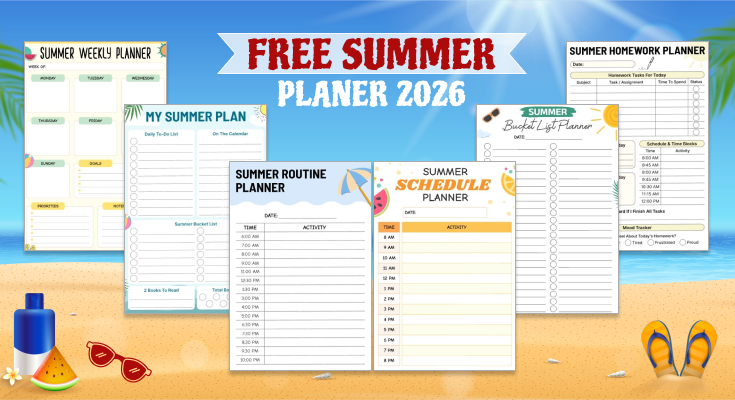
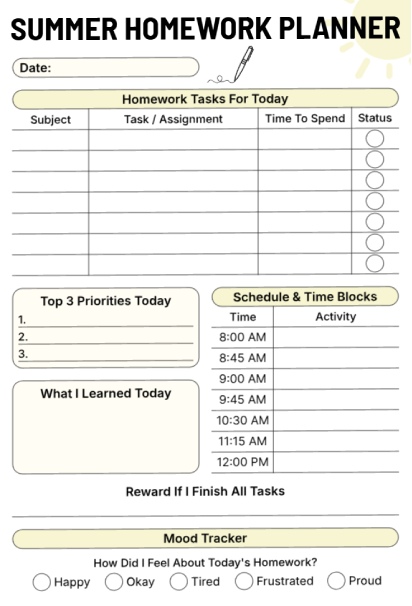
Template 1: Summer Homework Task Management Planner
Use this planner for organizing homework during the summer and reducing stress. Organize homework in such a manner that it is understandable for kids. Kids can identify their homework based on the subjects and the estimated time it requires to complete it. It also has a column where they have to identify their three most crucial tasks and allocate their day in terms of time. “What I Learned Today” will further help kids understand the concepts they’ve acquired today. It also includes an area for identifying their mood and analyzing their feelings towards homework. Kids also have to mention their reward after the completion of all tasks.
Best For: People looking to manage both summer homework and enjoyable activities in their lives, parents helping their kids stay on top of their homework assignments for school, or just general individuals seeking a way to properly implement the spirit of the summertime.
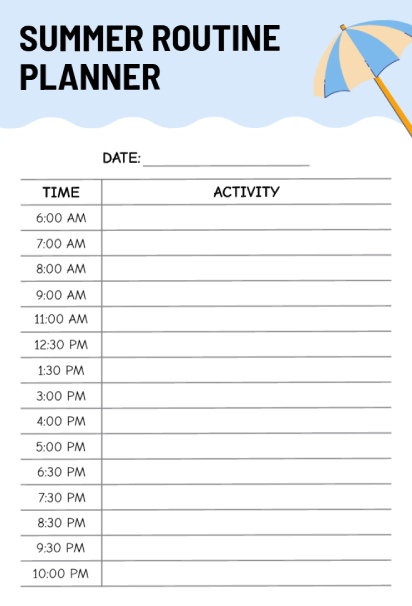
Template 2: Daily Summer Routine Scheduling Planner
Now, when you simply want a planner where you can organize your whole life, this one does exactly that. It covers your whole day, right from morning till sleeping time, with hourly spaces where you can note down whatever you are doing at that hour. Then, with this simple design of a beach umbrella, there’s no way you’ll get bored with this planner.
Best for: Someone making a daily schedule for the summer, a parent making a schedule for their kids’ activities, or a planner addict like myself who just wants a clean design without the extra bells and whistles.
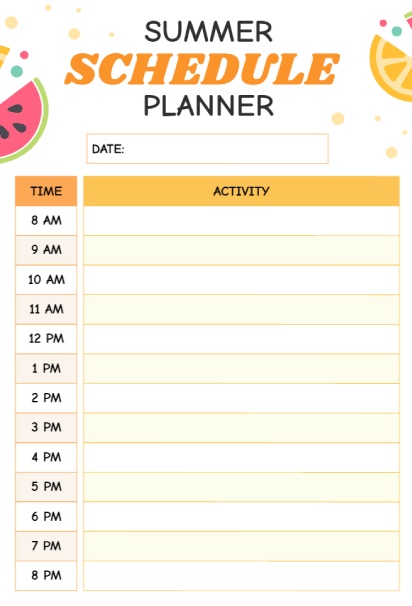
Template 3: Daily Summer Activities Schedule Planner
This bright and cheerful planner goes from morning to evening, with hourly slots for your activities. Fun watermelon and orange slice graphics give it that perfect summer energy. Simple and colorful, hence it is very easy to overview the whole day. A warm yellow background will allow even the planning of responsibilities to stay sunny.
Best for: Visual planners that love colorful designs, teens preparing for summer employment or activities, or anyone looking for a fun way to organize their schedule, similar to how summer should be.
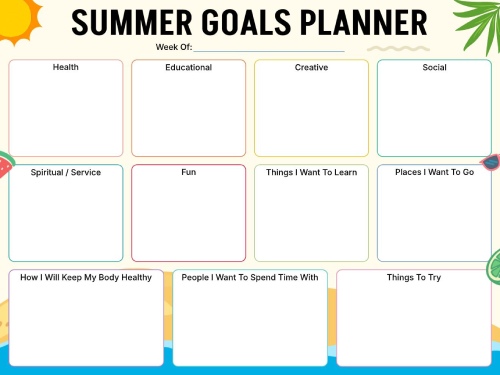
Template 4: Summer Personal Development Goals Planner
This one also has a well-rounded way of organizing your goals in the summer by listing them in terms of areas of your life. You have space here to list goals in areas like health, educational activities, creative pursuits, and social engagements, along with areas related to spirituality or serving others, fun activities, learning goals, and travel destinations. The bottom portion also has space to list plans on how and whom you’d like to spend time with, and things that you’ve always wanted to try but never have.
Best for: Goal-setters who are planning the summer of their dreams, or those engaged with personal development, families who are planning activities for the summer with their kids, or students on summer break who are looking for more than just leisure.
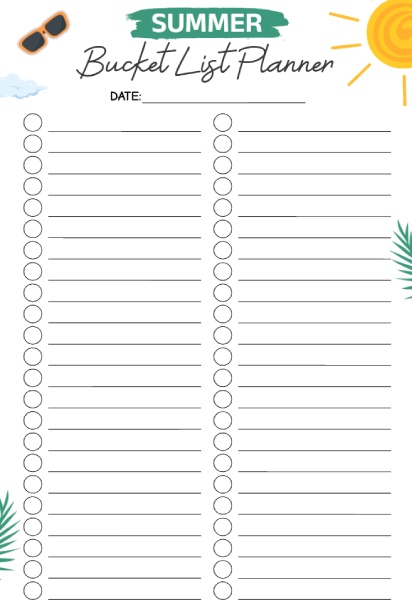
Template 5: Summer Bucket List Adventure Planner
This is the classic bucket list design that comes with two columns of checkboxes and a whole lot of leeway to dream big. You can create a list of all the things that you have been wanting to do when the weather permits. Whether you want to try out a new restaurant, visit the beach, learn something new, or organize your closet, you will have enough space to list all these things here. The designs that are filled with elements of summer, the sunglasses, and palm trees, give a rather casual and enjoyable feel.
Best for: Individuals making a summer to-do list, families planning fun things to do, families, friends, or anyone who finds satisfaction in crossing off completed goals.
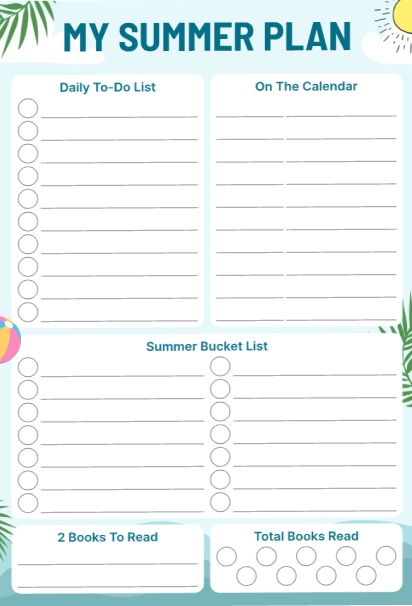
Template 6: Organized Summer Activities and Reading Planner
This all-in-one planner hits the important stuff without overwhelming you. You’ve got your daily to-do list on one side and calendar reminders on the other. Below that is a two-column bucket list for all your summer dreams. The reading tracker at the bottom is great motivation to pick up two books, and you can mark off how many you actually finish. It’s compact but covers what most people need for summer planning.
Best For: Busy people who want everything on one page, readers tracking their summer reading goals, or anyone juggling daily tasks with longer-term plans.
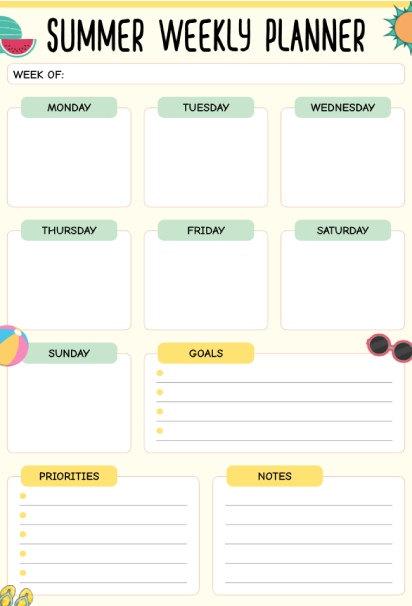
Template 7: Summer Activities Weekly Organizer Planner
This planner enables you to actually plan for the whole week because it has a box for each day of the week, from Sunday to Saturday. Moreover, you can prioritize your week before it happens because your goals for the completion of the week shall be stated in the Goals section, and the Priorities section shall contain other essential details you must keep in mind, as well as other notes you have in the Notes section. The theme is not quite overwhelming because it provides you with some flavor.
Best for: Someone using a weekly planner for perspective on “the bigger picture,” those having trouble balancing work and leisure activities, or family planners, or anyone feeling cramped using a “daily planner.”
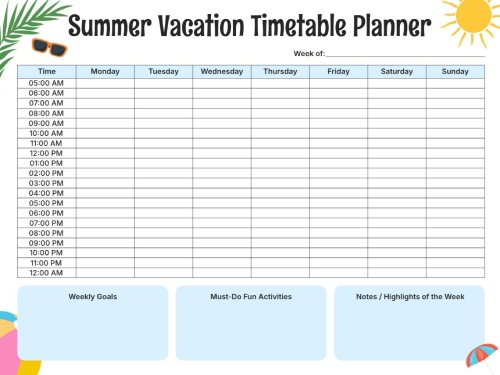
Template 8: Summer Vacation Timetable Planner
In case you want a whole week and don’t want a minute left unaccounted for, then you have got the right planner in front of you. Your planner allows you to see how a whole week looks, starting from Monday through Sunday, with timeslots starting from early morning until late into the night. Your planner will go through morning, evening, and night sessions with an allocated hour shown per slot until midnight.
Best for: People who like to see a detailed planner for their vacations, families planning group vacations, event planners, or anyone interested in having each aspect of their week planned out.
Template 9: Weekly My Summer Session and Goals Planner
This planner works great for a week-long session or camp-style planning. The weekly overview table lets you assign plans or to-dos to each day. Below that, you can list your top summer goals and ideas for fun or self-care. There’s also space for tasks you need to focus on and a notes section for reminders or random thoughts. The butterflies and summer graphics keep it feeling light and seasonal.
Best For: Summer camp organizers, teachers planning summer programs, students in summer sessions, or anyone dividing their summer into weekly focuses with specific goals.

Frequently Asked Questions
Children can start working with visual planners with pictures from the age of 3 to 4 years old. At age 6-7 years, they can work with basic checkbox planners. Ages 9-10: Children in this age group are capable enough to handle planners on their own but still need assistance from parents. Most children, aged 12+: Children can work with planning systems on their own, which will include homework planners, goal achievement planners, and schedule planners, etc.
Use weekly planners for juggling individual and family activities. Plan one-on-one sessions for each child, doing things that interest them most in life. Develop activities for all of them that they enjoy doing. Let the bigger kids take up entertaining the little ones while doing these activities for them. Make use of “everyone gets a turn,” and each of them gets to select one thing per week. This allows individual planning and does not allow their interests to take up their whole summer.
Give them ownership in managing their schedule. Use planning templates more like guidelines, not rules. Balance of work or volunteering, time with friends and family, as well as personal projects or goals, should always be the focus. Be flexible: manage the need to be independent but connected as a family. Discuss screen time management, not restriction. Engage them in meal planning.
Use picture trackers hung up in communal areas (kitchen, family room). Check off as they are completed. Take pictures of all activities and make photo boards or albums. Go over the list together weekly at family meetings. Reward completion with simple rewards and/or traditions. Don’t worry if it all gets finished. Sometimes it sparks inspiration rather than creating a to-do list. Some years it is 80% met, and some years maybe 40%, and still a successful summer.
A bucket list focuses on experiences and adventures you want to have (trying new foods, visiting specific places, learning skills). A to-do list covers tasks and responsibilities that must be completed (chores, homework, appointments). Bucket lists create excitement and memories, while to-do lists maintain daily functioning. Both are important for balanced summer planning.
Yes! Choose templates with blank date fields that you can fill in each year. Monthly calendars without pre-printed dates work year after year. Bucket list templates can be refreshed annually with new goals while keeping favorite traditions. Digital planners are easily edited and reused. Laminated templates with dry-erase markers offer unlimited reusability.
Conclusion: Make Summer 2026 Your Most Organized Yet
Planning out your summer doesn’t necessarily need to turn out stressful. There are planner templates and a flexible approach to meeting a mix of planning and spontaneity.
Key things to remember:
- Follow the 50-30-20 rule (50% free time, 30% structured activities, 20% productive time)
- Plan visually post-schedules where everyone can see them
- Engage relatives in planning for improved participation
- Be flexible, plans inevitably will shift, and it will be okay
Start now by downloading templates that match your needs with the Planwiz. Whether organizing kids’ activities, tracking homework, or planning adventures, these tools help you stay organized without losing the summer fun.
Summer 2026 is a one-time proposition. Get it down on your to-do list: create the space for fun. Print out your templates, gather your family, and then put your summer plans on the page! “The planning for your fun summer starts today.”
Your summer planning journey starts today – make it amazing!