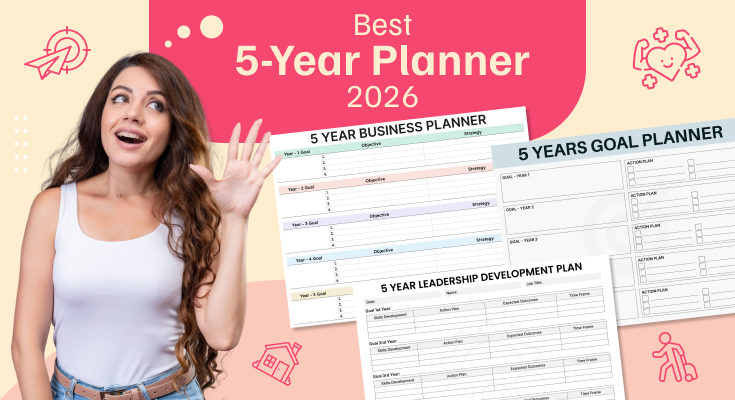
Where were you five years ago? What were you doing? Well, now picture yourself five years from now. Are you able to envision it easily, or is your future cloudy?
A majority of people live their lives in response to the things that come their way. But when it comes to accomplishing their greatest dream, the people who do so must have a plan, an idea that isn’t random but strategic, turning a mere wish into reality. This is what a 5-year planner does, and we will give you a guide on how you can do this as well.
What Is a 5-Year Planner and Why Does It Matter?
A 5-year planner serves as your strategic roadmap, mapping out the personal and professional goals you aim to achieve over the next five years. It breaks down big dreams into manageable steps with specific timelines and measurements, making the impossible feel achievable.
Why 5 years is the perfect timeframe:
| Benefit | Why It Works |
|---|---|
| Long enough for transformation | You can launch a business, switch careers, pay off significant debt, or completely transform your health |
| Short enough to create urgency | You can’t procrastinate; the clock starts today |
| Perfect for compound growth | Small daily actions multiply into massive results over 60 months |
| Balances ambition and reality | Stretch goals become achievable with proper strategic planning |
Research consistently shows that people who write down specific goals are 42% more likely to achieve them than those who just “keep things in mind.” Your 5 year planner transforms abstract dreams into actionable commitments. Goal planner templates provide the structure needed to document these ambitions and track progress systematically over the long term.
Why Do You Really Need a 5-Year Planner?
It is not only organizing that you will be getting; in fact, this 5-year planner will revolutionize your future by changing your approach in many ways. Here is what will happen if you choose planning:
Psychological and Practical Advantages:
- Clarity begets confusion: Your plan screens all of your decision alternatives. Am I moving closer or moving away from each of my decisions?
- Motivation becomes sustainable: The future vision plays a role in providing the fuel necessary to sustain the individual beyond the early stage of excitement.
- Allocation of resources is improved: You start spending your time and money properly.
- Accountability comes to life: Paper goals become tangible expectations that you can monitor.
- Becomes real: Goals on paper transform into commitments you can track and measure
- Stress decreases significantly: Knowing your direction reduces anxiety about the unknown.
- Confidence grows steadily: Each small win proves you’re capable of achieving bigger goals.
It has also been documented that people who know exactly what they are doing for the next five years are more in control of their lives, less worried about the future, and experience higher levels of satisfaction in different aspects of life.
Yearly planner templates complement your 5-year vision by breaking down annual milestones, making it easier to track progress and adjust strategies as each year unfolds.
What Should a 5-Year Planner Include?
A comprehensive 5-year planner addresses multiple life dimensions because success in one area often depends on progress in others. Here are the eight core areas your plan should cover:
| Life Area | Key Questions to Address | Sample Goals |
|---|---|---|
| Career & Professional Growth | What position do you want? What skills must you master? What kind of work environment energizes you? | “Become marketing director managing a team of 5+” or “Launch profitable consulting business.” |
| Financial Health | What’s your income target? How much should you save? What debt needs elimination? | “Build a $50,000 emergency fund” or “Achieve $120,000 annual income.” |
| Physical Health | What does optimal health look like? What fitness milestones matter? What habits need changing? | “Run a half-marathon in under 2 hours” or “Reach and maintain a healthy BMI.” |
| Mental Wellbeing | How will you manage stress? What self-care practices matter? How will you build resilience? | “Establish daily meditation practice” or “Complete therapy program for anxiety.” |
| Relationships | Who do you want in your life? What connections need strengthening? How will you build community? | “Build a network of 50+ industry professionals” or “Dedicate 2 hours weekly to family time.” |
| Personal Development | What skills excite you? What education will you pursue? What hobbies will you master? | “Achieve Spanish fluency” or “Complete MBA program.” |
| Living Environment | Where do you want to live? What’s your ideal home? How will your space support your goals? | “Purchase first home in target neighborhood” or “Create inspiring home office setup.” |
| Contribution & Service | How will you give back? Who will you mentor? What impact will you make? | “Mentor 5 junior professionals annually” or “Volunteer 10 hours monthly” |
Trying to change your entire life simultaneously leads to overwhelm and failure. Self-care planner templates support your mental well-being journey by establishing consistent routines for stress management and personal renewal.
Important reminder: Don’t try to revolutionize everything at once. Focus on 3-5 major goals maximum across these areas. Budget planner templates help you allocate financial resources strategically across different life goals, ensuring your money works toward your priorities.
How Do You Actually Create a 5-Year Planner That Works?
Creating an effective 5-year planner requires more than just wishful thinking. Follow this proven step-by-step process:
Step 1: Dream Without Limits (30-60 minutes)
Start by visualizing your ideal life five years from now without censoring yourself. This isn’t about what’s “realistic,” it’s about discovering what you genuinely want.
Daily journal templates provide the perfect space for capturing these unfiltered thoughts and recurring themes that emerge during your visualization exercise.
Visualization exercise:
- Close your eyes and imagine a typical day five years from now
- Where do you wake up? What’s your morning routine?
- What work are you doing? Who’s with you?
- How do you feel physically, emotionally, and mentally?
- What does your environment look like?
Put everything down without judgment. The critical voice within you saying “that’s impossible” needs to be silenced. Pay attention to repeating themes, which represent your true desires.
Step 2: Assess Your Current Reality (20-30 minutes)
Now bring yourself back to today with brutal honesty about where you currently stand. Notes planner templates help you document this honest self-assessment, creating a baseline reference point that you can revisit to measure how far you’ve progressed.
Self-assessment questions:
- What are my existing strengths, skills, and knowledge?
- What resources (time, money, connections) do I currently have?
- What gaps exist between where I am and where I want to be?
- What habits or fears might sabotage my progress?
- What past experiences have prepared me for this journey?
- Who in my network can help me achieve these goals?
This reality check identifies the specific bridges you need to build between today and your five-year vision.
Step 3: Set SMART Goals for Priority Areas
Transform big dreams into concrete targets using the SMART framework. Here’s how vague wishes become actionable goals:
| SMART Element | Vague Goal | SMART Goal |
|---|---|---|
| Specific | “Get in better shape.” | “Complete a half-marathon in under 2 hours.” |
| Measurable | “Save more money.” | “Build a $30,000 emergency fund by December 2029.” |
| Achievable | “Become a millionaire next year.” | “Increase income by 20% annually through promotions and skills development.” |
| Relevant | Random impressive-sounding goal | A goal that genuinely aligns with your core values and vision |
| Time-bound | “Someday I’ll learn Spanish.” | “Achieve B2 Spanish fluency by July 2027.” |
Pro tip: For each major goal, write down WHY it matters to you. Goals connected to deep values have much higher success rates than goals chosen because they sound impressive.
Step 4: Break It Down Into Annual Milestones
Five years feels distant, so break your vision into yearly checkpoints. Each year should build logically on the previous one.
Example: Marketing Professional → Marketing Director
| Year | Key Milestone | Supporting Actions |
|---|---|---|
| Year 1 | Lead first major project | Complete a digital marketing certification, and identify a mentor |
| Year 2 | Promotion to senior specialist | Build industry network, speak at 2 conferences |
| Year 3 | Transition to the manager role | Complete leadership training, and manage a small project team |
| Year 4 | Expand team management | Lead team of 3-5 people, develop strategic skills |
| Year 5 | Achieve a director position | Manage multiple projects, establish thought leadership |
Step 5: Create Quarterly Action Plans
Annual milestones are crucial, but quarters (90-day periods) are where real progress happens. Break each year into four focused sprints. Quarterly planner templates transform your yearly objectives into manageable 90-day action cycles, creating regular checkpoints that maintain momentum and allow for strategic adjustments.
Q1 2026 Sample Actions:
- ✅ Complete online data analytics course (January)
- ✅ Attend 3 industry networking events (January-March)
- ✅ Publish 2 LinkedIn thought leadership articles (February-March)
- ✅ Have coffee meetings with 5 professionals in target roles (ongoing)
- ✅ Read 3 books on marketing leadership (one per month)
Quarterly planning keeps you accountable without overwhelming you. It’s short enough to maintain focus but long enough to see meaningful progress.
Step 6: Build in Regular Reviews and Flexibility
Your 5 year planner should be a living document, not a rigid contract. Schedule these review sessions:
| Review Type | Frequency | Purpose |
|---|---|---|
| Weekly Check-in | Every Monday morning | Review last week’s progress, plan next week’s priorities |
| Monthly Review | Last Friday of the month | Assess current quarter goals, make micro-adjustments |
| Quarterly Deep Dive | End of each quarter | Major progress analysis, celebrate wins, course-correct strategy |
| Annual Revision | Every January | Comprehensive plan update based on lessons learned and new opportunities |
Critical insight: Studies show that people who review their goals weekly are 3x more likely to achieve them than those who set goals but don’t track progress regularly. Weekly planner templates provide the structure for consistent check-ins, helping you maintain awareness of your long-term trajectory while managing day-to-day responsibilities.
How Do Real People Use 5-Year Plans Successfully?
Sometimes the best way to understand planning is seeing it in action. Here are three different approaches for different life situations:
Example 1: The Career Accelerator
Sarah’s Starting Point:
Entry-level graphic designer at small agency, $42,000 salary, 18 months of experience, feels stuck in repetitive work.
Her 5-Year Vision:
Creative Director at mid-size tech company, $95,000+ salary, leading team of 5-7 designers, working on innovative projects
Year-by-Year Roadmap:
- Year 1: Skill Foundation
- Master Adobe Creative Suite and Figma completely
- Complete a UX/UI design certification online
- Build a portfolio with 3 passion projects outside work
- Target: $48K salary after annual review
- Year 2: Strategic Positioning
- Move to a larger agency for broader experience
- Lead design for 5+ client projects
- Start a personal design blog showcasing the process
- Target: $58K salary
- Year 3: Leadership Entry
- Transition to Senior Designer role
- Begin mentoring junior designers
- Speak at 2 design conferences
- Target: $70K salary
- Year 4: Team Management
- Move to the Design Manager position
- Manage a team of 2-3 designers
- Complete leadership training program
- Target: $82K salary
- Year 5: Goal Achievement
- Secure Creative Director role at tech company
- Lead larger team (5-7 designers)
- Establish industry thought leadership
- Target: $95K+ salary
Key Success Factor: Sarah identified someone already in her dream role and interviewed them quarterly to learn from their career path.
Example 2: The Life Transformer
Marcus’s Starting Point:
Accountant feeling burned out, $78,000 salary, poor health habits (overweight, sedentary), limited social connections, considering career change
His 5-Year Vision:
Working in nonprofit financial management, a healthy lifestyle (regular exercise, good nutrition), strong community ties, and financial stability are maintained
Balanced Transformation Plan:
| Year | Career Evolution | Health Progress | Financial Status | Social/Community |
|---|---|---|---|---|
| 1 | Volunteer 5hrs/month at local nonprofits | Join a gym, work with a trainer, lose 15 lbs | Pay off $12K credit card debt | Join a community running group |
| 2 | Get a nonprofit management certificate | Run first 10K race, consistent gym routine | Build $10K emergency fund | Volunteer lead for charity marathon |
| 3 | Transition to part-time corporate (30hrs) + part-time nonprofit work | Maintain a healthy weight, train for a half-marathon | Add $5K to the emergency fund | Join a nonprofit board, expand friend circle |
| 4 | Secure a full-time nonprofit financial manager role | Complete a half-marathon, establish lifelong habits | Maintain emergency fund, start retirement contributions | Mentor young professionals in the community |
| 5 | Thrive in meaningful nonprofit work | Peak physical health and wellness | Financially stable, growing retirement account | Strong community ties and rich social life |
Key Success Factor: Marcus didn’t try to change everything at once. Year 1 focused heavily on financial health and initial wellness. Each year is built on the previous foundation.
What Tools and Templates Make Planning Easier?
With the right planner templates, goal setting for the long term can be easy. Organized templates can help accomplish large five-year goals by breaking down goals into smaller segments. These templates ensure that your goals are aligned because they organize your thoughts and make it simpler to plan. There is less room for confusion regarding goals because everything is structured. It is simpler to measure progress.
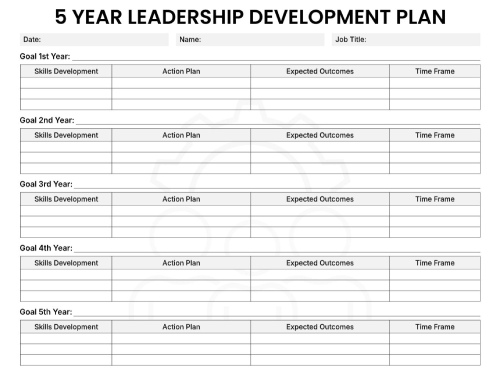
Template 1: Five-Year Leadership Skills Development Planner
This professional development planner provides current and future leaders with the opportunity to organize their growth over a period of five years. The top part of the form requires indicating the candidate’s name, job title, and date for personalizing the plan. Consequently, each year requires the identification of specific skills one would wish to develop, creating an action plan in building those skills, writing down expected outcomes for the same, and setting a timeframe wherein such must be completed. You will find it visually easy on the table format with four columns, enabling you to see your progress from year one through year five. It helps you keep on track with your ambition of being an even better leader instead of just hoping that this may well come naturally. You will be able to monitor technical skills and soft skills such as communication, decision-making ability, and strategic thinking.
Best For: Managers, team leads, and professionals aspiring for leadership roles who seek a multiyear structured road map to drive competency development in leadership and career advancement.
Template 2: Strategic Career Mapping for Five-Year Planner
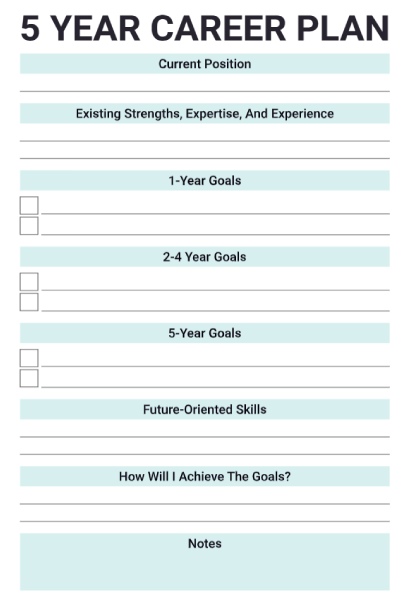
The simple career development template helps you build your way from your present career to your desired one. It begins by having you write down your present career and your present skills, expertise, and experience in order to determine what you are working with. The template follows by sectioning your aims into three different time periods: your goals in one to two years, checked-off goals; your goals in two to four years; and your goals in five years. Following that, you list the skills that are looking toward the future that you need to develop to achieve your goals. The “how will I achieve the goals” section is what makes this template work, as it helps you identify what you need to achieve your goals in terms of education, networking, certification, and experience.
Best For: Professionals at any career stage who want clarity about their career direction and need to identify skill gaps between where they are now and where they want to be.
Template 3: Comprehensive Five-Year Life Goals Planner
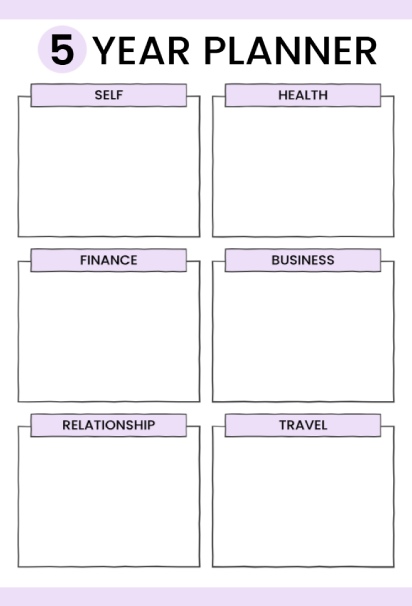
This comprehensive life planner will break down your five-year vision into six key areas of life, using boxes of equal size. The purple-bound template consists of sections that would be used for self, health, finance, business, relationship, as well as travel, all of which have boxes of equal size, providing you with ample space to jot down your goals, dreams, and objectives concerning a particular area of life for you. This life planner not only reveals why you need to be successful to be satisfied as a person, but also helps you to live a balanced life by focusing on all these aspects.
Best For: Those individuals who look for a well-rounded approach when planning their life without targeting only the career or financial objectives without considering the implications on their healthcare, social life, or personal satisfaction.
Template 4: Five-Year Strategic Goals Planner
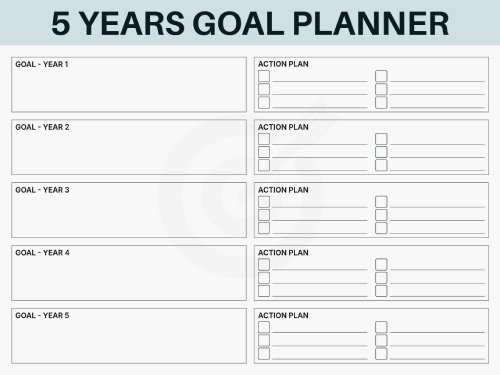
This clean goal planner template provides room to list one big goal per year, along with your action plans. On one side of the template, there are large boxes that will be used to list your goal objectives for year 1, year 2, year 3, year 4, and year 5. On the other side of the template, there are action plan boxes that provide checkboxes to list your steps toward achieving your goals. This template is great to employ if you are trying to complete five goals over five years that are related to one large objective, as well as five goals that vary. This template is very satisfying to check off as you complete your goals.
Best For: Those who are goal-focused and enjoy working to achieve their goals through creating yearly timelines and corresponding steps to take to achieve their objectives.
Template 5: Five-Year Personal Development Strategy Planner
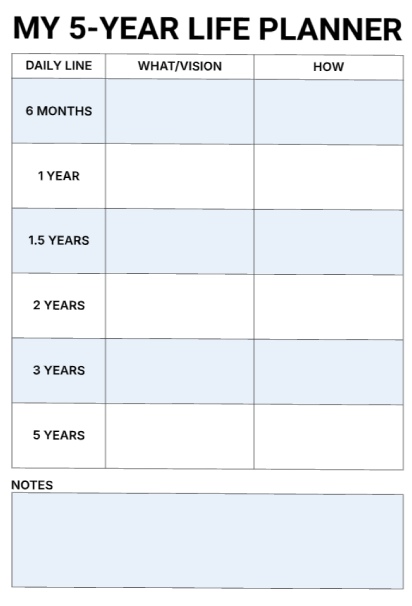
This is a strategic life planning tool, and it allows you to use a timeline to work your way towards your five-year vision. The spreadsheet has columns, consisting of the daily line (the timeline), the what/vision, and the how (strategies for achieving the objective). There are six different points that you get to plan for in the timeline, which include planning at 6 months, 1 year, 1.5 years, 2 years, 3 years, and the final one is after 5 years. The colored rows alternate, which allows you to easily see the timeline points. There is also a significant area allocated towards the bottom, which allows you to note your progress, set reminders, and even change your planning depending on the situation.
Best For: People who want to reverse engineer their five-year vision and establish specific milestones to be achieved at specific times to get back on target when needed.
Template 6: Five-Year Strategic Business Development Planner
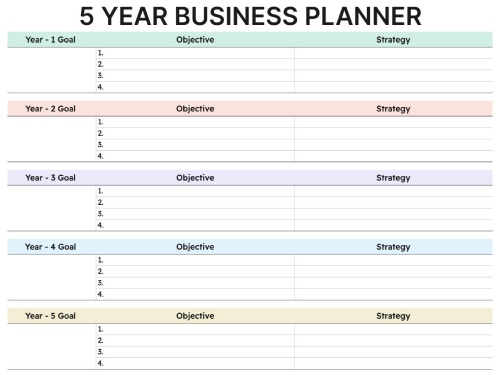
This planner is designed with your business in mind to make objectives for company growth. The year is color-coded, which makes it easy to glance at and know which year is which. You list one big overarching objective for each year, then you break that objective down into four items, and then you correlate each of those with a strategy. This planner will force you to be realistic because you are working towards achieving one objective in a year, versus trying to achieve everything in that year. The objective and strategy columns remind you to think not just about what you want, but also how you’re going to get it done.
Best For: Entrepreneurs, startup owners, and small business owners looking to develop a strategy for expanding their businesses over a period of five years with clear annual targets.
Template 7: Five-Year Personal Goal Setting Planner
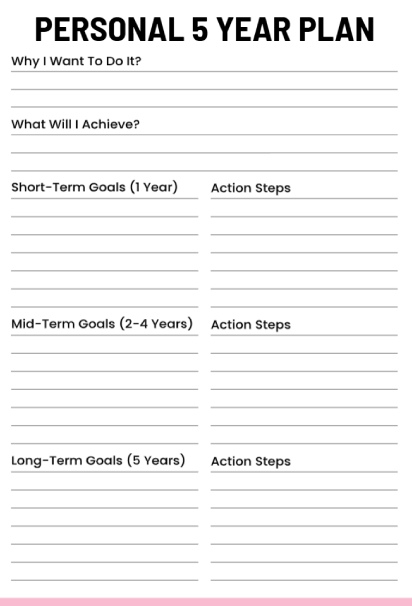
The personal planning template for ambitious goals begins with the most difficult question that you can answer: why do you want to achieve all these goals? This way, you can relate your own reasons why you should struggle when it gets difficult enough not to quit trying. Next, you should list down the goals that you want to achieve as your vision. The personal planning template divides your goals into three: your short-term goals within the first year, your goals from year 2 to 4 as your mid-term goals, and your goals from year 5 as your long-term goals. Each of the three has an action step side by side on the right part of the template, allowing you to always link your dreams with action at all times. Moreover, the design layout of this template allows enough space for all your personal actions so as not to appear cluttered.
Best For: Purpose-driven People who want their goals to be based on reasons that have meaning, with an implication that it takes a clear connection between short-term actions and reaching that goal in the long term.
Digital Planning Tools
It is easy to translate your goals into daily and weekly tasks with the use of planning tools. Besides, reaching towards your goals is easier because everything is in one place. With the use of proper planning tools, you will be able to create reminders for checking progress, as well as hold yourself responsible for your plans. Planning tools clear up all sorts of confusion in the head because you can organize your ideas properly.
| Tool | Best For | Key Features | Price |
|---|---|---|---|
| Planwiz | People who want ready-made planners for daily life, goals & holidays | Pre-designed templates, daily/weekly planners, goal tracking, reflections, meal & expense planning | Free-$ 47.99/life-time |
| Notion | Visual thinkers who want customization | Databases, templates, multiple views, and collaboration | Free-$10/month |
| Asana | Project managers who like task tracking | Goal hierarchy, timeline view, progress tracking | Free-$14/month |
| Trello | People who prefer simple board views | Kanban boards, checklists, and a card system | Free-$10/month |
| ClickUp | Those wanting an all-in-one solution | Multiple views, docs, goals, time tracking | Free-$12/month |
| Airtable | Spreadsheet lovers who want more power | Database functionality with spreadsheet interface | Free-$20/month |
Frequently Asked Questions
A comprehensive 5-year plan should include specific, measurable goals across major life areas: career development, financial targets, health objectives, relationships, personal development, living environment, and contribution goals. Each goal needs specific outcomes, realistic timelines, and actionable quarterly steps.
Try to begin by picturing your life exactly as you want it to be in five years. Your current reality, side by side with the truth, and then the gaps in between are where your answers lie. Your future is mapped out in the form of SMART objectives for 3 to 5 key areas, broken down into yearly milestones and action points for every quarter. Set these up to schedule regular checkpoints.
Yes, if you allow for flexibility and solve for outcomes instead of prescribing paths. Five years is enough time for major change and short enough to still be urgent. A good plan is reviewed quarterly and adapted based on new opportunities and changing factors by planners who have achieved their own success.
Your plan should be highly detailed for Year 1 with specific quarterly actions, moderately detailed for Years 2-3 with clear annual milestones, and broader for Years 4-5 with main outcomes and general direction. This graduated detail prevents rigidity while maintaining focus.
This should be shared strategically with your mentors, your accountability partners, or people who are close to you. This should not be shared with people who are doubters. This would just go against your own confidence. In searching for work, share the information that has something to do with your career. This would be beneficial for the company in terms of its own development.
Conclusion: Your Five-Year Transformation Starts Now
Five years will come regardless of whether you take any action or not. The only thing that matters is whether you design the life you want, or will the world just happen to you as you go through the cycle?
This guide has provided you with everything, from proven models and powerful templates to the steps that turn dreams into achievements. But it’s the templates that won’t bring about the necessary change in your life. What you need is action.
Your first 5-year plan is not going to be complete, and this is just the way things are. What matters is the starting point. Take 3 to 5 key objectives and delve into Year 1, and establish reviews every quarter to track your progress.
Use the right tools to help you stay on track:
- PlanWiz offers customizable templates for long-term goal tracking.
- Notion provides flexible planning systems.
- Asana breaks goals into trackable tasks.
- Trello offers a visual method of organization.
- ClickUp puts everything in one place.
Where do you want to be five years from today? Download your templates, block out 60 minutes this week, and start planning. Five years from now, you’ll either look back with pride at how far you’ve come or with regret at time wasted.