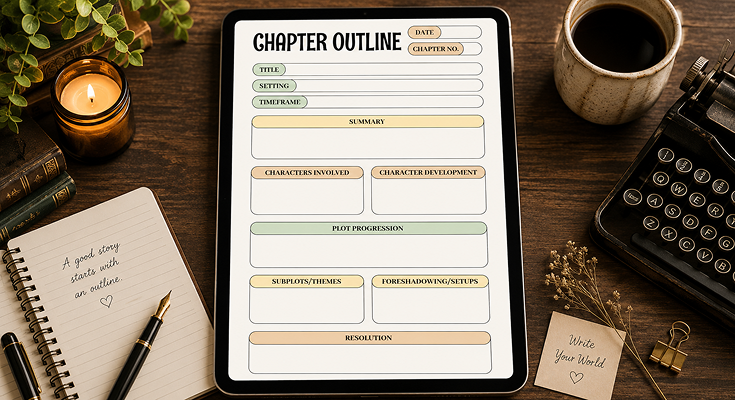
Many fiction writers struggle with keeping their chapters organized and maintaining narrative consistency throughout their manuscripts, how can you ensure each chapter serves a purpose without creating confusion or continuity errors? A fictional story chapter outline planner is a pre-designed organizational tool that helps writers structure individual chapters before drafting, focusing specifically on chapter-level details including scene progression, character interactions, and narrative elements.
Planwiz offers this comprehensive template with clear sections for tracking plot progression, character development, subplots, foreshadowing, and resolutions eliminating guesswork and reducing revision time significantly. Writers who use chapter outline planners report faster completion times, fewer structural revisions, and greater confidence during the drafting process.
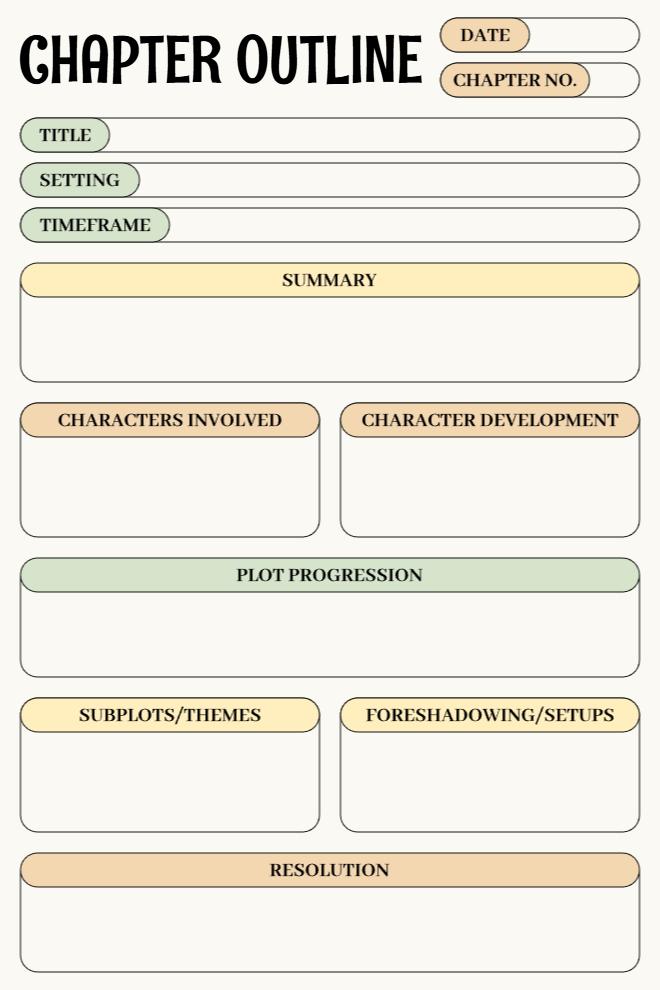
What is a Fictional Story Chapter Outline Planner?
A fictional story chapter outline planner is a pre-designed organizational tool that helps writers structure individual chapters before drafting their manuscript. Unlike a general story outline that covers the entire plot, this planner focuses specifically on chapter-level details including scene progression, character interactions, and narrative elements. Writers fill in designated sections for each chapter such as setting, timeframe, summary, and resolution-creating a comprehensive blueprint that guides the actual writing process.
This planning tool bridges the gap between high-level story concepts and the actual prose you’ll write. Whether you’re a meticulous planner who outlines every chapter before writing or a flexible writer who plans a few chapters ahead, a chapter outline planner provides the structural foundation needed to maintain consistency, track multiple storylines, and ensure every chapter serves a clear purpose in your overall narrative arc.
How to Use a Fictional Story Chapter Outline Planner? Step-by-Step Guide
Using a story chapter outline planner streamlines your writing process and keeps your narrative organized. This step-by-step guide shows you how to maximize this planning tool for any fiction project.
Step 1: Set Up Your Chapter Basics
Start by filling in the foundational information at the top of your chapter outline planner. Enter the chapter number to maintain sequential order throughout your manuscript. Add a working title that captures the chapter’s main focus or turning point.
Incl Include the date or timeframe when events occur to maintain chronological consistency. This is especially important for stories with complex timelines or multiple plot threads. Similar to how writers track story events, daily planner templates help organize time-based activities systematically. These basic details provide the structural framework for your chapter planning.
Step 2: Define Your Chapter’s Setting and Timeframe
Specify where and when your chapter takes place in the designated setting section. Be as specific as necessary for your story-this could be “Sarah’s apartment, evening” or “Battlefield outside King’s Landing, dawn of the third day.” Clear setting details prevent continuity errors.
The timeframe field helps you track how much story time passes within the chapter. Note whether events unfold over minutes, hours, or days to maintain realistic pacing and character logistics throughout your narrative.
Step 3: Write a Compelling Chapter Summary
Craft a concise 2-4 sentence summary of what happens in this chapter. Focus on the main action, conflict, or revelation that drives your story forward. Avoid getting lost in details-this is your quick reference guide, not the actual chapter.
Your summary should answer: What is the primary event? What conflict emerges or escalates? How does this chapter move the plot forward? Just as goal planner templates helps track objectives with clarity, your chapter summary should be clear enough that you’ll remember your intentions when you sit down to write weeks later.
Step 4: Map Character Appearances and Development
List which characters appear in this chapter within the “Characters Involved” section of your story chapter outline planner. Include both major and minor characters to track who’s present in each scene. This prevents accidentally placing characters in two locations simultaneously.
In the “Character Development” section, note significant changes, decisions, or emotional shifts. Document moments where characters reveal new traits, make important choices, or experience growth. These notes ensure consistent character arcs across your manuscript.
Step 5: Track Plot Progression and Major Events
Outline the sequence of events in the “Plot Progression” section. Break down the chapter into its key beats-what happens first, second, third. This doesn’t need to be detailed prose, just enough to capture the flow of action.
Focus on cause and effect relationships between events. Each plot point should logically lead to the next, maintaining narrative momentum. Use your fictional story chapter outline schedule to identify any gaps in logic before you start drafting.
Step 6: Document Subplots and Thematic Elements
Use the “Subplots/Themes” section to track secondary storylines developing alongside your main plot. Note which subplot receives attention in this chapter and how it progresses. This ensures all story threads receive adequate development throughout your novel.
Also document thematic elements you’re reinforcing-symbolism, recurring motifs, or philosophical questions. Notes planner templates can serve as a companion tool for capturing thematic insights during your writing process. These notes help maintain thematic consistency and ensure your story’s deeper meaning resonates across all chapters.
Step 7: Plan Foreshadowing and Story Setups
The “Foreshadowing/Setups” section is essential for laying down the narrative seeds in your story outline planner. Write down any hints, clues, or setup moments that will be the main event of future chapters. It might be a thing that is lost in the description, a conversation that seems to have no consequence, or a character’s quiet reaction.
Good foreshadowing makes a plot twist seem natural and not forced. When you mark these things in the plan stage, you can share the load of the setup, payoff throughout the story. Run through the previous chapter outlines so that you can check if you are really following through on the setups of the earlier chapters.
Step 8: Identify Your Chapter’s Resolution
Determine how the chapter ends in the “Resolution” section. Does it conclude with a cliffhanger that propels readers forward? A quiet moment of reflection that provides emotional breathing room? Or a resolved conflict that sets up new questions?
Consider how this ending transitions into your next chapter. Strong chapter endings create page-turning momentum while giving readers a satisfying sense of completion for the immediate scene. Your story outline planner helps you strategically vary ending types across your manuscript.
Frequently Asked Questions
A chapter outline template is essentially a detailed template that aids fiction authors in planning the essential features of every chapter such as the storyline, characters’ development, and environment topography.
It functions as your story guide, guaranteeing that your narrative remains coherent throughout your book. Authors utilize this instrument so that they do not lose track of their stories and can handle the pace well.
This chapter outline template has sections that can be used for keeping track of the summary, characters, plot development, and resolution.
If you organize a chapter structure beforehand, you will be able to see how single chapters can make up your whole story arc. The planner will be your artistic director while writing the manuscript.
Using a novel chapter planner can be very helpful in keeping the narrative flow and avoiding continuation errors, which are the main problems in the discovery writing method.
It makes sure that each chapter is devoted to one specific objective of the story. Moreover, such a measured approach saves you a great deal of time when doing revisions.
Through outlining, you will be able to spot pacing problems even before you throw away weeks in writing first drafts. You will know exactly where to put the hints of what is to come, and also how to combine the characters development with the times of action.
Of course, you should not be deprived of the joy of free writing, yet a structured planning with a novel chapter planner is what you need if you want to be more productive and finish your manuscripts quicker.
Initially, input fundamental details such as chapter number, title, and timeframe to establish your temporal framework. After that, identify the place, and summarize the main action briefly in 2, 4 sentences. Subsequently, list the characters that are present and make a note of their development arcs.
On the plot progression part of your fiction writing planner, you should outline the sequence of events which are the main drive of the narrative.
Document the subplots, themes, and also any foreshadowing elements you might be introducing for future chapters. Lastly, decide how the chapter concludes, whether it is a cliffhanger, resolution, or a transition to the next scene.
Keep your story outline planner summaries concise but specific enough to remember your intentions when you start writing. Focus on capturing essential action, conflict, and outcomes rather than writing full prose.
Two to four sentences per summary section typically provides adequate guidance. Character development and plot progression sections can be brief bullet points noting key changes. Save detailed descriptive writing for your actual manuscript drafting sessions.
The goal is creating a helpful reference tool, not writing the chapter itself in your fiction writing planner.
Lay out as many chapters as you think necessary to be sure of the direction and structure of your story.
Some authors plan their entire novels in advance and use various chapter planning template sheets for a broad overview. Others only reveal 5, 10 chapters in the outline and continue to evolve the story organically.
Doing all the pre, planning can be very productive if you are the type of person who needs a very detailed set of structures before you can draft a single sentence. In order to keep track of your actual writing time, you can use weekly planner templates as a tool to help you develop regular writing habits.
Discovery writers who want to be free to roam without having to worry about the very rigid constraints that can sometimes stifle their creativity, find rolling outlines very helpful.
Yes, you can easily customize the chapter planning template by modifying section labels to reflect genre-specific elements. Add “worldbuilding notes” for fantasy novels, “clues planted” for mystery stories, or “romantic tension” for romance fiction. The basic structure works for any genre.
Personalizing field names helps you track elements most critical to your specific storytelling needs. Writers who enjoy flexible organization methods might also explore bullet journal templates for capturing creative ideas alongside structured planning.
You can also add custom sections for genre conventions like magic systems, investigative discoveries, or relationship milestones. The book chapter outline adapts to your unique creative requirements.
Use the timeframe field in your book chapter outline to track when events actually occur versus when they’re revealed to readers. Note connections between non-chronological chapters in the foreshadowing/setups section. This helps maintain clarity in complex narrative structures.
For stories with flashbacks, dual timelines, or fragmented narratives, add a “chronological order” number separate from your “reading order” chapter number.
This dual tracking system in your story planning template helps you monitor the actual sequence of events. Review both orders periodically to ensure your non-linear structure enhances rather than confuses the story.
8: How do I create a fictional story chapter outline planner from scratch?
First focus on fields like the chapter number, summary, and main conflict of the chapter in your story planning template design.
You can then incrementally add sections that reflect your particular planning needs, for example, character tracking, subplot notes, or thematic elements.
Utilize a word processor, spreadsheet, or design software to make labeled sections with enough space.
Before you fix the layout, try out your custom writing outline planner with a few chapters. Modify it according to what you’d actually like to use during your writing sessions.
A lot of writers gradually develop their planners over several projects as they realize which planning aspects most effectively aid their creative process.
One common mistake an overly detailed fiction chapter planner makes is over, planning so much that the outline becomes a set of unbending rules which stifle creative spontaneity.
Another mistake is under, planning to such a vague level that the planner actually does not provide helpful guidance during writing. Sometimes, writers also totally ignore the section on character development and therefore end up with plot, driven chapters that are emotionally empty.
Failing to jot down foreshadowing and setups in your fiction chapter planner causes you to lose some chances for fulfilling payoffs. Finding the right balance is important think of a planner as a flexible guide, not a rigid blueprint.
Review completed sections of your book writing planner template to assess the distribution of high-intensity scenes and character development moments.
Look for clusters of similar chapter types-too many consecutive action scenes can exhaust readers. Ensure major plot points are spaced strategically across your story arc.
Check that each section of your book maintains appropriate pacing for its narrative function using your chapter summary template. Balance high-stakes scenes with quieter character moments and alternate between different subplot focuses. This visual overview helps you identify pacing problems before they require extensive rewrites.