Maintaining a clean home shouldn’t consume your entire weekend or leave you overwhelmed by endless to-do lists. Most people struggle without a house cleaning planner because they tackle tasks randomly, leading to either exhausting marathon cleaning sessions or constant guilt about neglected areas that pile up over time.
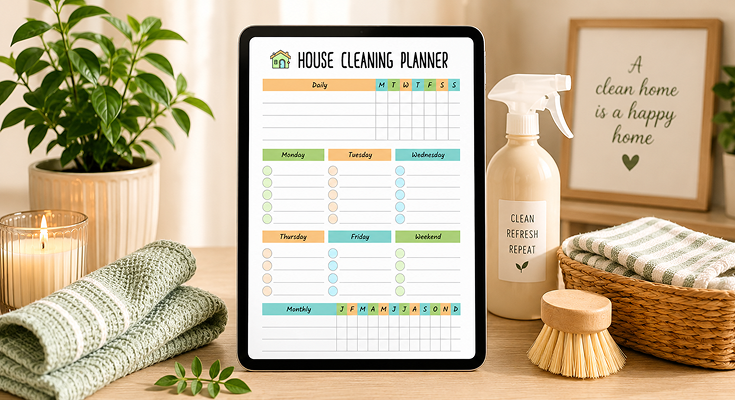
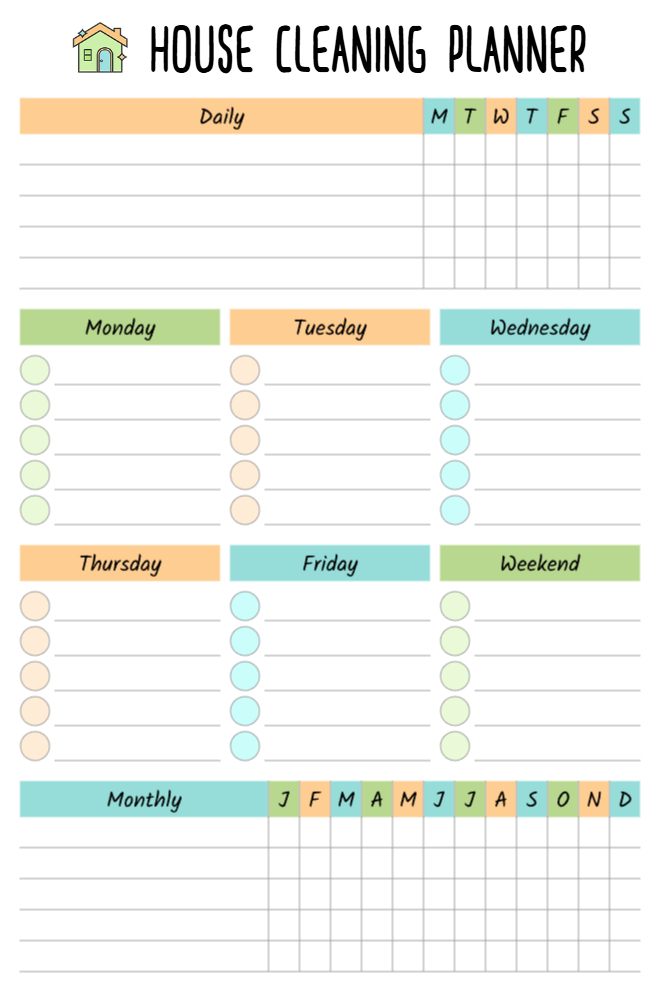
This printable cleaning schedule template from Planwiz organizes your entire week with a daily task tracker at the top, individual sections for Monday through Friday tasks, a dedicated weekend cleaning area, and a monthly deep-cleaning calendar covering all 12 months. The color-coded layout with checkboxes for each day helps you quickly see what’s done and what needs attention, keeping your home consistently clean without last-minute panic cleaning.
What is a Home Cleaning Routine Planner?
A home cleaning schedule planner is a structured organizational tool designed to break down home cleaning tasks into a list of daily, weekly, and monthly tasks. This is different from others because it is a systematic way of planning your home cleaning schedule compared to others where you perform home cleaning tasks as they arise.
This utility helps translate abstract cleanliness responsibilities into practical, implementable tasks by subdividing an immense notion such as “keeping a clean house” into bite-sized tasks that will only take 15-30 minutes a day. Helped either by a small space or a large one meant for an entire family, this cleaning schedule template will adjust according to your needs, complementing your ever-changing schedule. To monitor your daily tasks aside from cleaning, you might find it a good idea to get a daily planner templates.
What Should Be on a Home Cleaning Routine Planner?
Breaking down your entire range of cleaning chores by room increases efficiency and ease of use of your home cleaning routine planner. Every room has its own level of need for attention.
Kitchen Cleaning Schedule
- Daily Tasks (10-15 minutes): Wipe countertops and stovetop after meals to prevent grease buildup. Load the dishwasher and take out trash to maintain freshness.
- Weekly Tasks (45-60 minutes): Mop floors thoroughly, especially around the stove and sink. Clean appliance exteriors and sanitize the sink with disinfectant.
- Monthly Deep-Cleaning (60-90 minutes): Monthly Deep-Cleaning (60-90 minutes): Deep-clean the oven interior and clean out the refrigerator completely. Degrease range hood filters and organize pantry items with a meal planner templates to coordinate grocery shopping and kitchen organization efficiently.
Bathroom Cleaning Schedule
- Daily Tasks (5 minutes): Quick wipe of counters and sink after morning routines. Squeegee shower walls after use to minimize mildew growth.
- Weekly Tasks (30-40 minutes): Scrub toilets with disinfectant and clean shower/tub thoroughly. Mop floors, clean mirrors, and wash bath mats.
- Monthly Deep-Cleaning (45-60 minutes): Deep-clean grout lines with specialized cleaner to remove mold. Organize cabinets and wash shower curtains or liners.
Bedroom Cleaning Schedule
- Daily Tasks (5 minutes): Make your bed each morning for an instantly tidy appearance. Do a quick 5-minute pickup of clothes and items.
- Weekly Tasks (30 minutes): Change bed sheets and pillowcases for hygiene and better sleep. Dust surfaces and vacuum floors, including under the bed.
- Monthly Deep-Cleaning (60-90 minutes): Rotate or flip your mattress for even wear, and track your sleep quality improvements with a sleep journal templates. Organize closets by season and wash curtains or blinds.
Living Room Cleaning Schedule
- Daily Tasks (5-10 minutes): Fluff cushions and do a quick declutter of magazines and remote controls. Spot-clean any visible spills or crumbs immediately.
- Weekly Tasks (35-45 minutes): Vacuum or mop floors and dust all surfaces including electronics. Wipe down coffee tables and organize entertainment centers.
- Monthly Deep-Cleaning (45-60 minutes): Deep-clean upholstery with appropriate cleaner or vacuum attachment. Wash windows, dust ceiling fans, and reorganize shelves.
Laundry Cleaning Schedule
- Daily Tasks (5 minutes): Sort dirty laundry into designated bins by color or fabric type. Wipe down washer and dryer exteriors after use.
- Weekly Tasks (20-30 minutes): Clean lint traps thoroughly and wipe interior of washing machine. Organize detergents and supplies on shelves or in cabinets.
- Monthly Deep-Cleaning (30-45 minutes): Run a washer cleaning cycle with vinegar or specialized cleaner. Vacuum behind appliances and wipe down walls around machines.
Frequently Asked Questions
A Home Cleaning Routine Planner is an Organizing Assistant that helps an individual plan and track the household cleaning activities systematically. It helps to break down the daunting house chores into manageable daily, weekly, and monthly activities.
A system of household management will benefit most families, whose members tend to be strugglers in home maintenance, as a result of a lack of system, ending up in weekend cleaning marathons.
“The major advantage is that it creates a system which changes the feared and disorganized task of cleaning into something that is easy and a habit.” With decision fatigue eliminated, you no longer have to worry about what needs to be cleaned.
First, a full home energy audit should be done to determine a comprehensive list of cleaning tasks needed within your home. This includes everything from dishes to wash windows seasonally, then prioritize based on frequency.
Now, you have to incorporate the activities of your cleaning routine template with the obligatory tasks of clean counters and washing dishes. Assign the cleaning tasks of more substantial nature to different days of the week, which are Tuesdays for bathrooms, Mondays for bedrooms, and Wednesday for the kitchen.
You would use the monthly grid to plan bigger tasks involving cleaning or organization that you complete quarterly or seasonally. You would check off the tasks as you complete them.
This would obviously serve as motivation.
Daily duties ought to revolve around the parts of the house where there is a lot of traffic and which get dirty quickly and have a negative effect on the general look of your home.
Among the most important daily chores are dishwashing, wiping kitchen counters and stovetops, bed, making, and a 10, minute evening tidy, up.
Moreover, certain daily tasks depend on the composition of your household-families with small children may require that you put toys in order and that you sweep the floor every day.
The idea behind these daily tasks is that they should take less than 30 minutes in total so that you can keep them up long term without any problems. Concentrate on upkeep rather than flawless execution and deal with those parts that have the greatest impact on your daily comfort.
Absolutely. Customization is important since you need to take care of a small apartment in a completely different manner than a large house with lots of family members.
Smaller apartments such as studios or one-bedroom apartments allow you to combine a variety of areas into one.
For bigger houses, it is best that instead of tackling the whole house at once, you split cleaning by zones or floors. You allocate Monday for first-floor bathrooms, Tuesday for upstairs bedrooms, and so on.
Where to Begin Cleaning?
Multi-story dwellers can benefit by incorporating additional task lines to their day section of their planner. Another great feature is that you can generate individual planners for individual family members. This can be accomplished by maintaining an overall family planner templates that tracks all of their duties.
Working professionals require a home cleaning routine planner that acknowledges their limited availability during weekdays without allowing them to feel overwhelmed on weekends.
The emphasis should be on 15-minute daily maintenance tasks that you can do either before or after work.
You should reserve deeper cleaning tasks for one or two weekday evenings when you have a little more energy. Weekend sessions can take care of more intensive projects, but the goal should be only 1, 2 hours in total.
The point is to choose quality rather than quantity completing five focused tasks weekly is better than planning twenty which you will never finish. Be very honest with yourself in terms of your energy and adjust your expectations accordingly.
A weekly planner templates can be a great tool to help you balance cleaning tasks with work commitments and personal activities during the week.
6.What are the biggest mistakes people make with cleaning planners?
Firstly, the most common error is setting up an overly ambitious schedule that is not maintainable, causing guilt and abandonment of the systems. Starting small with 3-5 necessary tasks and adding on to these is one way to introduce new habits.
Another big mistake is assuming that the home cleaning schedule planner is inflexible instead of flexible, causing stress when life interferes. Create flexibility days to account for when life gets in the way.
Most individuals fail to observe the deep cleaning record on a monthly calendar while at the same time failing to observe the weekly and daily records. This leads to an accumulation of seasonal cleaning that has to be performed through costly expert services.
Look at your quarterly planner templates and make changes every 2 to 3 months or after major life events such as the birth of a baby or a move to a new job. Change of season in spring and autumn is also the right time to revisit your priority list of what needs to be done. You can use a quarterly organizer to plan when to review your list and to set seasonal cleaning schedules.
Your cleaning needs will change as your lifestyle changes. Therefore, gradually, your cleaning routine will prove ineffective. Your solo lifestyle requires one kind of cleaning schedule.
Regular system reviews also provide an opportunity to find the things that are not delivering value and/or the things that are being done too frequently. This will save unnecessary effort and make sure that the system stays relevant.
Yes, actually the home cleaning routine planner is quite effective in managing and balancing the domestic chores among family members. You just have to designate different colored pens to different individuals or use the checkboxes.
Visual accountability helps remind the kids and your significant other that they too have a task to complete as far as the functioning of the household is concerned. Imparting them some activities that suit their level of understanding will teach you the value of responsibility and at the same time reduce your burden.
Hold short family meetings weekly to review the planner, reward your children, and modify the tasks as there are changes. This will promote team spirit among your children and eliminate resentment among them with regard to any inequality at home.
Start with a template or a spreadsheet, and develop a daily task area using a 7-Day Tracking Grid. Include the schedules for each individual day from Monday to Sunday, using at least 5 to 10 lines to create the checkboxes for the list of tasks to be completed.
Add a tracker for deep-cleaning chores that has 12 columns corresponding to January to December. This can be done by computer using Canva, Google Sheets, or Microsoft Word. Another option is to sketch it by hand.
The design needs to have a clear focus on the layout and space necessary to complete the actual tasks being written. For example, a clean and practical planning calendar that includes ample white space will outperform a design-intensive planning calendar.
Bathrooms require a heavy clean on a weekly basis. This will include grout cleaning, toilet cleaning, and floor cleaning. Kitchens benefit from a wipe down appliance clean, a clean refrigerator on a monthly basis, and a clean oven every quarter.
Bedrooms are provided with the care of weekly sheet changes, monthly mattress rotation, and seasonal closet organization and decluttering. Living areas are serviced with a weekly vacuuming or mopping, a monthly furniture dusting, and a quarterly upholstery deep, cleaning.
Record these different frequencies in your planner so that nothing is overlooked or cleaned more often than necessary. Proper scheduling saves time, products, and energy, and the spaces remain clean consistently.
When planning seasonal deep, cleaning projects on an annual basis, a yearly planner templates will help you distribute the major tasks over the twelve months.
The structured approach means that you eliminate decision fatigue completely, as you spend no time trying to determine what you need to clean since the plan will direct what to do. Based on mental efficiency alone, you will save 10-15 minutes of every cleaning routine.
Regular maintenance will prevent dirt buildup and clutter. Doing so will make every cleanup faster and easier. This means you are keeping your space clean instead of fighting against dirt buildup. This can cut down your cleanup time by 40-50%.
This planner also helps avoid duplicated work and missed tasks, which end up requiring last-minute emergency work. It is much more efficient to deal with something ahead of time than waiting until it becomes an emergency.
Digital planners provide for easy editing, cloud backup, and the facility to create reminders for respective tasks. They can work well for those individuals who are comfortable with technology and handle their lives through apps and online calendars.
One advantage of printed planners that gives a person the tactile satisfaction of marking off the task they’ve completed is that they are always visible without having to open a device.
Think about your personal preferences and habits-ultimately, it is important that you find a planner that you will actually use. Some people find that a combination approach that involves both digital reminders and paper planners works for them.
If perhaps your preferred method for documenting the activities accomplished during the day and week is through a bullet-point system, a bullet journal templates can help enhance the customization of your personal cleaning routine.