Having a clean home doesn’t have to be a frustrating and overwhelming task when the right tools are being utilized. The existence of a household cleaning task organizer planner will allow the individual to organize the process of home cleaning. The printable household cleaning tasks organizer planner will make chaotic home cleaning activities operate effectively as a well-organized home cleanliness system to keep the whole home clean and tidy.
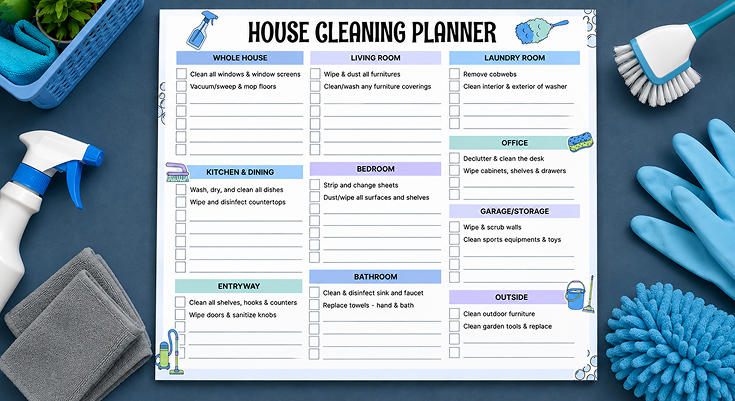
The Complete House Cleaning Organizer by Planwiz is filled with pre, made lists of house cleaning chores targeting every nook and cranny of your homes, whether it is the kitchen, baths, garage, or even outside. The organizer helps you create parts depending on your own requirements, thus it becomes easy to follow a cleaning routine. And, with this organizer, you will be able to turn house cleaning into a daily pleasure that you anticipate.

What Is a Household Cleaning Tasks Organizer Planner?
A household cleaning tasks organizer planner is an organized check-off system that breaks down your home into dedicated areas, including but not limited to: the kitchen, restroom, bedroom, and living spaces. Instead of an ordinary to-do list that lacks organization, an organizer planner helps you organize your home-cleaning chores by room and interval.
When you lay out all the house chores in one picture, you are able to create manageable schedules for all the chores, assign the chores to the residents of the house, and ensure that the house stays clean on a regular basis without forgetting any part of the house. The approach of planning room by room ensures that it helps the individual to prevent feeling overwhelmed by the process of cleaning all the house.
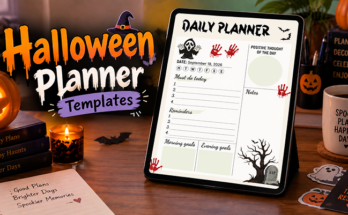
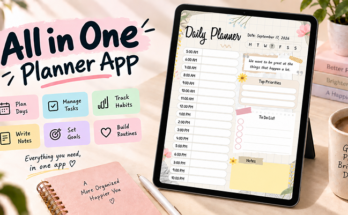
Hence, it alters the vicious cycle to a manageable system. You might want to integrate the cleaning schedule planner with a daily planner templates to organize your scheduled activities, including the cleaning times.
What Are the Tips for Using a Household Cleaning Tasks Organizer Planner?
Master these expert strategies to upgrade your house cleaning tasks organizer planner into a potent cleaning power tool. These classic strategies guarantee to assist busy families in keeping a clean home while sparing entire weekend days from cleaning rituals.
Intelligent cleaning is not about working hard; it is about working efficiently. The following are the techniques that need to be implemented to reduce the time taken for cleaning by 50 percent or more. These result in better outcomes.
Which direction should you clean?
- Always clean from ceiling level down to the floor. Dust ceiling fans and light fixtures first, working down to shelves and countertops, and floors last.
- This is the method where gravity works to your advantage since debris falls down, and thus you never clean surfaces again. Professional cleaners swear by this order for effectiveness.
Where should you keep supplies?
- Organize stock caddies for cleaning designated areas of the house, such as caddies for cleaning the bathroom, caddies containing cleaning supplies found under kitchen sinks, and caddies for dusting supplies in accessible locations. Organize supplies relevant to that area in each caddy.
- This prevents the waiting involved when one Goes back for the Forgotten items. You’ll work on the rooms quickly when the materials are right At your side.
How long should each room take?
- Create a timer setting of 15-20 minutes per room and see if you can complete the task within that time span. You may mark these timeslots in your weekly planner templates to ensure that it doesn’t clash with your commitments.
- Time pressure promotes focus and avoids the perfectionist’s paralysis. A clean-up job in most rooms can be completed within 30 minutes if one remains focused.
What tasks should you batch together?
- Complete all dusting throughout your home first, then all vacuuming, then all mopping. Don’t clean one room completely before starting another.
- This assembly-line approach maintains momentum and minimizes tool transitions. You’ll work faster when you’re not constantly switching between different cleaning mindsets.
What daily habits prevent big messes?
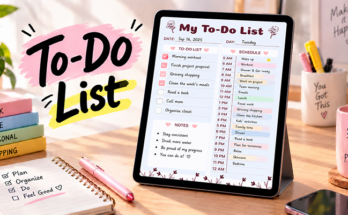
- You must separate different 5-minute maintenance tasks (wiping the kitchen counter, swirling water in the toilet bowl, spot vacuuming in heavy traffic zones) in your personal deep-cleaning planner. A To-Do planner templates may assist you in organizing your quick maintenance tasks aside from your regular schedule.
- Regular touch-ups will prevent soil accumulation that makes cleaning a challenge every week. Spending five minutes a day will cut an hour on cleaning day.
How often should you deep clean?
- Each week, assign one “extra attention” area beyond your routine tasks. 1 Week: baseboards. 2 Week: inside cabinets. 3 Week: window tracks. 4 Week: light fixtures.
- This rotation keeps your entire home maintained without overwhelming any single cleaning session. Deep tasks get done systematically instead of being perpetually postponed.
What makes cleaning sessions faster?
- Make a cleaning playlist that associates each song with a certain task or room. Once the song is over, move on to the next task on your planner. It transforms dull and boring chores into fun activities.
- In addition, it serves as a natural time indicator. A 3, minute musical performance is the perfect time to clean a bathroom or a bedroom.
Frequently Asked Questions
A home cleaning task organizer planner is actually a checklist that helps you organize all the cleaning chores according to the room and type of chore. It is helpful for maintaining your home as it provides a possible visualization on which areas in the house need cleaning.
The use of this planner is different from using a to-do list because it groups chores according to designated areas within a home. Chores are grouped according to room, with all pertinent cleaning chores being contained within a designated room.
The structured system serves to ensure consistent methods of cleaning and help ensure critical tasks are not forgotten. Whether you opt to do the cleaning by yourself or in a team effort with the rest of the household members, the planner promotes accountability and tracking progress.
Hard copies of planners provide visibility without the distractions of devices and you are able to post them in common areas around the house to allow accessibility by family members. It is also psychologically fulfilling to cross off tasks that you complete.
Another benefit of paper planners is the fact that they are always visible and serve as constant reminders, creating more accountability.
One advantage of physical planners is the fact that they do not require the use of batteries and/or internet connection to be functional, and you do not need to navigate through all the pages to view the information available.
They can be mounted anywhere in the house where all the family can view them.
An efficient cleaning plan should cover not only the whole house (windows, floors) but also the kitchen and dining area, living rooms, bedrooms, bathrooms, laundry rooms, home offices, entryways, garage or storage areas, and outdoor spaces.
It guarantees that you acknowledge and treat every corner of the home with a brush to prevent places that you frequently overlook and thus get dirty.
No two houses are the same in terms of layout, so your planners should be a realistic reflection of your living spaces. It is desirable that your planners depict your particular home, not only its geographical layout but also the patterns of activities.
Areas in a home that have a lot of traffic and also exposure to moisture like the kitchen and bathroom, you have to take care of every week, while you can clean the bedroom and living room by vacuuming and dusting which you should do every week as well.
The spaces that are used less, for example, the guest room or storage, can be cleaned every month or every season. You can plan your household cleaning tasks with the help of a planner.
The number of times you will clean different areas in your home is conditional on whether your household has pets or children.
Finishing one room before starting another helps create the feeling of completed work and can be an effective strategy for deep cleaning on the weekend. Doing similar activities together, like dusting and then vacuuming, can help streamline the process.
Both of them are effective depending on your choice and time. Many people consider room by room to be effective in the case of deep cleaning, while the other is effective in daily or weekly maintenance.
Yes. The planner does contain blank lines throughout the categories designed specifically for adding your tasks. Remove tasks irrelevant to your home environment and include tasks characteristic of your lifestyle, such as pet care sections, specialized equipment, or outdoor spaces.
You can further vary the frequency of tasks based on the need for those tasks in your household. You can create variety in daily, weekly, and monthly tasks by using different colors, symbols, and highlights.
It might be nice to include comments regarding favourite cleaning solutions or techniques. This is especially important when multiple individuals are using the planner to help promote consistency with the completion of several tasks throughout your home.
Display the planner in an area which is visible to all. Divide rooms and tasks among the family members according to their ages and capabilities using different colors of pens, preparing separate planners for each member of the family.
Have a brief weekly meeting to go through the planner together. You can then check off what got accomplished and look at the upcoming week. A family planner templates may be what your family needs to get everyone on the same page for their schedule and cleaning duties.
This instils a sense of responsibility and accountability among them, teaching them important life skills in the process.
Keep it interesting by mixing up the jobs so that no one person gets the most disliked jobs. A reward system might be a good way to keep the interest of the younger ones.
Begin by enumerating all rooms and zones in the house. After that, for every room, write down all the cleaning activities that are necessary. These actions will have to be classified later. Put a checkbox before each item and leave places for more additions.
It is possible that you want to add color, coding to show the priority of the task or the family members responsible for its completion. Make sure that your design has enough space between the tasks so that you can easily mark your checkboxes and see what the text says.
If you are unfamiliar with organizing systems, you might want to use a notes planner templates as an intermediate step before making your final cleaning planner. Employ your initial version for a week, and then alter it according to both your accomplishments and the areas that require enhancement.
Some of the most common tasks that you easily forget are cleaning window screens, lighting fixtures, ceiling fans, sanitizing doorknobs and light switches, and cleaning the interiors of appliances such as the microwave and dishwasher.
Other tasks might be cleaning under furniture, baseboards, exhaust fans, and cluttered storage areas.
A thorough planner helps to make sure that you don’t forget these jobs when you specifically plan for the following areas. Create reminders for the seasonal or annual jobs which you don’t have to do too often.
Instead of looking at the planner as one huge undertaking, break it down into smaller, more digestible bits. Get one or two rooms done per day, or set a timer for either a 15-30-minute blitz.
Keep in mind that the planner is a guide, not the rule-modify the list of tasks according to the amount of time and energy you have. This is better than following the planner as written and quitting because it is just too scary.
High-priority areas that you can initially focus on include the kitchen and bathroom. You can then gradually include other areas as the routine becomes more comfortable.