Being stuck in your career or having doubts about which way to turn in life doesn’t mean that you have failed; it is simply a sign that you are on their doorstep and are now prepared to move to a much deeper level of understanding. The ikigai Life Purpose Discovery Planner is a tool which has already proven successful for millions of people worldwide and is committed to trying to find a great way to succeed through doing things you enjoy and are good at, and also through recognizing what the world needs and lastly things which you can be paid for.
Whether you are fresh out of school and beginning to contemplate a course in life, in the midst of your working life and feeling as though you have nothing better to do with it all, or are nearing retirement age and pondering what’s to come, this graphic can help you structure your self-reflection in a way that truly helps you to confront your questions and concerns. This template has been provided by Planwiz in both downloadable versions: PDF and digital.
What is a Ikigai Life Purpose Discovery Planner?
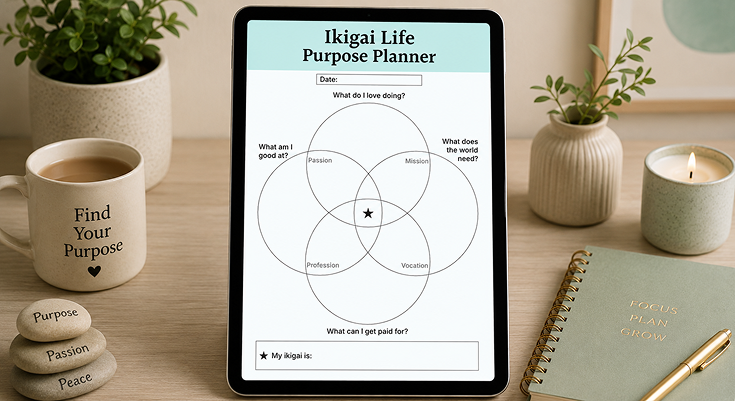
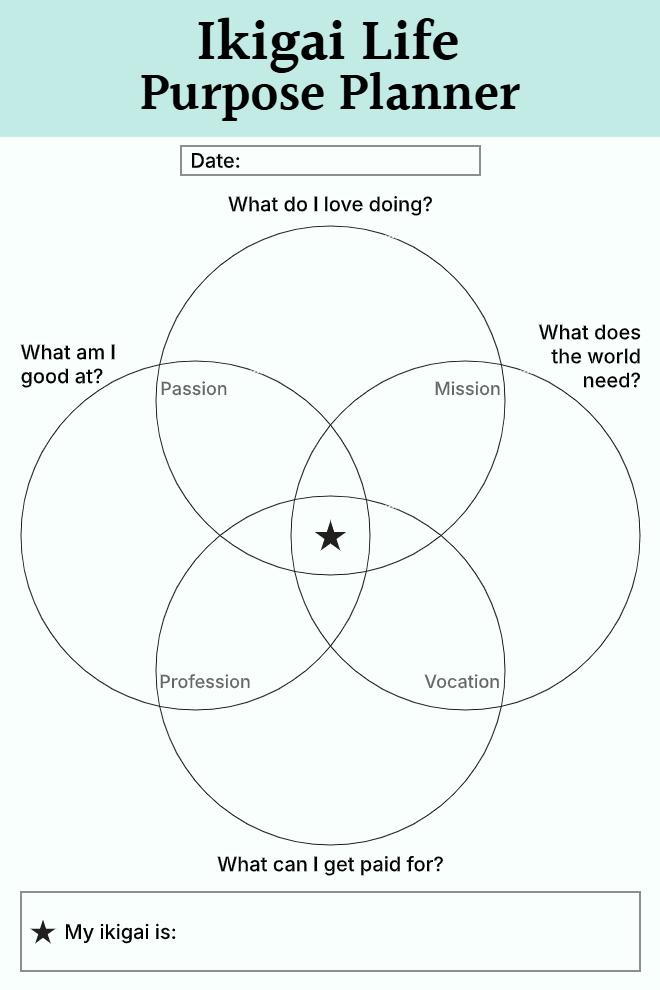
An ikigai life purpose discovery planner serves as a visual tool for personal reflection that visually illustrates the meeting point between your most heartfelt passions, inherent talents, the impact you want to have, and ways of earning money. The planner is designed based on a four, circle Venn diagram concept, with each circle symbolizing a main aspect of life: your favorite activities, your strengths, the needs of the world, and the possibilities of getting paid.
This template helps apply abstract purpose-seeking to actual action using a systematic brainstorming tool for analysis. While filling out each circle and analyzing the intersections, a big picture forms to show a personalized way forward whether its a changeover into a new career, a new business venture, a charity focus, or a life makeover. Once accomplished, goal planner templates can help apply purpose-driven goals to actual progress based on ikigai discoveries.
How to Find Your Ikigai Life Purpose ? Complete Step-by-Step Guide
Identifying with your purpose and reason for living takes time, and this reliable method yields results in a matter of weeks. The Ikigai Life Purpose Discovery Planner Template is designed to guide one through the self-discovery process by focusing on easy-to-complete tasks that can be accomplished by people of all ages and levels of employment.
Step 1: Discover What You Love
First up, write down activities that make you forget time. Don’t judge, include everything from the work stuff to the hobbies and the little everyday things. Ask questions like: What would I do for free? What do I enjoy reading about? When am I the happiest?
Action: Allocate 20 minutes to think and write down whatever comes to mind with no criticism. You should have 15, 20 things at least in the What I Love circle. Get into the habit of using daily journal templates so that you can note down the activities that bring you pleasure during the week.
Step 2: Identify Your Skills and Strengths
Make a list of skills you’ve learned in your job, education, hobbies, or just living. Remember to point out skills that are technical (designing, programming, or writing) and nontechnical (listening, organizing, problem solving). Try not to be humble. What kinds of things do people come to you for help with?
Action: Go through your achievements and the kind words people have said. Get feedback from three to five close people by asking them: ‘What do you think are my natural talents?’. Write down these discussions and your thoughts in bullet journal templates so you can identify the patterns in your skills over time.
Step 3: Determine What the World Needs
Reflect on the challenges that concern you and that you’d like to solve. These could be world challenges (climate change, education access) or neighborhood or employment dynamics (sense of community, company culture). Ask yourself: “What bothers me about the way things are now? What do I wish was available?”
Action: Read the “What the World Needs” as “What problems do I want to solve?” Fill this circle with causes that genuinely matter to you.
Step 4: Explore Income Opportunities
Investigate ways that people are monetizing skills and interests similar to yours. Be creative about how you could monetize, whether it’s through freelancing, consulting, product development, services, teaching, or blended career strategies. Utilize your ikigai life purpose planner template to generate ideas about non-traditional sources of income.
Action: List 10-15 ways your skills could generate income. Include current possibilities and future potential after skill development.
Step 5: Find the Intersection
Now examine where your four circles overlap. Your ikigai sits at the center where all four elements meet. Look for patterns: Which items appear in multiple circles? What combinations feel both exciting and practical?
Action: Connect similar items using lines between circles. Write your version of ikigai by saying: “My reason for existing is to [apply your skills] to [solve a problem] as I [do what you love] and [get paid by X].” Organize your ikigai goals towards greater accomplishment by applying quarterly planner templates to keep you moving forward.
What Are Real-Life Ikigai Life Purpose Discovery Examples?
If you watch people who have found their purpose, it is easier to understand the meaning of ikigai. These examples demonstrate that it is possible to find work that is not only satisfying but also in harmony with your passion, skill, contribution, and income through various paths.
Example 1: The Teacher Turned Educational YouTuber
Background: High school science teacher who felt limited by curriculum constraints
| Circle | Content |
|---|---|
| What She Loves | Explaining complex concepts, video editing, creative storytelling |
| What She’s Good At | Breaking down science topics, engaging presentation, connecting with teens |
| What World Needs | Accessible STEM education, free learning resources, diverse role models in science |
| What She Gets Paid For | Ad revenue, sponsorships, online course sales, speaking engagements |
Her Ikigai: “Creating engaging science content that makes learning accessible and exciting for students worldwide.”
The Journey: Started with weekend YouTube videos while teaching full-time. After 18 months and 50K subscribers, transitioned to content creation full-time. Now reaches millions while maintaining teaching passion without classroom limitations.
Example 2: Corporate Manager to Sustainability Consultant
Background: 15-year marketing executive feeling disconnected from meaningful impact
| Circle | Content |
|---|---|
| What He Loves | Nature, environmental activism, helping businesses improve, strategic planning |
| What He’s Good At | Business strategy, stakeholder communication, change management, data analysis |
| What World Needs | Companies reducing environmental impact, sustainable business practices, climate solutions |
| What He Gets Paid For | Consulting fees, workshop facilitation, sustainability audits, speaking at conferences |
His Ikigai: “Helping businesses transition to sustainable practices that benefit both profit and planet.”
The Journey: Volunteered with environmental nonprofits while employed. Got sustainability certification during evenings. Took consulting projects on the side before launching his firm using business planner templates to organize his transition strategy.
Key Takeaways from These Examples
✓ Your ikigai evolves-it doesn’t appear fully formed overnight
✓ Transitions can be gradual-most people build bridges before burning ships
✓ Unexpected combinations work-your unique mix is your competitive advantage
✓ Income follows value-when you serve real needs with genuine skill, money follows
✓ Age is irrelevant-people discover purpose at 25, 45, or 65
Your ikigai life purpose discovery planner template helps you map your own unique intersection. These examples prove there’s no single “right” path-only your authentic path waiting to be discovered.
Frequently Asked Questions
An ikigai life purpose planner takes the form of a guided self-exploratory exercise, as inspired by the Japanese philosophy for discovering one’s purpose for living.
This activity involves making use of four overlapping circles in order to determine where your passions, skills, needs, and earning potential intersect.
This template is essentially a guideline through which you make abstract ideas about the purpose of life concrete and actionable. Through the analysis of each circle, you discover the ikigai, which is the spot where passion, talent, contribution, and livelihood meet.
This planner gives you clarity when you may be feeling lost in regards to a path in a career or personal situation. This tool assists in informing decisions when you identify where the natural talents and real interests intersect.
Another difference of this goal-setting framework over generic goal-setting solutions is its ability to include not only needs for income but also additional needs such as passion and purpose for a more pragmatic goal-set.
This would not require making a choice between fulfillment of purpose and income.
People who are career changers, young graduates, or mid-career individuals experiencing burnout will greatly benefit from this template. It does not matter if you are embarking on your career path or if you are re-entering it after decades of working life.
People looking for new ventures as entrepreneurs, those thinking of retiring and what transitions that might mean for them, and anyone yearning for more significant work each day can all benefit from ikigai analysis. The tool is as useful for life planning as it is for career development.
Begin by brainstorming your honest responses to each of the four questioning prompts without putting too much thought into your answers.
Write down what you love to do, what skills you’ve got to offer, what problems you want to solve, and what services people might be willing to pay for in their networks.
Now look for where these lists overlap naturally-the center intersection symbolizes your ikigai life purpose planner finding. Write out your purpose statement in the box provided: An explicit statement of purpose to life as informed by your codified patterns.
While you can physically fill out the ikigai life purpose planner in one sitting, meaningful discovery typically takes several days to weeks. Initial completion might take 1-2 hours, but revisiting and refining your answers over time produces significantly better results.
The most valuable work happens during reflection between sessions when your subconscious processes the questions. Allow yourself 15-30 minutes on each circle over multiple days using weekly planner templates to schedule dedicated reflection time, letting ideas develop naturally rather than forcing immediate answers.
Be brutally honest in your own self-evaluation, as opposed to writing down what you think sounds impressive or what others are wanting from you. Ask some trusted friends or mentors for their take on what they think you do well, as sometimes the answer will lie in blind spots that you aren’t seeing.
Reflect on past experiences in which you felt truly energized or accomplished-this is where the clues to your true interests reside.
The ikigai life purpose planner is effective in its emphasis on truth over aspiration, acknowledging what is true about yourself and your life as it is presently as well as its potential via your aspirations.
Yes, there are modified versions of this model being used in organizations for team alignment and employee development programs. The “what can I get paid for” circle needs to be changed to “how does this role serve our mission?” or “what value do I add to other colleagues?”
This is incorporated into the career development discussion in the company to help employees find meaningful activities within the business.
This ikigai life purpose planning tool is used to assist in connecting personal talents to business needs while keeping employees motivated and satisfied.
You can focus the framework on particular domains like relationships, hobbies, volunteer work, or retirement planning. For relationship ikigai, modify questions to explore what you love sharing with others and relationship skills you possess.
The four-circle structure of the ikigai life purpose discovery planner template remains the same while the content becomes domain-specific. This flexibility makes the template valuable for multiple aspects of your life beyond just career decisions and professional development.
The biggest mistake is confusing current reality with potential-listing only existing skills rather than abilities you could develop. Many people limit “what you can be paid for” to conventional jobs instead of exploring creative income possibilities their unique combination offers.
Other mistakes include being overly practical, where you completely sacrifice real interests for what is more ‘practical’, or vice versa: you focus on the interest and never take into consideration whether the market will bear it or not.
In the ikigai life purpose planner, aspiration needs to be tempered with pragmatism-you need to work on both your dreams and what practically works.
Evaluate your template every 6-12 months because your skill set, interests, and lifestyle will change naturally over time through the usage of 6-month planner templates to plan your evaluations for ikigai.
Big life changes, like a change of jobs, moving to a different location, change of relationships, or achievements of personal milestones, are the best opportunities to do so.
Comparing several versions across a number of years allows you to notice patterns where things stay the same versus where things change with different circumstances.
Going forward with your ikigai life purpose planner is a great tool to develop the ability to separate wants versus purpose based on time.
After you’ve established your purpose in life, you create an action plan for small steps to better align you with your findings by using to-do planner templates.
Perhaps your current life situation does not align with your ikigai. An individual can seek incremental steps by volunteering or learning a new skill through night classes or online courses.
You do not need or have to quit your job right away-you can work towards your purpose for years. Now, take your Ikigai Life Purpose Planner and use it as a guide for your daily life in order to narrow the distance between your dream life and your real life.