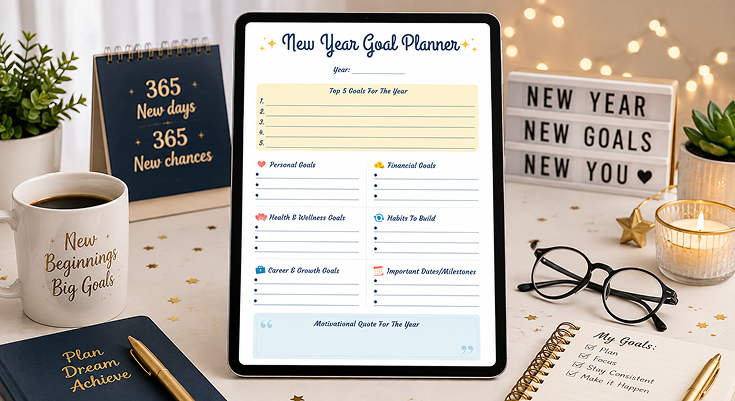
Beginning a new year with a focused and structured set of goals will help you turn blurry objectives into tangible accomplishments. By using a New Year Goal Setting and Tracking Planner, you will have a structured way to establish legitimate objectives in areas of personal development, finances, wellness, professional, and everyday activities. Such a planner will help you steer clear of a typical problem of abandoned goals by ensuring a perfect alignment of goals along various dimensions of life.
Whether it’s career development, building an emergency fund, or establishing a routine for your wellness needs, this goal planner for 2026 helps keep your goals in your focus for the entire year. Planwiz has a printable and customizable template design for setting goals in 2026, which takes care of priority goal pages, goal categories, and motivational reminders. You can download it and achieve concrete steps in 2026 in spite of your New Year resolutions.
What is a New Year Goal Setting and Tracking Planner?
Definition and Core Purpose
A New Year Goal Setting and Tracking Planner is a template with a specific format especially designed for managing yearly goals under various life aspects. In contrast to other everyday organizers that are centered around managing appointments and activities, a goal setting template includes specialized pages for establishing yearly goals regarding personal development, finance, health and wellness, business and career, and significant lifetime accomplishments.
Whereas traditional planners prioritize daily planning, this planner prioritizes annual objectives based on desired outcomes. Your goal setting template responds to the question of “what I want to achieve this year,” and your daily planner responds to “what I need to do today.” This planner works as a tool for setting goals as well as a tool that monitors progress on a daily, monthly, and annual process from January to December.
Key Components of an Effective Planner
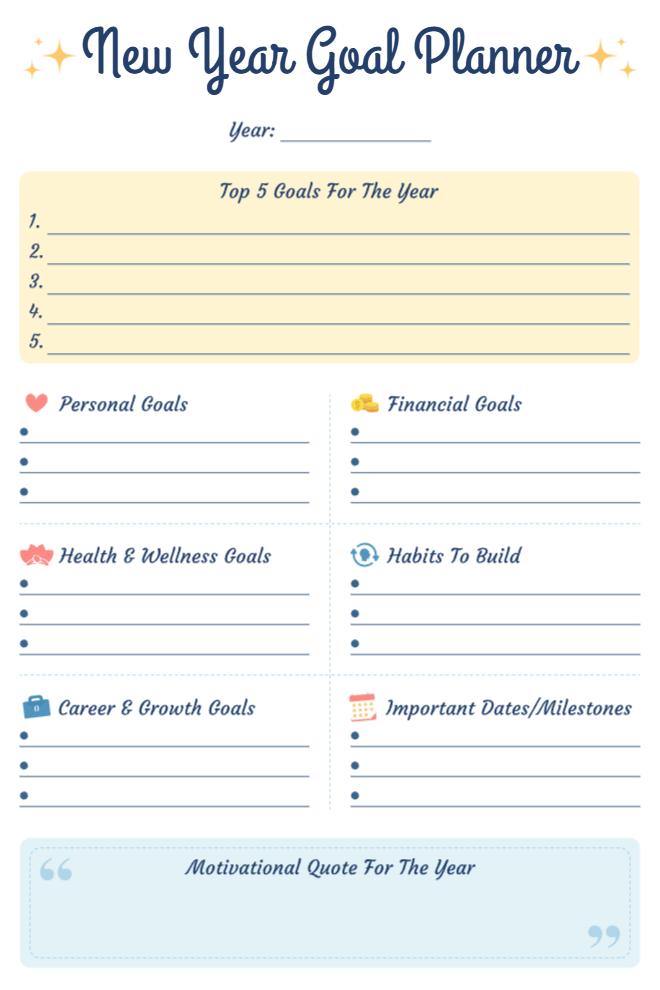
In many complete goal planners, there will also be a priority area where you are to list your top 5 goals that are most important to you for each year. The goals will then be organized by category such as Personal goals, Financial goals, Health & Wellness goals, Career & Growth goals, Habits To Build goals, as well as Important Dates so that you can remember not to forget about important aspects of your life.
This structured format eliminates the setup time required by bullet journals templates while providing more strategic direction than daily task planners. Your goal setting template becomes the foundation document that informs your daily activities, monthly priorities, and quarterly reviews throughout the entire year.
What Goals Should I Set in New Year Goal Setting and Tracking Planner?
How to Choose the Right Goals for Each Category
Selecting meaningful goals requires understanding what each life area truly needs versus what sounds impressive. Your New Year Goal Setting and Tracking Planner provides six categories-Personal, Financial, Health & Wellness, Career & Growth, Habits, and Important Dates. Choose goals that align with your current life stage and authentic priorities, not what society expects.
Avoid filling every category just because space exists-three meaningful objectives per section work better than nine mediocre ones. Your goals should genuinely excite you when you imagine achieving them by December 31st.
For more structured year-long planning, consider using a yearly planner templates alongside your goal tracker to break down objectives into monthly actions.
What Personal Goals Should I Set for Growth and Relationships?
Relationship Goals:
- Host monthly dinner parties for friends to strengthen connections
- Call parents every Sunday for 30-minute conversations
- Plan quarterly date nights trying new restaurants or activities
Creative Goals:
- Write in journal three times weekly
- Complete one creative project monthly (painting, crafting, writing)
- Practice musical instrument 30 minutes daily, five days weekly
Experience Goals:
- Take three weekend trips to new places
- Visit two national parks and complete five hiking trails
- Attend 12 cultural events throughout the year
What Financial Goals Should I Set for Savings and Wealth?
Savings Goals:
- Build $6,000 emergency fund by saving $500 monthly
- Save $3,600 for vacation by depositing $300 monthly
- Contribute $6,500 to retirement account throughout 2026
Income Goals:
- Increase annual income by $10,000 through raise or side hustle
- Start investing $200 monthly in index funds
- Negotiate 15% salary increase during annual review
Money Management Goals:
- Track every expense using budgeting app entire year
- Reduce dining out spending to $200 monthly
- Cancel unused subscriptions saving $600 annually in your goal setting template
- Track your spending systematically with a budget planner templates to ensure you stay on target with your financial goals throughout the year.
What Health and Wellness Goals Should I Set for Physical and Mental Health?
Fitness Goals:
- Complete three 45-minute strength training sessions weekly
- Run three 5K races after 12-week training program
- Walk 8,000 steps daily tracked through fitness app
Nutrition Goals:
- Meal prep healthy lunches every Sunday for workweek
- Drink eight glasses of water daily
- Eat five servings of fruits and vegetables daily
- Organize your weekly meals efficiently using a meal planner templates to support your nutrition goals and save time on food decisions.
Sleep & Rest Goals:
- Achieve 7.5 hours sleep nightly by maintaining 10:30 PM bedtime
- Create phone-free bedroom charging devices outside
- Take one complete rest day weekly without work
Mental Health Goals:
- Meditate 10 minutes every morning using app
- Schedule therapy sessions twice monthly
- Practice gratitude journaling three times weekly
What Career Goals Should I Set for Professional Development?
Networking Goals:
- Attend two industry networking events monthly
- Connect with 24 new professionals on LinkedIn throughout year
- Schedule four coffee meetings quarterly with industry mentors
- Keep your professional meetings organized with a meeting agenda templates to maximize networking opportunities and follow-up actions.
Professional Branding Goals:
- Update LinkedIn profile and post industry insights twice weekly
- Publish six articles on Medium about your expertise area
- Speak at two conferences or webinars by December
Work-Life Balance Goals:
- Leave office by 6 PM four days weekly
- Take all 15 vacation days without checking work email
- Establish clear boundaries declining weekend work requests in your goal setting template
Frequently Asked Questions
This type of planner helps in structuring and managing your goals for the upcoming year in several different realms of your life. You get separate pages for personal development goals, financial goals, health goals, professional achievements, and building habits.
This planner translates fuzzy resolutions into doable plans, which have measurable outcomes. Unlike common to-do lists, this planner provides a visual account of accountability in the form of goal space categories and progress areas. It helps you stay on track regarding important matters all year round.
Research has found that physical goals are 42% more attainable than just mental commitments. Goal planners help gain visual accountability, which also serves as a reminder for people not to forget their resolutions.
The categorized process avoids burnout by breaking down your goals into more manageable areas of your life. You can balance priorities instead of locking your mind on one area while ignoring the rest. A systematic process will help you turn your wishes into action plans that show success.
First, start by filling out the “Top 5 Goals For The Year” section with the most important goals you want to accomplish in a given year. Use concrete, specific measures of your goals, which include numbers, deadlines, or success factors.
Work through each section of the categories. List three goals for each category that relate to either your top priorities or other significant parts of your life. Be specific when setting goals. For example, set a goal to “save $3,000 by December” rather than “save money.”
Fill the motivational quotes part of the page with words of inspiration to meet your goals. Once per month, examine your planner to determine the results of your planning efforts. Place it where it will remind you of what needs to be done daily or simply take a photo to put on your cell phone.
Look at your planner every month on a specific date to check your progress and keep yourself on track. Schedule a calendar reminder with “Goal Planner Review” so that you do not miss this very important step of holding yourself accountable.
Use a 3-month planner templates for deep reviews of whether the goals are still valid after a life event has changed the individual. These extended sessions will help one modify the unrealistic goals or even change the goals that do not fit one’s values.
Monthly check-ins only take 10 minutes to complete, yet they alone can significantly increase success levels.
Dedicate the Career & Growth section to business objectives like revenue targets, product launches, or client acquisition numbers. The Financial Goals area can track business savings, equipment investments, or quarterly profit targets using a business planner templates that supports growth.
Use the Personal Goals section for networking activities or skill acquisition that benefits your business. Transform the Habits To Build section into consistent business routines like daily marketing activities, weekly content creation, or monthly financial reviews.
This adaptation makes the New Year Goal Setting and Tracking Planner work for entrepreneurial success.
Absolutely-adjust all timeframes to reflect remaining months rather than a full year. If starting in June, create six-month objectives that are realistically achievable by December 31st.
Use the Important Dates section to plan quarterly reviews instead of monthly ones given the compressed timeline. Consider this your “second half planning session” to finish the year strong. The structured format still provides valuable organization even with shortened goal periods.
Use Canva, Google Slides, or PowerPoint to recreate the layout with text boxes for each section. Create a decorative header for the title, add a year field at the top, and build six category sections with three bullet spaces each.
Include a highlighted box for your Top 5 Goals and a quote section at the bottom. Save as a PDF for printing or use digital annotation tools for on-screen completion. Apps like Good Notes or Notability allow handwriting directly on your digital planner with an iPad and stylus.
Setting too many goals simultaneously guarantees incomplete achievement and creates overwhelming frustration. The template intentionally limits you to three per category-this constraint forces prioritization of truly important objectives over scattered wishes.
Adding ten goals per section dilutes your focus and reduces likelihood of accomplishing any successfully. Quality focus beats quantity sprawl every time.
Respect the three-goal limit in your New Year Goal Setting and Tracking Planner to maximize completion rates and maintain motivation throughout the year.
Indeed, every goal must include measurable criteria in which success is attainable, free from ambiguity. Instead of seeking to “exercise more,” set criteria specifying “complete three 45-minute strength training exercises each week.”
SMART goals require specific dollar values for financial goals and specific deadlines for accountability of those goals. Professional goals should outline specific promotion levels, certifications, or skills achieved in a particular year. The only way that another person looking at your goal might not be able to determine whether you reached success is if your goals are not specific enough.
Break annual goals into monthly mini-milestones that create frequent achievement opportunities and regular motivation boosts. Update the motivational quote section quarterly with fresh inspiration that addresses your current challenges and renewed commitment.
Connect each goal to deeper “why” reasons that fuel persistence during difficult periods. Understanding that “save $5,000” enables “six-month emergency fund for career transition confidence” strengthens commitment. Review completed goals regularly to remind yourself of progress already made when facing obstacles.