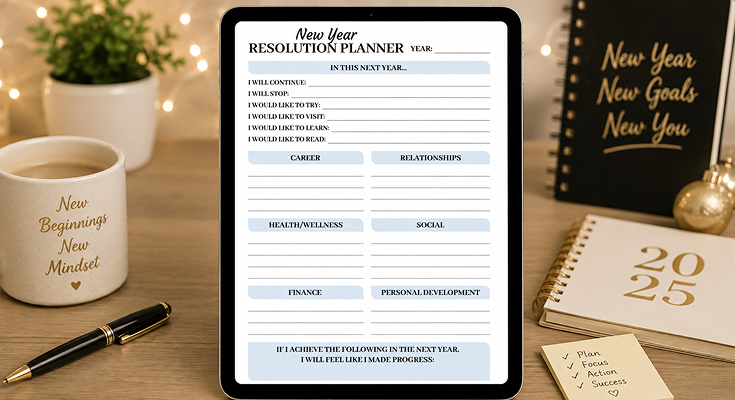
Beginning the year with the intent in mind, it is possible to turn general aspirations into attainable objectives, but without an organized approach, it is very likely that nine out of ten desires and aspirations are forgotten after the month of February. A New Year resolution goal setting planner helps you make the necessary structure in your task management so that instead of making superficial goals, you can formulate workable plans.
“No matter what your goals are for professional successes, personal development, and financial goals in 2026, this printable planner template helps to break down daunting goals into more bite-sized and more manageable sections.” According to Planwiz, having this planner will assist in considering a more well-rounded perspective on what a person wishes to Continue, Stop, Try, Visit, Learn, and Read in the upcoming year. The format provided within this planner enables one to see their goals more clearly and stay on track every month out of the whole year, and not just January.
What Is a New Year Resolution Goal Setting Planner?
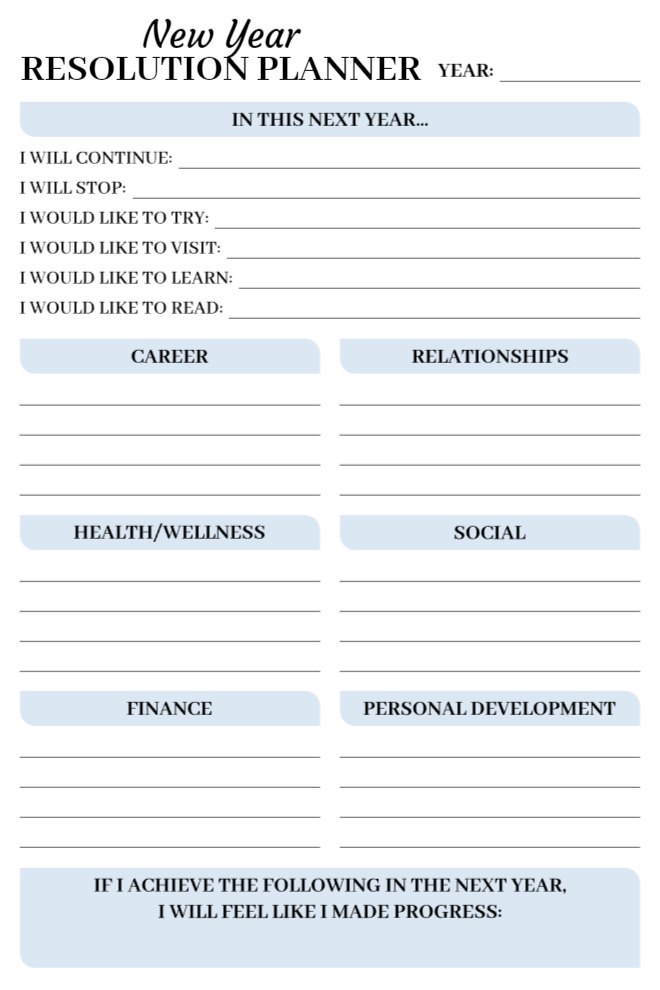
A New Year resolution goal setting planner is an organized document that helps you define, organize, and manage personal and professional goals to achieve in the new year. Unlike the common calendars that you use to schedule activities on a daily basis, you specifically use the goal setting planner to plan goals within the year in such areas as career goals, relationship goals, goals on improving health, financial goals, and personal goals.
Comprehensive planners, as a rule, delineate objectives across different spheres of life such as career, relationships, health/wellness, social life, finance, and personal growth. Research keeps showing that people who put their goals in writing are way more likely to achieve them than those who just think about what they want. If you have some goals that you want to keep an eye on throughout the year, a goal planner templates might be more suitable for that purpose alongside your resolution template.
What Is the Step-by-Step Guide to Setting New Year Resolutions?
Setting your new year resolution goal setting planner that last beyond January requires intentional planning and realistic goal-setting. Follow this proven framework to create meaningful resolutions you’ll actually achieve in 2026.
🔍 STEP 1 → Reflect on Your Past Year
Before setting eyes on the future, examine the past. Devote 20, 30 minutes to understanding what was successful, what failed, and what insights you gained throughout last year. Put your triumphs, toughest times, and the thinking patterns that most recurred in your behavior onto paper. This sincere evaluation is a safeguard against making the same unproductive resolutions repeatedly over the years.
💎 STEP 2 → Identify Your Core Values
Before setting your goals, consider this question: What is really important to me at this moment? Your resolutions have to be in harmony with your beliefs, and these may be your family, health, creativity, safety, or self, development. Thus, your goals will still be significant to you even if the motivation to accomplish them fades.
🎯 STEP 3 → Choose 3-5 Primary Focus Areas
Do not make too many changes in your life in just one year. Choose three to five areas where you want some personal growth in your personal and professional front, like your career, health, and relations. It is better to target three to five areas because this way, your accomplishments are bigger compared to what they would be if you target ten areas.
✍️ STEP 4 → Write SMART Goals for Each Area
Transform vague wishes into specific targets using the SMART framework: Specific, Measurable, Achievable, Relevant, and Time-bound. Instead of “get healthy,” write “exercise for 30 minutes, four times per week by establishing a morning workout routine.” The more specific your goal, the clearer your path to achievement becomes.
📅 STEP 5 → Break Annual Goals into Quarterly Milestones
Break down each of your yearly resolutions into smaller checkpoints that span three months. A quarterly milestone for a yearly saving goal of $6, 000 is $1, 500. These shorter timeframes make the progress towards goals seem more immediate and manageable, thus, they refrain the people who tend to get overwhelmed and quit by February. You can use a quarterly planner templates to efficiently organize and keep track of these three, month milestones.
🤝 STEP 6 → Create Your Accountability Systems
It’s helpful to determine how to measure progress and who to share this with to keep yourself on track in achieving your goals. This may involve sharing some of these goals with a close friend, becoming a member of an online group created for like goals, or setting up regular personal reviews on a yearly schedule in a planner. The impact of having someone outside your circle to report to will significantly improve overall follow-through on goals
🔄 STEP 7 → Schedule Regular Review Sessions
Schedule non, negotiable appointments with yourself monthly for the first three months, and then quarterly. In these check, ins, take time to celebrate the wins, assess honestly what isn’t working, and tweak your strategies without feeling guilty. Being flexible isn’t giving up, it’s intelligent goal management that takes into account the realities of life. Use a monthly schedule planner templates to lay out the concrete actions and check, in points for each month.
🌟 STEP 8 → Visualize Your Success
Close your planning session by imagining what your life will look and feel like when you reach these resolutions. Where would you be at? How would you feel? Imagine what would be different in your life. This will help you build a stronger commitment when you inevitably hit plateaus when it comes to your resolutions.
Remember: Resolutions aren’t about perfection; they’re about progress. They’re not about becoming someone entirely new; they’re about becoming the best version of who you already are.
Frequently Asked Questions
A resolution goal setting planner is an organized paper where one can make plans to set goals in regards to personal and professional life at the start of the year. The paper is organized in a way to assist one in reflecting on the previous year, and there is space to plan goals in different categories of life.
This aid converts general “New Year’s resolutions into specific plans using a visual tool.” By putting down these resolutions in an organized form, people are more likely to achieve these goals than if they were just brainstorming in their minds.
Writing out resolutions provides an actual accountability system and turns general goal orientation into specific goals that are possible to measure. It is a universally proven fact that people who write out their goals tend to achieve them much more effectively than people who haven’t.
A structured planner helps you take into account your goals in different areas of life and not just focus on one or two areas. This helps you not overlook other crucial areas of life while working on your career goals.
Begin by answering the reflection prompts about what you’ll continue, stop, try, visit, learn, and read. Be specific in your responses instead of being general. Do not, for instance, put “exercise more.” Instead, say “continue with morning yoga sessions thrice a week.”
Now, proceed to each life category to write 2-4 specific goals in each section. The Health and Wellness Goals will utilize a tool called a health planner templates to assist in planning goals for health and wellness routines.
Ensure goals include measurement and where possible, time, as in, “save $5,000 as emergency fund by September” as opposed to “save money.”
End by explaining, in the success visualization section, what will happen when these resolutions are accomplished. This will necessitate reviewing your calendar periodically, whether it is monthly or quarterly, to check your success.
It seems to me the best time to resolve to change your habits and your business is between the 27th of December and the 5th of January, when you have your perspective freshly in mind and are already motivated toward next year.
However, you can begin your resolution planning at any point in the year; there is no requirement to begin on January 1st. Some individuals begin on their birthday, the start of a fiscal year, or whenever they are ready to begin their resolutions.
The key ingredient is selecting a time when you can allocate extensive, unbroken attention to thoughtful planning. Scanning your planner during a busy time of the year yields weaker outcomes than spending reflective moments contemplating your priorities.
To achieve success, it helps to set common goals and share them with someone to create an external motive. You should pick 1-2 people to hold you responsible by checking and celebrating milestones.
However, it’s also important to not overshare your goals with all of your acquaintances, as studies indicate that publicly declaring all of your goals can produce premature satisfaction. This particular concept, where disclosing your goals can produce the exact same satisfaction as reaching them, can actually hinder following through with your goals.
Think carefully about sharing and sharing sources-talk about goals when having an outside presence is important, but when personal goals are private if doing so is awkward. How to reach the proper mix will vary according to personality and goal.
Absolutely – it allows you to make the planner more relevant to your personal circumstances, which in turn gives you a better chance that you’ll actually use it. Add, delete, or re-label the categories as you see fit based on the current priorities and that time in your life.
They may focus on academics, extracurricular activities, and socializing if they are students, whereas another individual who is close to retirement age might focus on hobbies, voluntary activities, and health.
Both parents and entrepreneurs could add a category called “Family Goals” using the family planner templates. Then, instead of just a career category, they could create several categories related to their business.
The aim is to have a tool which represents what is important to you, and not to shape your life to suit a pre-set template. Go ahead and vary the size of the sections too, allocating more room to the areas where your main focus is in the year.
Make a collaborative version where individuals can assign different colors or specific areas to their personal goals and then create a category labeled “family goals.” This practice takes into account personal development as well as family goals in one collective planning tool.
Couples may want to set goals that are more specifically “couples” oriented, such as regular “date nights” per month or improving communication efforts. As you are considering personal goals and examining them in planning sessions, discuss ways in which personal goals may complement rather than conflict with one another for shared time and focus.
Family planning can be very effective if age-specific-for instance, older children can make independent goal-setting choices within simplified sections, while younger ones can make contributions to the family wish list by suggesting what needs to be accomplished.
You can create your own planners using Canva, which has free templates and a drag-and-drop feature, perfect for those new to planners. InDesign/Illustrator from Adobe will provide more advanced layouts for those familiar with design software.
Microsoft Word or Google Docs can be used as a simple, text-only format where functionality takes precedence over complicated designs. Electronic versions with interactive elements can employ Notion templates, Google Sheets with checkbox tracking, Trello boards, and finally, Evernote.
Depending on whether you want something that will be placed on the wall as an PDF to print or something that can be accessed on multiple devices, most people end up with both; print it to display and keeping an online copy as well.
The worst thing you can do is set too many goals. This Floods Your Abilities and Ensures You Drop Most of Them.
Concentrate on resolutions that involve 3-5 broad areas, enabling sufficient time and effort to make progress. The To-Do planner templates breaks work related to broad resolutions into daily actions.
Too general to be measurable is the second big mistake-it’s not specific enough to have an exact goal, such as “be healthier” instead of something like “exercise for 30 minutes, four times per week.” Goals that don’t have an exact measure always have an air of incompleteness to them, as you’ll never really be able to achieve it.
“The third mistake,” O’Conner argues, “is not reviewing the planner after January,” essentially allowing it to collect dust on a shelf with forgotten goals. “The best time to schedule these appointments is on January 2nd,” O’Conner writes. “Every day that passes brings you closer to January 2nd.”
Take stock of it every month in January, February, and March to gain momentum and spot potential speed bumps when you can mix it. This allows you to not fall into the common habit of quitting by Valentine’s Day.
After the first quarter, start doing quarterly reviews in the months of April, July, and October. In between, the action plan can be created using a weekly planner templates.
The rhythm provides for accountability without making it tedious, as it gives one sufficient time between reviews to make progress toward their objectives.
The key to making progress on these things:
It helps to schedule these reviews in advance as events in the calendar that are given the same level of importance as work meetings or doctor appointments.
Even in the course of these reviews, celebrate what’s working. It also helps if, rather than beating oneself up over the goals not accomplished, one changes the timelines or methodologies.
Your planner must be accessible, not stowed away somewhere, like on your desk, cork board, frig, or even set it as your computer desktop. Seeing it often will help your subconscious reinforce your commitment without ever leaving your mind.
Use your computer or smartphone’s calendar feature to remind yourself of the monthly review deadlines so that you don’t have to rely on memory and motivation to stay on track. Set these appointments up so that they look like important ones that you couldn’t possibly miss rather than something that may excite your desire to do them.
Add accountability by discussing specific goals with a trusted friend who will hold you accountable by asking about your progress, or join groups of people with goals similar to yours. Accountability outside of yourself turns “resolutions” into public, note private statements that help ensure that you follow through when you find yourself less motivated.