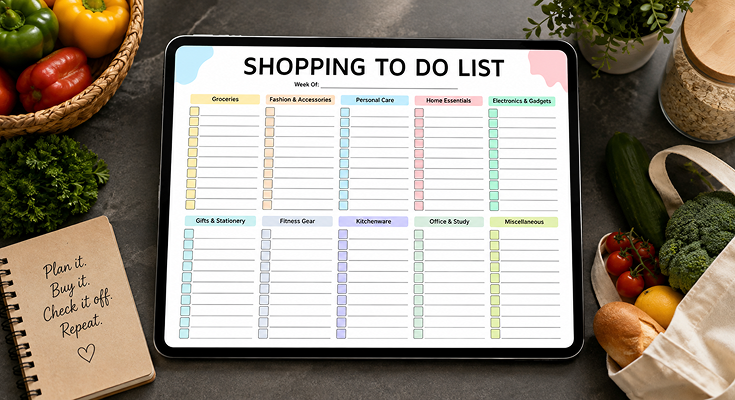
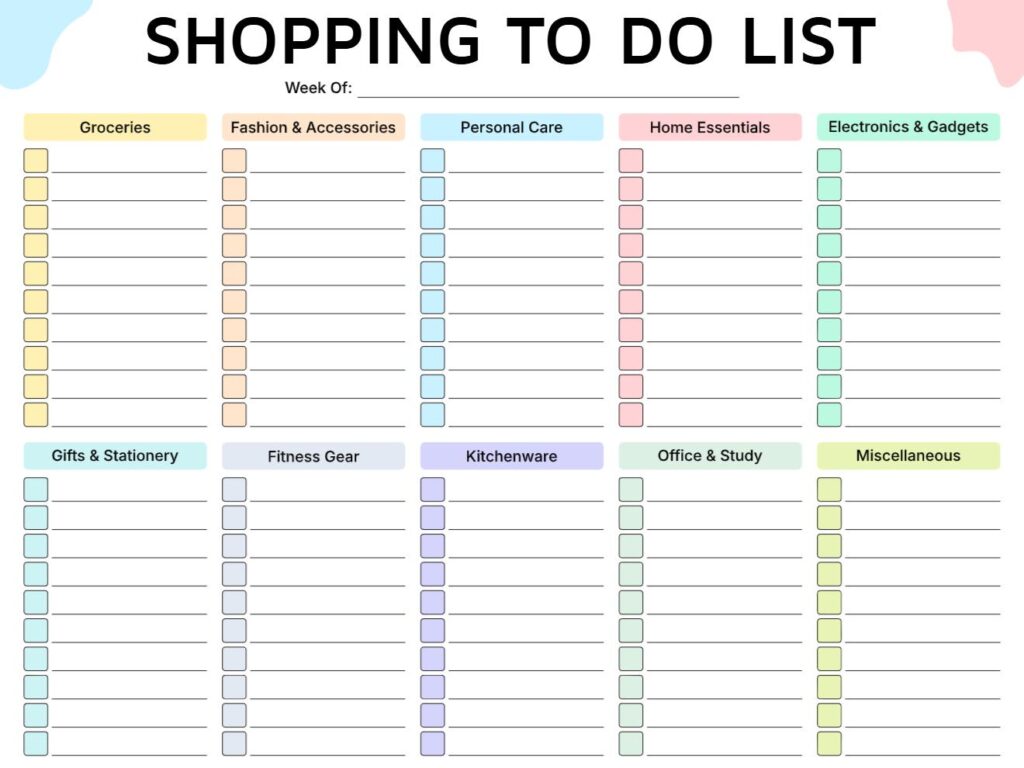
A weekly shopping organizer planner assists you in organizing shopping into categories like groceries, fashion, personal care, home essentials, among others, to prevent any item from being left out when going shopping. The given template helps you organize shopping into ten different categories, including checkboxes in each category to assist you in planning shopping efficiently.
Avoid multiple visits to shopping stores because of forgotten necessary products or walking around to remember shopping requirements. This extensive template breaks down your shopping requirements in color-categorized types to ensure busy families and cost-conscious shoppers and meal organizers remain on track all through the week. Get this downloadable shopping planner template from Planwiz to turn confused shopping outings into positive experiences with all your home shopping requirements in clear perspective.
What is a Weekly Shopping Organizer Planner?
A weekly shopping organizer planner is a kind of checklist template where you arrange things in a categorized manner to help you manage your purchase of assorted products during a particular week. Unlike a shopping list where you arrange all products randomly in a single list, this shopping planner divides into separate sections that include things like groceries, personal care products, home essentials, electronics, and so on.
This is a tool that plans everything related to purchasing as a central point that you can control by ensuring that you forget nothing while shopping, since it helps in coordinating everything that you need to purchase within a given family. Just like family planner templates that ensures scheduling is coordinated, it also does that for purchasing as it ensures that everything is organized when it comes to purchasing. Whether you are purchasing from various stores or from one location, it ensures that you have a shopping route that will enable you to compare prices while you are shopping.
What are The Benefits of Using a Weekly Shopping Organizer Planner?
A Weekly shopping organizer planner helps consumers transform disorganized and inefficient shopping behaviors into an optimized process that saves time and money. The systematic way of organizing different categories in planners helps track expenses and removes forgotten products from shopping lists.
Shopping Efficiency Comparison: Planner vs. No Planner
| Shopping Aspect | Without Planner | With Planner |
|---|---|---|
| Time Spent Shopping | 90-120 minutes per trip | 45-60 minutes per trip |
| Forgotten Items | 5-8 items per trip | 0-1 items per trip |
| Return Trips Weekly | 3-4 additional trips | 1 or fewer trips |
| Impulse Purchases | $25-40 weekly average | $5-10 weekly average |
| Budget Tracking | Difficult or impossible | Easy and visual |
| Food Waste | 20-30% of groceries | 5-10% of groceries |
| Duplicate Purchases | 2-4 items monthly | Rare occurrences |
| Shopping Stress Level | High anxiety | Low and manageable |
Time-Saving Benefits: Shop Faster and Smarter
A weekly shopping organizer cuts shopping time nearly in half because it eliminates backtracking and indecisive wandering through a store. The category structure mirrors store layouts, therefore creating systematic movement through sections without needing to return to previously visited aisles. In-store time is pure execution because planning happens before going in-store; there is not as much mental fatigue that generally makes shopping exhaustive. You can pair this with the weekly planner templates to schedule days when you would go shopping, which massively increases your time efficiency.
Money-Saving Benefits: Cut Spending by $100-200 Monthly
Impulse purchases represent 40-60% of unplanned spending, but organized planning dramatically reduces these costly spontaneous buys. By category budgeting, it will show where your money is going every week. You can eliminate duplicate purchases because your inventory list can guide your decision in creating your weekly shopping planner instead of guessing what you have in your house. To have a comprehensive financial management in your household, combine it with budget planner templates so you can monitor your total spending together with your spending on shopping.
Reduce Food Waste: Keep Groceries Fresh and Used
It ensures that all food items that are bought have been assigned to a particular recipe. The category structure assists in balancing purchases of perishable goods versus purchases that have long expiration dates. This purposeful approach reduces the 20-30% of groceries that typically spoil before use in most households. Use meal planner templates alongside your shopping organizer to create weekly menus that align perfectly with your grocery purchases.
Stress-Reduction Benefits: Shop With Confidence
Mental load reduction happens immediately when you externalize shopping needs onto paper rather than trying to remember everything mentally. Family coordination becomes smoother when everyone can add items to appropriate categories rather than verbal requests that get forgotten. Shopping confidence increases when you enter stores with clear direction rather than anxiously wandering and hoping you remember everything needed.
Frequently Asked Questions
A weekly grocery shopping organizer planner is a type of categorical checklist template that assists in managing various types of items purchased with check box tracking.
The organizer further categorizes the needs for shopping into sections such as groceries, personal care items, home essentials, and electronics. This will make planning more efficient. The sections have a number of checkbox lines where you will state the items that you will require.
This method eliminates lost shopping list items, makes consumers less prone to impulse buying because they know exactly what they want to buy, and helps consumers save time while shopping by organizing similar products under a singular category.
They just fill in products during the course of a week and mark the corresponding boxes once they buy products from other stores.
Category organization helps cut shopping time because shopping organized by categories and random shopping reduce shopping time by 30 to 40%.
The graphic arrangement enables you to track expenses related to different purchase groups in an effective manner. There are separate columns for different products; therefore, you can never miss anything and end up buying it again.
The checkbox system is pyschologically pleasing as you tick off completed tasks, keeping you motivated on what you want to buy, while it also makes it even easier to involve family members, as each can contribute their items to the correct category without confusion.
Start by dating your weekly shopping organizer template, then walk through your home room by room to identify what needs purchasing.
List specific items with quantities in their matching categories-place “2% milk, 1 gallon” under Groceries rather than just writing “milk.” Review store circulars and digital coupons to identify sale items that match your needs, marking priority purchases.
Many users find it helpful to use to-do planner templates for the initial planning session to break down the inventory process room by room.
Before shopping, organize your route to match category groupings so you can check off items efficiently. Keep the planner accessible during shopping trips-either carry the printed version or photograph it on your phone for easy reference.
Use a hybrid approach by compiling a comprehensive base list through your weekly planning session, then keeping your planner handy for additions throughout the week.
Sunday and Monday nights can be good for overall meal planning strategies where you can apprise yourself of your pantry contents, check meal strategies, or coordinate with other members.
Week by week, as needs become evident, mark these in your organizer planners for your weekly grocery purchases so that you avoid the “I forgot something” nagging.
This way, you ensure planning while allowing for flexibility in case of unforeseen needs. You can update electronic copies easily; however, planners you hang in refrigerators are best suited for families in which more than one member contributes to making up the shopping list.
Categorize sections of category info based on regular visits to similar stores-you can organize categories you buy at the same place together.
If you shop at the same superstore for groceries, personal care items, and household essentials, organize the corresponding areas of your planners side by side. Make the areas dedicated to fashion, electronics, and special items separate when you go to the stores individually.
Some people like to organize their shopping list organizer planner by store instead of organizing it by type of item, making separate Target pages, Walmart pages, and pages for specialty stores. The plan organizer needs to be tailored to fit personal habits to work efficiently.
Use specific category names that correspond to your own personal patterns of spending each month.
Families who own pets can replace “Gifts & Stationery” with “Pet Supplies.” They can monitor their pet’s food, snacks, and accessories through this option. They can modify “Fitness Gear” to “Children’s Items” or “Baby Supplies” to manage infants’ products like diapers, formula, and clothes.
Create custom categories such as “Meal Prep Ingredients,” “Garden Supplies,” or “Car Maintenance” based on your personal purchases. The shopping organizer planner template functions well when the categories are based on how you actually organize your thoughts and purchases.
For parents who have to handle a number of needs within the household, the following suggestion may be useful. It can be paired with mom planner templates to help organize shopping and other household tasks.
Create a small price column next to each checkbox where you write estimated costs before shopping, then actual costs after purchasing.
Total each category at the bottom to see spending per section-this reveals which categories consistently exceed expectations versus those with budget room. Over four weeks, you’ll establish realistic budget allocations per category that reflect your household’s actual needs.
Use different colored pens for budgeted versus actual amounts to quickly spot discrepancies when reviewing your weekly shopping organizer planner. Some shoppers add a monthly summary page that tracks category totals across four weeks, identifying trends and opportunities for savings.
For deeper financial planning, integrate this data with monthly schedule planner templates to align shopping budgets with bill payment schedules.
The categories should include Groceries (your biggest category), Personal Care, Home Essentials for unforeseen requirements.
Subcategory ideas are: Health & Wellness for pharmacy products, “Office & Study” for items related to working from home, and “Entertainment” for books, games, and hobby goods.
Add 10-12 check box entries for high frequency items such as groceries and 6-8 entries for low frequency items like those occasionally purchased.
Add a “Week Of” date field at the top, priority indicators near the checkboxes, and a notes section for coupon usage or meal plans.
Having the ability to replicate weekly in a spreadsheet version of your shopping organizer planner is very convenient, although the hands-on experience of making your own by hand is very satisfying and easy to display on the refrigerator.
Try to commit to buying only items that are checked off in your planner while shopping as opposed to trying to rely on memory.
Similarly, you can also use the “done list,” as described
Steer clear of the aisles that do not have the items that are on your list-if your shopping organizer shows that nothing on your list is to be found in the candy or magazine aisle, do not go to those aisles. The simple act of reviewing your list prior to putting items into your shopping cart is enough to create a delay that will stop you from making impulse buys.
Look through your planner before going to the store to remind yourself and make a plan as to what purchases you’re going to make.
This is to ensure that when you return from your shopping excursion, you use “checked” boxes to compare goods to make sure nothing is inside that doesn’t belong.
Writing vague entries like “snacks” or “bathroom stuff” instead of specific items with quantities, brands, and sizes defeats the planner’s organizational purpose.
Detail matters-“Cheerios, family size, 2 boxes” is actionable while “cereal” leaves you guessing at the store, often resulting in wrong purchases or forgotten items. Another major error is creating your weekly shopping organizer planner but leaving it home during shopping trips, forcing you to rely on imperfect memory.
Don’t ignore the category structure by cramming everything into one section or skipping sections entirely. The organizational design saves time by grouping items found in similar store locations, so use it as intended for maximum efficiency.
Connect your meal planning organization activity using a shopping organizer planner by listing the specific ingredients for each recipe instead of generic food categories.
Planning for seven dinners before making your shopping list ensures that you purchase food with a plan in mind, rather than simply because you like the food but haven’t thought through where you’ll use it.
Always check your refrigerator and cabinets before you add items by cross-checking what you already have in stock to avoid duplicating purchases that go bad before you use them.
Think about using food journal templates to monitor the food that your household is actually eating versus the food that is purchased.
Monitor which items have remained unused for consecutive weeks and remove them from shopping lists for good to avoid throwing money away on wish list items.
Analyze your past week’s planner for any items left unchecked to determine if they were indeed required or just wishes that can be crossed off for good.