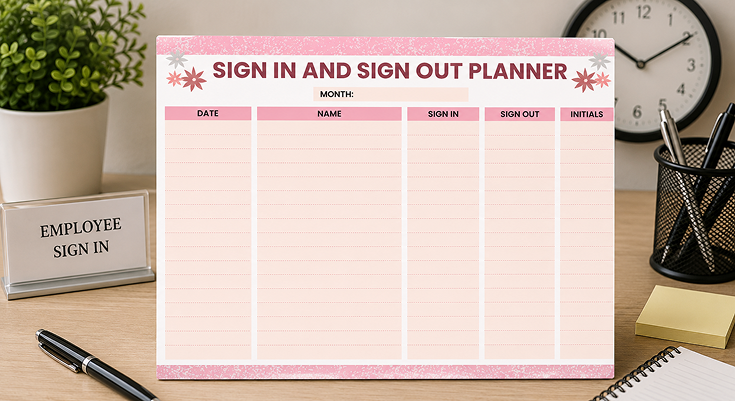
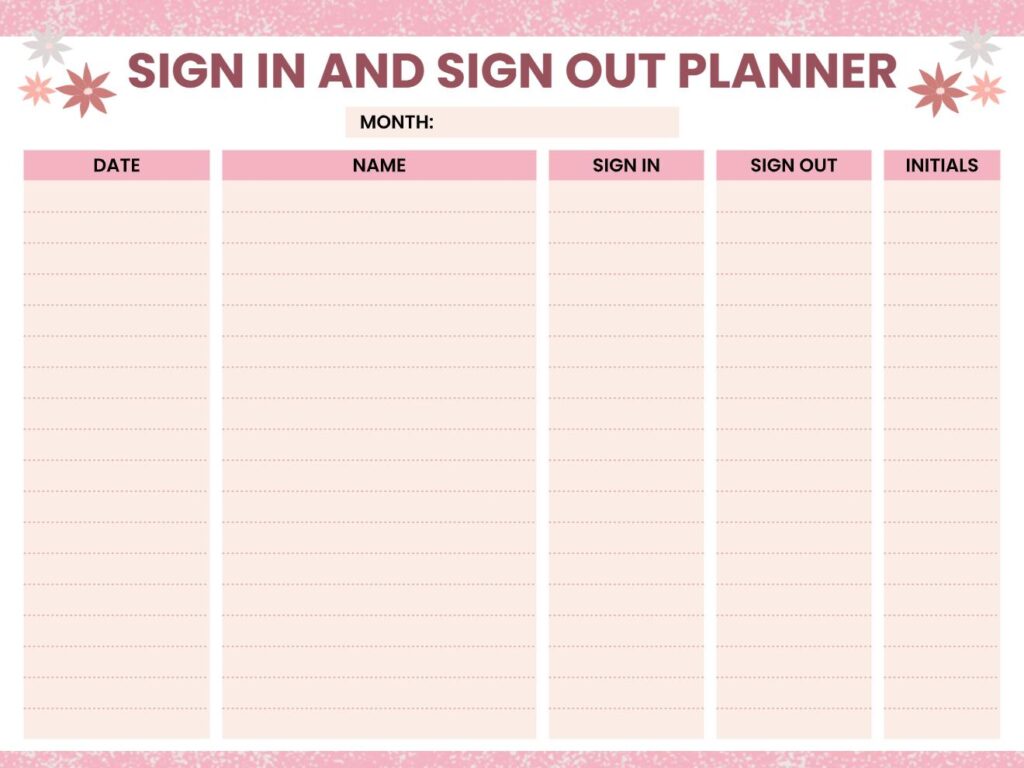
The system for tracking employee attendance should not eat into your time and money. Whether it is a small-scale business, a system for tracking employees working different shifts, and different departments, it is necessary to know who is there and for how long for accurate payment and a legal system. It is made simple with as employee attendance sign in and out planner for attendance, having proper columns for different entries like date, name, sign-in time, sign-out time, and initials for verification purposes.
Available in both printable and electronic formats through Planwiz, this template can be used in any office environment, retail establishment, warehousing company, healthcare facility, or any other establishment that requires accurate attendance record-keeping without the need for costly computer applications or learning how to operate them.
What is a Employee Attendance Sign in and Out Planner?
A sign-in and sign-out attendance planner for employees is a physical or digital document, which is supposed to track the time of employees’ daily arrivals and departures from work. This form includes neat columns for dates, listing employee names, clock-in and clock-out times, and verification by signatures or initials. It is used by businesses as the official document to trace the attendance of workers, record working hours, and keep on file, perhaps, for payroll processing and other legal purposes.
Unlike automated time clock systems, which need the cost of purchasing or licensing software, this simple planner can be used right away with only a writing instrument and paper. It normally takes one month’s attendance per sheet, depending on the user’s industry, shifts, and the size of the staff. Whether in-office or remotely, the attendance tracker establishes accountability as well as satisfies the company’s record-keeping requirements.
How to Use an Employee Attendance Sign In and Out Planner?
Implementing an attendance sign in and out planner is simple and requires minimal setup. Follow these steps to maximize effectiveness and ensure accurate record-keeping.
Step 1: Set Up Your Planner
Print the template or prepare it digitally for each work area. Fill in the month at the top of the sheet. For larger teams, consider multiple sheets or designated stations. Place the planner in a visible, accessible location near entrances or time clock areas.
Step 2: Establish Clear Expectations
Make the attendance policy public among the employees. Let them know they have the responsibility of registering their attendance personally when they come to work, as well as when they are leaving the office. It’s also important to remind them that faking employee attendance is against office rules.
Step 3: Daily Recording
Employees enter the date in the first column or from pre-entered data. Employees enter their complete name under the Name column and Employees enter their exact time of arrival under the Sign In column (example 9:05 AM). As the day ends, employees enter the time under the Sign Out column. Lastly, they enter their initials under the Initials column for verification purposes.
Step 4: Manager Review
Supervisors should review attendance sheets daily for accuracy and completeness. Cross-reference with scheduled shifts to identify absences or tardiness, and consider using daily planner templates to organize follow-up tasks and employee meetings. Address discrepancies immediately while details are fresh.
Step 5: Archive and Store
At month’s end, file completed sheets chronologically for record-keeping using monthly schedule planner templates to track retention deadlines and audit dates. Many businesses retain attendance records for 3-7 years for legal compliance. Store in secure locations to protect employee privacy.
What Are the Benefits of Using an Employee Attendance Sign In and Out Planner?
Using the employee sign in and out planner for tracking attendance provides quantifiable benefits which directly affect your bottom line. This nifty concept tackles various problems at work while maintaining a low cost.
Improved Payroll Accuracy
Human errors in a payroll computation cost the business thousands of money every year due to overpayment and underpayment. An employee attendance sign in and out template enables one to have exact times for both entries, thus removing the need for estimation when undertaking the payroll process.
Legal Compliance and Audit Protection
Both federal and state laws demand businesses must maintain attendance records correctly for 3-7 years. The attendance calendar you can create will serve as a paper trail and protect your business should you go through an audit by the Department of Labor with regards to pay claims, unemployment, or any related department issue. Courts also always side with businesses that maintain proper and updated attendance records. Using the attendance calendar with budget planner templates can also assist with pay management and means to cut down on spending.
Reduced Time Theft and Accountability
Time theft, in the form of late arrivals, early exits, or prolonged meal breaks, costs American businesses more than $11 billion each year. The need for manual sign-in is immediate, as the employee must record the time in writing. Accountability is quick, as the individual signing in records their own time.
Cost-Effective Solution
Digital time clock systems cost $500-$3,000 upfront plus monthly subscription fees. A printable employee attendance sign in and out planner costs nothing to implement and requires zero technical training. Small businesses gain professional attendance tracking without straining budgets or IT resources.
Better Workforce Planning and Dispute Resolution
Analysis of attendance reveals inefficiencies with respect to meeting attendance and punctuality before it becomes a larger issue down the road. Using attendance information and weekly planner templates can further ensure that workforce distribution is well coordinated. In case any query pertaining to the attendance of employees arises, with the use of planners, the issue is resolved at once with the creation of dated and signed attendance proof.
Frequently Asked Questions
An employee sign in and out attendance planner is a way through which the daily entries and exits of the employees are documented and tracked. It is essentially a system or format that employees are required to use while signifying their entry and exit points within the workplace environment.
It usually consists of columns such as date, employee name, sign-in time, sign-out time, and corresponding initials for validation. The most common use of the document relates to employee attendance management for payment purposes.
A business requires attendance sheets to make sure they calculate payroll correctly to prevent any cases of time theft or buddy punching. This attendance planner creates accountability among employees and serves as a legal form to ensure compliance with labor law.
An employee sign in and out attendance planner will enable managers to detect patterns such as constant lateness and absenteeism. The document will further act as proof when taking disciplinary measures and when conducting performance reviews.
Small business owners will benefit immensely since the system will allow them to monitor the working hours of their employees without investing in clock timing systems. The HR managers will have a well-organized system when it comes toaudits, and the supervisors will be able to easily identify productivity problems associated with employees’ attendance.
Facility managers use these planners for security purposes and visitor logging. Remote team coordinators also benefit when you adapt templates with location tracking features for hybrid work arrangements.
Start by placing the planner in a visible, accessible location where employees naturally pass during arrivals and departures. Clearly communicate your attendance policy and explain that each person must personally record their times upon arrival and before leaving.
Train employees to write the date, their full name, exact arrival time, and initials in the appropriate columns. At shift end, they should return to record their departure time and initial again for verification purposes.
Review the attendance records daily to ensure completeness and accuracy using to-do planner templates to track verification tasks and follow-ups. Store completed sheets securely in chronological order, and maintain these records for at least three years to meet legal compliance requirements.
You should place your employee sign in and out book in locations like entrance and time clock areas or break rooms, where your employees will likely congregate. The sign in and out book should be in an easily accessible location and in well-lit areas, and there should always be several pens to choose from.
With bigger facilities that have several entrances, place the attendance sheet at each point to avoid congestion. Place it in a position that allows some privacy to individuals yet still within visible distance to allow for supervisors’ monitoring and verification.
Managers will want to check the in and out sign in and out planner card of the employee attendance record each day for errors or missed entries, while the information is still fresh in their memory.
Weekly reviews enable the manager to recognize trends, such as tardiness or early leaves, which are developing. Quarterly planner templates enable the manager to follow the trend of employee attendance over time, enabling them to schedule an attendance review meeting. Monthly audits enable the manager to complete a thorough audit of payroll, which will aid in the employee review meeting.
Yes, one easy way to modify the employee sign in and out attendance planner depending on the types of shifts is by creating a ‘Shift’ column. You can attain a means of easy identification using the blue, yellow, and gray color schemes that will distinguish daytime, evening, and night shifts, respectively.
For 24-hour businesses, one can create different sheets for different shifts or expand headers to include shifting timings. To manage related decisions and timings for businesses, individuals can maintain templates for their business planner templates. You can add employee ID numbers or department codes for better organization in teams in some businesses.
Adapt your employee attendance sign in and out planner for remote teams by adding a “Work Location” column where staff indicate Office, Home, or Client Site. Digital versions using shared spreadsheets work best for distributed workforces needing remote access.
Many hybrid teams combine digital tracking with daily email confirmations for additional verification. Consider using cloud-based templates that allow real-time updates while maintaining backup paper systems for when technical issues arise.
Biggest mistake would be related to buddy punching, in which employees are allowed to punch in for their absent colleagues. This is time theft and poses legal risks. Nobody should be allowed to mark attendance for someone else.
Avoid disparate enforcement levels among teams, as patchy enforcement can be demoralizing and challenge legal enforceability. Do not leave completed sheets lying about in non-secured public places, since the employee attendance sign in and out planner contains employee information that data privacy protection laws cover.
By using pencils rather than permanent ink, it is possible to alter, whereas not verifying every day leads to an accumulation of mistakes. It is important to keep a backup system because sometimes technology can fail, and unaccounted-for attendance data creates serious payroll issues.
Most organizations should keep their attendance sign-in and out records for 3-7 years, according to regulations set by law and industry for that region. The Fair Labor Standards Act specifies a retention period of at least 3 years, and when it comes to IRS audits, retention periods are subject to those regulations as well.
Check your state laws for the exact requirements, as some states have laws about extended retention of records. Store the completed employee planners in a locked area that is easily accessible for legitimate audits.
Use permanent ink signatures rather than pencil to avoid the possibility of easy changes on your staff attendance sign in and out planner. Have supervisors certify each day by signing to confirm the authenticity and thus create a layer of accountability.
Keep all the finished sheets in locked cabinets that only authorized personnel can access, and have digital backups or photocopies as a secondary form of verification. You can also think about spot checks or security camera surveillance at the sign-in stations to discourage dishonest behavior and ensure that people are following the rules.