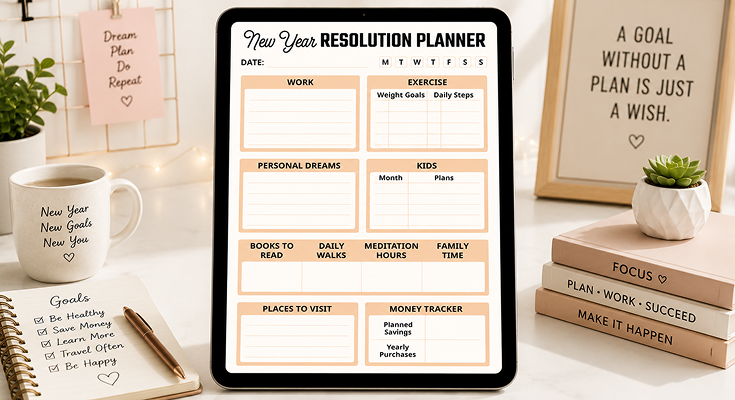
Every January brings the same cycle: excitement about change, a mental list of things you want to accomplish, and then… life happens. By mid-February, those ambitious plans fade into the background of daily routines and responsibilities. The problem isn’t your motivation or willpower-it’s the absence of a structured New Year resolution activity planner that turns abstract wishes into concrete actions.
This printable template from Planwiz changes that dynamic. Instead of relying on memory or motivation alone, you get a visual roadmap that holds space for every important area of your life. Whether you’re aiming to build healthier habits, strengthen relationships, advance your career, or finally tackle that bucket list, this single-page planner keeps everything visible and measurable throughout the entire year.
What is a New Year Resolution Activity Planner?
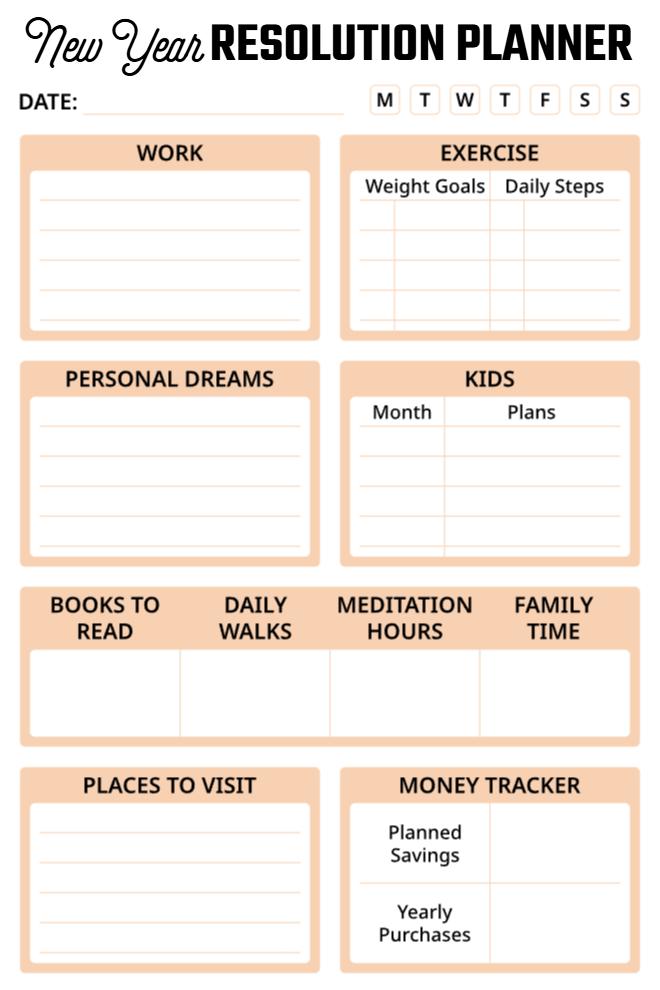
New Year resolution activity planner is a pre-designed template which helps to organize and monitor a variety of personal goals in various areas of your life. Unlike a common to-do list organizer, a New Year’s resolution activity planner separates your personal resolutions into specific categories, which may include business, physical activity, family, financial, as well as personal development.
The difference in activity planners from the usual notebooks lies in their visualization and accountability system. The categories “Places to Visit,” “Money Tracker,” “Personal Dreams,” and “Family Time” embody not only habit-building, but also personal ambitions that make it an excellent choice for those advocating for a holistic lifestyle.
What Are the Benefits of Using a New Year Resolution Activity Planner?
Helps You Actually Complete Your Goals
Individuals who put down their objective attainment goals tend to be 42% more effective in meeting them than those who merely think of them. A resolution planner provides boxes where specific goals, for example, “lose 15 pounds” or “save $5,000,” can be placed, and progress becomes easier to track through weekly checks. Seeing your completed checks pile up will encourage you to continue. You can break down these annual goals into manageable chunks using a quarterly planner templates for 3-month milestones.
Shows You Where You’re Falling Behind
The weekly tracking grid reveals exactly which goals you’re ignoring. If your “Exercise” section has empty boxes while “Work” is fully checked, you’ll notice the imbalance immediately. This visual feedback helps you adjust your priorities before small neglect becomes a big problem.
Keeps Multiple Goals Organized in One Place
Instead of having fitness goals in one app, financial targets in a spreadsheet, and family plans in your head, everything lives on one page. You can see your work deadlines next to your meditation goals and travel plans, making it easier to balance different life areas. This prevents you from focusing only on career while accidentally ignoring health or relationships. For proper organize you use the planner templates.
Reduces the Overwhelm of Too Many Resolutions
Instead of one big, daunting list of 20+ goals, this planner subcategories those into clearly defined sections with 2-3 items in each. Breaking “improve my life” down into smaller areas such as “Work”, “Exercise”, and “Personal Dreams” makes progress palatable.
Makes Weekly Reviews Quick and Easy
The structured layout means you can review all your goals in under 10 minutes each Sunday. You simply scan each section, check what’s working, and adjust what isn’t. Regular reviews prevent the common problem of setting January goals and forgetting them by March. Pair this with a weekly planner templates to break down your resolutions into actionable weekly tasks.
Frequently Asked Questions
A new year resolution activity planner is a planned document that provides a framework in which all annual resolutions are categorized in many aspects of life to track progress regularly.
This calendar is different from the usual calendars used, which involve listing resolutions in categorized segments like work, exercise, family, money, and personal growth. This helps planners achieve different objectives when using this calendar.
“Activity-based design prioritized tangible actions over broad intentions. For example, rather than reflecting an intention to “get healthier” on a habit card, you’d log weight loss goals, step counts, meditation sessions, and exercise plans into designated boxes with tangible outcomes.”
Pre-designed planners provide visual structure that prevents goal abandonment and ensures balanced attention across life areas.
Studies show people are 42% more likely to achieve goals when written down with specific tracking systems. Resolution planners eliminate the “blank page problem” by prompting you to consider work, health, relationships, and finances equally.
The categorized format also reveals patterns-like overcommitting to career goals while neglecting personal wellness. Having all resolutions visible on one page creates accountability that scattered notebook entries cannot match.
Begin by mind-mapping 2-3 goals per category, then break down each goal into a measurable weekly activity to correspond with the tracking grid of the planner.
Begin with Exercise by creating realistic goals: “Weight Goals: lose 15 lbs by June” and “Daily Steps: 8,000 average.” For “Personal Dreams,” set result-oriented goals rather than tasks: “Launch side business” rather than “research business ideas” in “Personal Dreams.”
Use the weekly grid from M-S to mark off compliance, recognizing the power of momentum from consistent action. In the area “Money Tracker,” include specific dollar amounts for the category “Planned Savings” at $500/month, as well as major “Yearly Purchases” with desired target months.
For a precise financial planning process, you also require a budget planner templates.
Turn ahead to the daily columns (M-S) for quick checks on habits, then each week review each section of categories for what’s working and what can use refinement.
Marked the days completed by checking or using an X in the appropriate box of the corresponding weekday. For categories such as “Books to Read” or “Places to Visit,” include entries as they get completed in order to see the accumulation.
The habit of keeping an eye on one’s tasks and reflecting on the goals achieved
It will help your planner stop being merely a decoration – set a recurring reminder on your calendar to spend 15 minutes reviewing and adjusting unrealistic expectations in each area set on the planner per month. It’s been three weeks since you last reviewed “Meditation Hours”; consider reconnecting with a revised and more realistic target or consider changing the section to fit your lifestyle.
Daily sections for habit tracking (exercise, meditation, walks), weekly sections for progress evaluation, and monthly sections for goal setting and reflection.
The ‘Weight Goals’ and ‘Daily Steps’ boxes should be updated every day or after each workout session. ‘Money Tracker’ and ‘Books to Read’ sections should be updated on a weekly basis to record changes.
It is imperative that monthly meetings occur – this is where you assess whether “Planned Savings” are in line with spending or whether “Personal Dreams” have to be subdivided into smaller goals on a quarterly level. Finally, closing out each quarter (March, June, September, December), you celebrate success and may replace “New Year Resolutions” with new ones.
A monthly schedule planner templates can be used to manage these review sessions.
Customize your category labels according to your personal preferences by renaming categories such as “Kids” to “Pet Care,” “Work” to “School,” and create personal categories like “Creative Projects” or “Health Appointments.”
If you’re not a parent, swap “Kids” for volunteer activities or skill-building workshops. Students can convert “Work” into “Academic Goals,” tracking thesis deadlines or exam preparations.
Digital users can achieve this organization in applications such as Notion or Good notes through hyperlinking, whereas paper players could highlight categories using highlighters. Solo entrepreneurs could divide “Work” into “Client Projects” and “Business Development,” with each subsection having its own tracking area.
Yes-print multiple copies for each family member or create a shared version where the “Family Time” section becomes the collaborative focus area.
For family use, dedicate the “Exercise” section to household fitness challenges (“Who walks most this week?”). The “Money Tracker” becomes a shared budget view, while “Personal Dreams” can include family goals like vacation planning.
Teams can use the “Work” section for collective project milestones, with each member tracking individual contributions in other categories. Hang the planner in a common area like the kitchen or office break room, and use different colored pens for each person’s entries to maintain individual accountability while supporting group goals.
You can use a family planner templates designed specifically for household goal coordination.
To do that, one should use a word-processing or design software to set up a grid format consisting of 6-8 boxes for categories, a row for tracking on a weekly basis (M-S), and assign space according to the levels of complexity involved.
Begin with an 8.5×11″ canvas. Add a header for “New Year Resolution Planner” with a spot to input a date.
Break the page into sections using large boxes for the complex goals (Work, Exercise and the sub-columns), medium boxes for the constant tracking (Personal Dreams, Kids), and a horizontal row for the daily activities (Books, Walks, Meditation, Family Time).
Insert an additional row to include the goals of “Places to Visit” and “Money Tracker”.
Use borders and shading to distinguish sections. Leave plenty of space inside the boxes-tightly packed sections will never be used on a daily basis.
Too many goal setting, inability to make targets measurable, and not allocating time to look at the plan every week are the three most common that cause abandoned planners by February.
Overcommitting on every category will overwhelm you-stick with no more than 2-3 goals in a category. General goals such as “exercising more” do not have enough detail to put in a tracking chart; be specific: “30 minutes of walking 5 days a week.”
“The biggest mistake would be to view the planner as something to do at the start of the next year rather than something to refer to on a regular basis.” Therefore, without regular reviews, the planner might end up as yet another unrealized new year’s resolution in the drawer.
Incorporate review efforts throughout your busy week by setting 3-5 doable objectives rather than trying to complete all sections, then making changes on a quarterly rotation based on what you see is effective.
Appointment on Sunday night, non-negotiable, to review the planner, just 15 minutes. First month is the pilot phase to see what the reality of the goals is, and if the goal of “Daily Steps = 10,000” does not get ticked, change it to 6,000.
Publicly acknowledge small achievements (with stickers and colore markers for full weeks completed). Do not allow one setback to become a full-blown quit; the structure of the planner makes restarting simpler than traditional goal achievement.
The planner should be kept in an area that gets lots of foot traffic, such as from placing it on the nightstand, kitchen counter, or office desk.
Focus 50% of attention on 2-3 cornerstone goals (often health and career), 30% on relationship/family objectives, and 20% on aspirational items like travel or hobbies.
Most people can’t maintain peak effort across 8+ categories simultaneously. Identify which areas will create the most life improvement-for many, this is fitness and financial stability.
Allocate your daily tracking grid primarily to these. “Places to Visit” and “Books to Read” function better as aspirational lists you reference quarterly rather than daily tracking targets.
The “Family Time” and “Kids” sections prevent tunnel vision on personal achievement at the expense of relationships. If you notice one category remains empty for weeks, either eliminate it or reduce other commitments to make room.