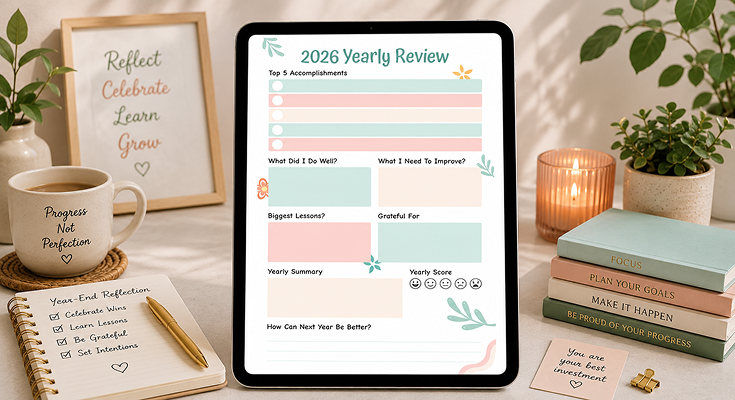
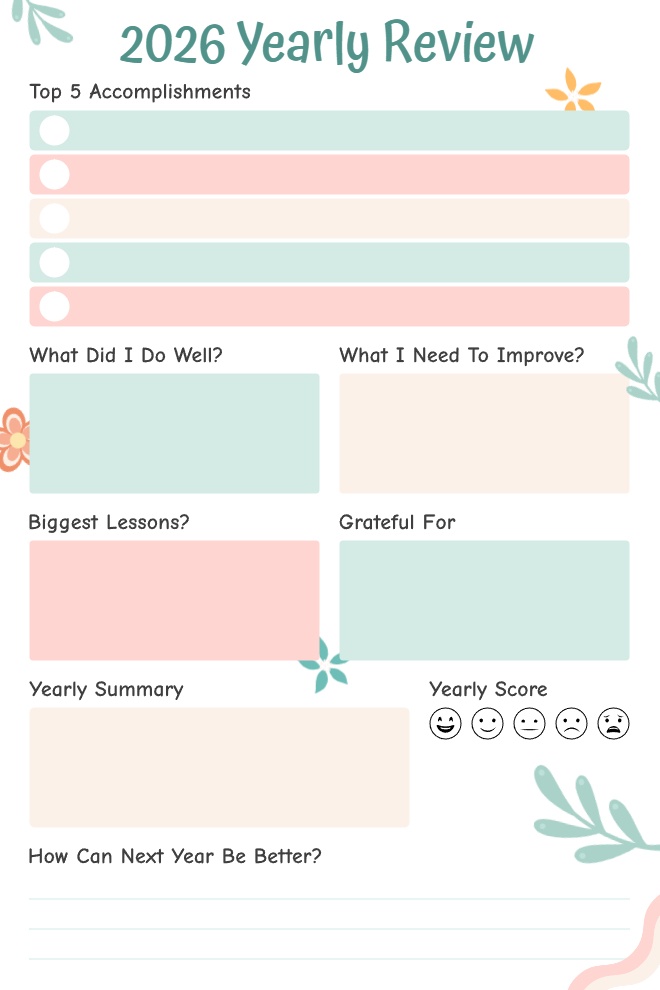
The 2026 Yearly Review Planner Template helps you reflect on accomplishments, lessons learned, and areas for growth from the past year. With organized sections for achievements, improvements, and gratitude, it provides a clear framework for meaningful self-assessment. After reviewing your past year, use yearly planner templates to organize and execute your goals. Download now to celebrate your wins and create a roadmap for continued growth.
Frequently Asked Questions
A yearly review template is a guided worksheet designed to help you reflect on the past year. It prompts you to look at accomplishments, challenges, and personal growth.
Most templates include sections for goals, lessons learned, and gratitude. This ensures your reflection is balanced and covers multiple areas of life.
Using this approach helps you avoid shallow thinking. It provides structure so you can capture insights you might otherwise miss.
Over time, yearly reviews create a personal growth record. They make it easier to see progress and patterns across the years.
A yearly review template provides structure for your reflection, ensuring you consider all areas of life instead of only recent or dramatic events. It reduces recency bias and helps you recall the entire year more accurately.
With guided prompts, the template uncovers deeper insights and patterns that casual reflection misses. Documenting your thoughts also creates a valuable record, letting you track growth and compare progress over the years.
Set aside 2-3 hours of uninterrupted time in a quiet space where you can think deeply and honestly about your year.
Begin by reviewing your calendar, photos, journal entries, or social media posts from throughout the year to jog your memory about events and experiences.
Work through each section sequentially, spending adequate time on reflection rather than rushing to complete it. Be specific in your responses instead of writing “got healthier,” note “exercised 3 times weekly for 6 months and lost 15 pounds.”
After completing the template, identify 2-3 key themes or patterns that emerged from your reflection. These insights should inform your planning and goal-setting for the upcoming year, which can be implemented using goal planner templates for systematic action.
You can adjust the template by adding or modifying sections that reflect your priorities. For career focus, expand areas like accomplishments, skills, or networking. If health is a priority, include sections for fitness, wellness habits, or mental well-being.
Some people list many detailed wins, while others reflect deeply on a few. You can also add unique categories like “Books That Changed Me” or “Fears I Overcame.” The template is flexible and should serve your journey, not limit it.
Yes, you can adapt the template by reframing each section with a career focus. For example, list promotions, completed projects, new skills, or valuable workplace relationships as accomplishments. Use the “What Did I Do Well?” section to highlight your professional strengths and contributions.
The improvement areas can cover skill gaps, challenges, or behaviors you want to develop, while lessons might reflect leadership insights or industry trends. Many professionals complete both personal and career reviews to ensure balanced growth across life and work.
Include the most important insights you gained about yourself, relationships, work, or life over the past year. Focus on lessons that surprised you or meaningfully changed your perspective.
Make lessons actionable and applicable to the future, not just observations. Include insights from both successes and challenges, as difficult periods often teach the most valuable lessons.
Start by listing key life areas you want to evaluate, like career, relationships, health, personal growth, or hobbies. Then create 2–3 reflection questions for each area that cover both past evaluation and future planning.
Design the template with enough space for thoughtful responses, either digitally or in a notebook. Many people find that handwriting their review enhances focus and encourages deeper reflection.
Complete your comprehensive yearly review once annually, but refer back to it quarterly to track progress on intentions and goals.
The main yearly review is most valuable as an annual ritual rather than something done more frequently. The twelve-month perspective is what makes it meaningful; shorter timeframes are better served by monthly or quarterly check-ins.
However, revisiting your completed review every 3 months helps you stay aligned with the intentions and improvements you identified. These quarterly reviews take only 15-30 minutes and involve reading what you wrote and assessing whether you’re following through.
Some people also create a simplified mid-year check-in (around June/July) to evaluate the first half of the year. This allows for course corrections before the year ends, ensuring you don’t arrive at December having ignored your January intentions with 6-month planner templates approach.
The biggest mistake is being too vague or general rather than documenting specific examples, events, and measurable details.
Many people write generic responses like “I want to be healthier” or “I learned to be more patient” without concrete examples or context. These vague reflections provide little insight and don’t help you understand what specifically worked or didn’t work.
Another common error is focusing only on achievements while glossing over challenges and lessons from difficult experiences. Growth often comes more from our struggles than our successes, so avoiding honest reflection on setbacks limits the value of the review.
People also frequently complete their yearly review too quickly, treating it like a checkbox exercise rather than dedicating sufficient time to deep reflection. A rushed review produces superficial insights that won’t meaningfully inform your growth in the coming year.
Yes, the template can be adapted for team retrospectives, department reviews, or organizational annual assessments.
Modify the language from “I” to “we” and adjust accomplishments to focus on collective achievements, team milestones, and collaborative successes. The improvement section becomes an opportunity for better team processes, communication, or collaboration.
Team yearly reviews work best when each member first completes an individual reflection, then the group comes together to discuss common themes. This approach honors both individual and collective perspectives while building shared understanding.
Access the template through the download link provided, then choose between printing the PDF or editing the digital version.
If you prefer a handwritten reflection, print the template on standard letter or A4 paper and complete it with a pen in a quiet setting. The physical act of writing can enhance the reflective quality of the experience.
For digital completion, open the file in a PDF editor or import it into note-taking apps like Notion, Evernote, or OneNote. Digital versions allow you to easily edit, expand sections, and keep your yearly reviews organized in one accessible location.
Save your completed review with a clear filename like “2026_Yearly_Review_[YourName]” in a dedicated folder for personal development documents. This organization makes it easy to compare reflections across multiple years and observe long-term growth patterns.
The template is available in both printable PDF format and editable digital formats for maximum flexibility.
The PDF version maintains the original design with all visual elements, colors, and spacing intact, making it perfect for printing and handwritten completion. Simply download, print, and fill in each section with a pen or pencil.
Editable formats allow you to type directly into the template using PDF editors, word processors, or note-taking applications. This option is ideal if you prefer digital journaling or want to save your responses electronically for easy reference.
You can also import the template into productivity tools like Planwiz, which offers additional features for tracking your progress throughout the year. Digital formats make it easy to update, expand sections, or create multiple versions for different life areas.